If you're in SF for the ASSA meetings, why not come to our session on international trade in history on Friday at 230 PM?
www.aeaweb.org/conference/2...
02.01.2025 22:43
👍 4
🔁 1
💬 0
📌 0
If you're in SF for the ASSA meetings, why not come to our session on international trade in history on Friday at 230 PM?
www.aeaweb.org/conference/2...

Come to my #ASSA2025 session on #Finance #Development and #Growth!
Presenters: Muhammad Meki Nishant Vats @emilverner.bsky.social Rebecca De Simone
Discussants: Gautam Rao @raissafabregas.bsky.social Kristina Manysheva @sumudu.bsky.social
www.aeaweb.org/conference/2...
#EconSky #EconConf
I suspect the answer is yes. DI often implemented or expanded in response to crises. www.imf.org/external/pub...

Here is an interesting figure from Demirguc-Kunt et al on the adoption of deposit insurance over time across countries. US was much earlier than other countries in adopting federal deposit insurance (and some US state banking systems experimented earlier). DI is relatively recent in most countries.

The basic message of Failing Banks, though, is that runs on solvent banks seem to be a quite rare cause of failure before DI. This was also the view at the time at the Fed/OCC. For example, the OCC bank examiners rarely cite runs as the cause of failure (even though failures many involved runs)
Yes, you exactly right. The motivation for the FDIC Improvement Act seemed to suggest many believed it went too far (and most people agree I think)
In fact, we have a new paper (to be released soon) showing that improved supervision accelerates bank closures of unviable banks in the GFC, in line with this story.
I think these channels matter, esp for the timing of failure but perhaps not the overall rate. Take the S&L crisis. DI + forbearance meant that failures were delayed a lot. Some banks gambled and a few maybe even got lucky and survived, but overall most unviable banks eventually failed.
In short, yes, but with some nuances. For example, DI does affect exactly how banks fail, and removing DI would imply more role for market discipline to close insolvent banks (eg no insured deposit run-in), as opposed to supervisory closures (or forbearance).
Oh thank you!

I'm not sure exactly what their political playbook or ultimate aim is. But just taking this idea at face value for a second, there are lots of potentially reasonable arguments for consolidating regulatory authorities
www.marketplace.org/2018/03/19/w...
Your tweet says:
"Bank runs don't exist anyway"

To be clear, that's not exaaaaactly what we find or claim. See figure below. But certainly our paper suggests that preventing run-induced failures of solvent banks is not an important benefit of deposit insurance (there are likely other benefits... and some costs...)
Thank you @petercontibrown.bsky.social for featuring our paper on Failing Banks in your PCB Central blog!
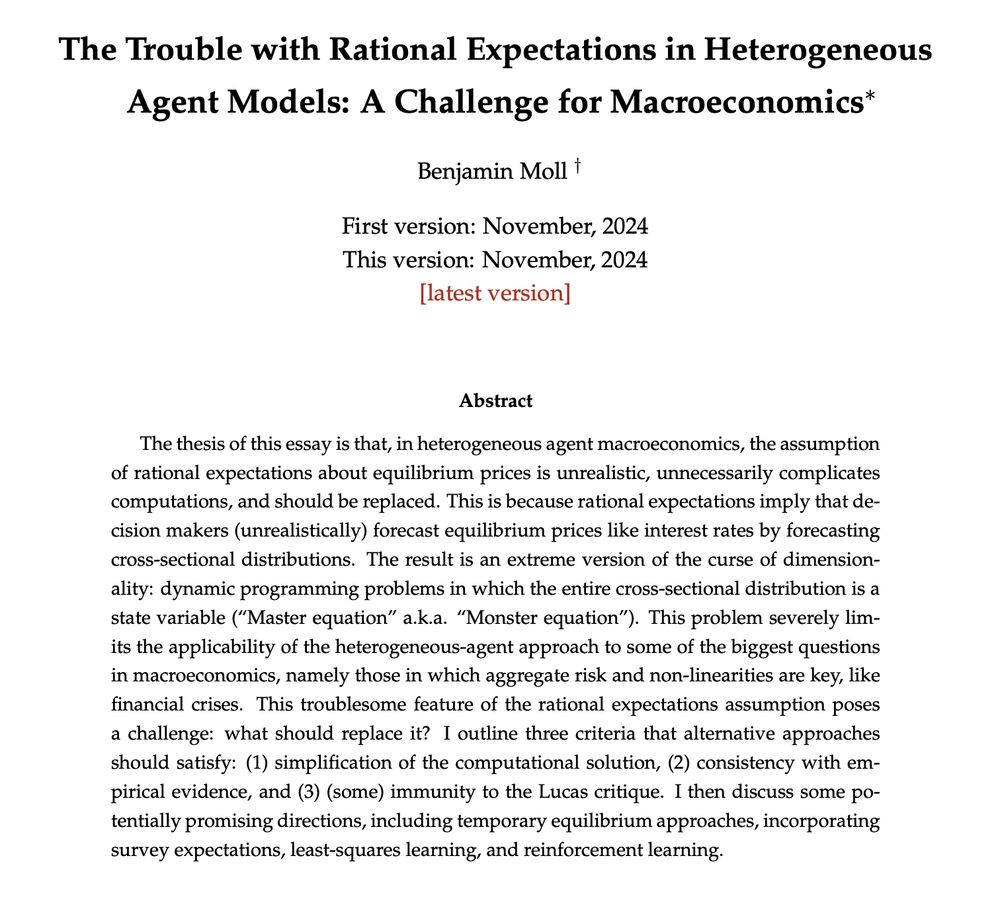
New paper: benjaminmoll.com/challenge/
It must be the only bird named after not one but two countries (Turkey and Peru in Portuguese)!

Here is the full transcript of the show: www.mercatus.org/macro-musing... and his paper on bank failures: papers.ssrn.com/sol3/papers.... (2/2)
Thank you, @kwhankins.bsky.social!
Remember when "Ferris Bueller's Day Off" tried to teach us about tariffs and no one was paying attention
Remember the Dardanelles


Excited to debut my new paper, "Housing Is the Financial Cycle: Evidence from 100 Years of Local Building Permits,” joint with @cortesgustavos.bsky.social. We document that building permits predict financial market volatility across a century of U.S. economic history.
papers.ssrn.com/abstract=485...

I am less sanguine than the article above about providing unlimited deposit insurance. Insured deposits tend to flow into failing banks (see blue line below). With full insurance, there is even more onus on supervisors to close failing banks and prevent moral hazard.


This is closer to depositor loss rates for historical (pre-FDIC failures), which were initially around 60 cents on the $, but fell to 30-35 cents on the $ in receivership

Uninsured depositors in a recent bank failure i Oklahoma set to lose 50 cents on the $ (though this may fall over time)-- much higher than the typical loss rate of 6 cents on the $ for bank failures since 1992.
www.ft.com/content/91c7...