New blog post with animations demonstrating key considerations for periodogram analysis: signal-to-noise, resolution, Nyquist aliasing, and aliasing due to gaps in the data. #astromethods
Read here: keatonb.github.io/archivers/ft
28.02.2026 17:20
👍 18
🔁 3
💬 0
📌 1

My Python environment.
22.08.2025 14:25
👍 2
🔁 0
💬 0
📌 0
Great to revisit this photo! Many people I now know in the field whom I don't recall meeting at this, one of my first real science meetings.
30.07.2025 13:04
👍 1
🔁 0
💬 1
📌 0

RIP to Bill Paxton, lead developer of MESA. I feel privileged to have learned from the man himself at the 2012 MESA Summer School. #stellarastro #astrocode
30.07.2025 13:04
👍 17
🔁 1
💬 1
📌 1
A minor update to Pyriod is now available (v0.3.3), addressing some pesky depreciation warnings that would crop up. pypi.org/project/Pyri...
09.07.2025 12:51
👍 1
🔁 0
💬 0
📌 0

Also another notebook showing how to automate prewhitening analysis (I will try to build more convenience functions into Pyriod for this soon). github.com/keatonb/Pyri...
09.07.2025 12:51
👍 1
🔁 0
💬 1
📌 0

For this presentation, I have also uploaded a demonstration of how to use Pyriod to measure O-C diagrams to track timing variations of a signal. github.com/keatonb/Pyri...
09.07.2025 12:51
👍 1
🔁 0
💬 1
📌 0

At the 9th TESS/16th Kepler Asteroseismic Science Consortium Workshop this week in Vienna. I'm presenting this poster on my code Pyriod for pre-whitening frequency analysis of astronomical time series data. #astromethods
09.07.2025 12:51
👍 10
🔁 0
💬 1
📌 0
Here it is: the first set of riches from Rubin's Cosmic Treasure Chest!
Introducing NSF–DOE Rubin Observatory's first wide and deep view of the cosmos, the southern region of the Virgo Cluster.
Rubin produced this image in just 10.5 hours over parts of 7 nights! 🔭🧪
youtu.be/Gitit3LwQ20
23.06.2025 15:46
👍 89
🔁 30
💬 1
📌 9
I present the #astrocode Pyriod for interactive or scripted pre-whitening frequency analysis of astronomical time series data. See the demo of #stellarastro #TESS data analysis of a pulsating white dwarf star. Check it out at github.com/keatonb/Pyriod/.
09.06.2025 20:26
👍 13
🔁 2
💬 0
📌 0
aas (iPosterSessions - an aMuze! Interactive system)
Check out the #AAS246 iPoster "White Dwarf Asteroseismology in the Age of Gaia Astrometry" from Andrew Dublin, Agnes Bischoff-Kim and myself: aas246-aas.ipostersessions.com/Default.aspx...
#stellarastro
09.06.2025 20:21
👍 4
🔁 0
💬 0
📌 0
aas (iPosterSessions - an aMuze! Interactive system)
Check out the #AAS246 iPoster "TESS CROWDSAP Errors from White Dwarf Observations" from Nikoo Hosseininezhad and myself: aas246-aas.ipostersessions.com/default.aspx...
#stellarastro
09.06.2025 20:20
👍 3
🔁 0
💬 0
📌 0
Fun article!
09.06.2025 20:16
👍 2
🔁 0
💬 0
📌 0
The development of Pyriod is supported by the National Science Foundation under Grant No. AST-2406917.
09.06.2025 19:51
👍 0
🔁 0
💬 0
📌 0
GitHub - keatonb/Pyriod: Python implementation of basic period detection and fitting routines for astronomical time series.
Python implementation of basic period detection and fitting routines for astronomical time series. - keatonb/Pyriod
The interface works in Jupyter, and it can also be scripted for automated analysis. We are grateful to lightkurve, astropy, lmfit, qgrid, and qgridnext, which make Pyriod work. I am working to improve tutorials and documentation. Submit issues/feature requests at github.com/keatonb/Pyriod
09.06.2025 19:51
👍 0
🔁 0
💬 1
📌 0
Period04 - Homepage
Pyriod is inspired by Period04 (www.period04.net), aiming to provide a similar interactive data analysis experience for the modern Python workflow, with open-source code, and with a faster periodogram better-suited for the big data era.
09.06.2025 19:51
👍 0
🔁 0
💬 1
📌 0

Our reward for completing this process is a table of signal frequencies, amplitudes, and phases, with estimated uncertainties. These measurements of resonant frequencies of a white dwarf star are published and interpreted in Bell et al. (2019, ui.adsabs.harvard.edu/abs/2019A%26A...632A..42B).
09.06.2025 19:51
👍 0
🔁 0
💬 1
📌 0

The fit to the light curve reveals the complex variability that we otherwise couldn't visibly see for all the measurement noise, shown here for one day of the TESS light curve.
09.06.2025 19:51
👍 0
🔁 0
💬 1
📌 0

Pyriod can enforce strict relationships between combination frequencies and independent frequencies when they are identified by their arithmetic relations. We proceed to pre-whiten all significant signals, with combinations marked with gold diamonds.
09.06.2025 19:51
👍 0
🔁 0
💬 1
📌 0

Three signals down, but the next three are "combination frequencies" that appear at precise sums, multiples, and differences of frequencies. If the first three signals are f0, f1, and f2, this next cluster of peaks are f0+f1, 2*f0, and f0+f2.
09.06.2025 19:51
👍 0
🔁 0
💬 1
📌 0

We then identify additional signals from the periodogram of fit residuals (the "pre-whitened" data). Pyriod displays the periodogram of the residuals in blue (highest peak marked). The model is displayed in green. In practice, we move significant peaks from blue to green.
09.06.2025 19:51
👍 0
🔁 0
💬 1
📌 0

We "pre-whiten" signals by fitting and subtracting sinusoids from the light curve. We currently fit the frequency, amplitude, and phase of one sinusoidal signal. The data may be noisy, but TESS collected enough that we detect this signal to high significance.
09.06.2025 19:51
👍 1
🔁 0
💬 1
📌 0
The periodogram displays the frequency content of the light curve, and we identify significant signals as having amplitudes well above the noise floor. The red curve gives an approximate significance threshold, and Pyriod marks the highest peak for inclusion in the model. Let's add it.
09.06.2025 19:51
👍 0
🔁 0
💬 1
📌 0

The pre-whitening algorithm is a method for measuring sinusoidal signals in time series data. It is best suited for signals that are coherent for the duration of the observations. We start with the periodogram of the TESS Sector 3 light curve of the pulsating white dwarf WD 0158-160.
09.06.2025 19:51
👍 0
🔁 0
💬 1
📌 0
Had to withdraw my #AAS246 poster due to COVID, but let me demo "Pyriod: Interactive Pre-Whitening Frequency Analysis in Python." Here is a quick guide to reproducing the analysis of TESS data on a pulsating white dwarf from Bell et al. (2019, ui.adsabs.harvard.edu/abs/2019A%26A...632A..42B).
09.06.2025 19:51
👍 1
🔁 0
💬 1
📌 1

positive COVID test
Disappointed to be missing #AAS246 this week, but I gotta keep y'all safe.
08.06.2025 20:38
👍 2
🔁 0
💬 2
📌 0
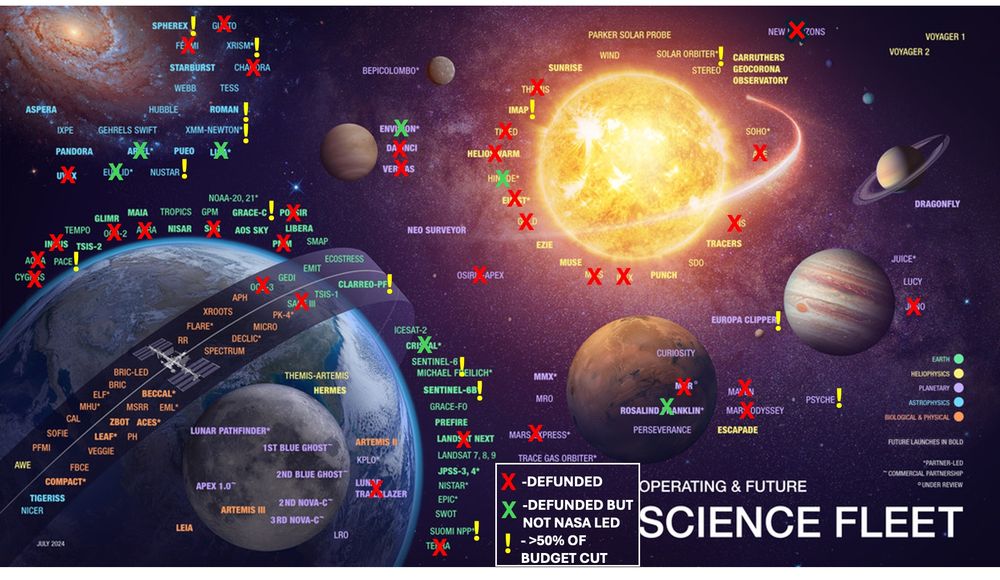
Following the inspiration of @ohdearz.bsky.social @theplanetaryguy.bsky.social @jtuttlekeane.bsky.social here’s the NASA fleet with the proposed budget cuts. Red X’s will be fully defunded, green X’s will lose all NASA funding but have other funding sources, and exclamation point means >50% cuts
31.05.2025 23:29
👍 136
🔁 71
💬 7
📌 13
I'm coordinating a How to Read a Paper workshop for undergrads i and was wondering if people have any resources they have found helpful for outlining readings/building that skill? Any resources or advice help!
29.05.2025 17:06
👍 2
🔁 2
💬 0
📌 0
Astronomy is in trouble, but you can help! 🔭🧪
I made this video as part of the @aas.org #savescience week of action. Check out their resources on how you can help here
aas.org/advocacy/get...
08.05.2025 16:27
👍 34
🔁 18
💬 1
📌 1


