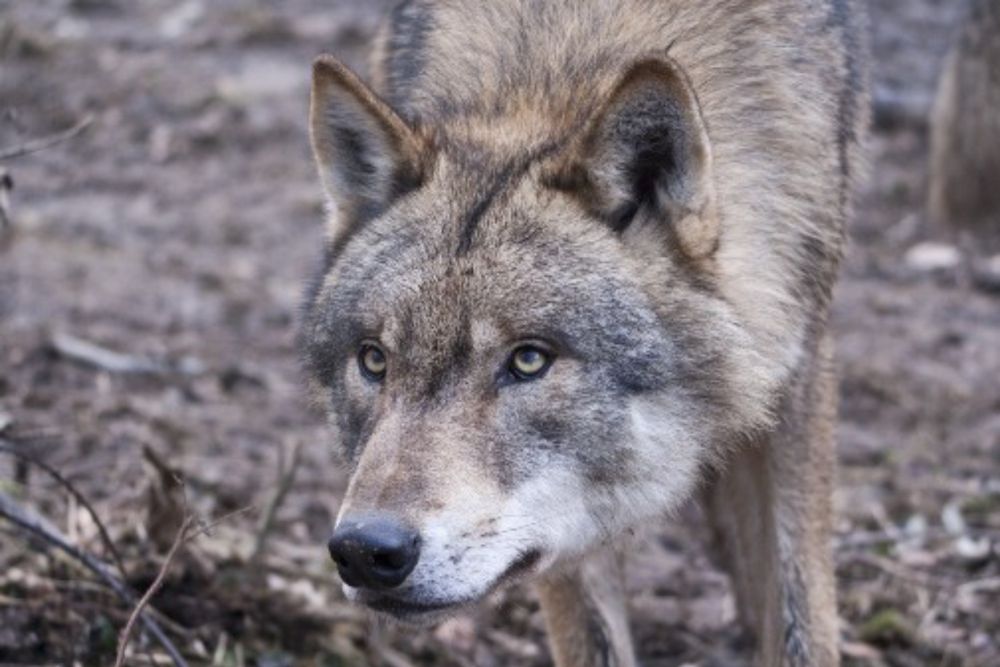
Podcast episode cover art for Tommy's Outdoors Conservation and Science featuring a woman with glasses and dark hair pulled back, wearing a black blazer over a white top, smiling while looking downward in an indoor setting. The episode title 'EU Wolf Downlisting: Time to Stop Crying Wolf' appears in white and gold text on a dark olive green overlay in the lower left corner. The design uses an olive green background with gold border framing, and includes 'PODCAST' text at the bottom.
Can we find a middle ground between those who see the EU's wolf downlisting as a catastrophe and those who celebrate it as good news? With @hannalp.bsky.social, we discuss the frustratingly polarised debate about wolf conservation in the EU. 🌍🦤🧪🦊
🎧➡️ pod.fo/e/362998
09.12.2025 07:18
👍 7
🔁 6
💬 2
📌 1
What he said 👆
21.11.2025 09:14
👍 0
🔁 0
💬 0
📌 0

A table showing profit margins of major publishers. A snippet of text related to this table is below.
1. The four-fold drain
1.1 Money
Currently, academic publishing is dominated by profit-oriented, multinational companies for
whom scientific knowledge is a commodity to be sold back to the academic community who
created it. The dominant four are Elsevier, Springer Nature, Wiley and Taylor & Francis,
which collectively generated over US$7.1 billion in revenue from journal publishing in 2024
alone, and over US$12 billion in profits between 2019 and 2024 (Table 1A). Their profit
margins have always been over 30% in the last five years, and for the largest publisher
(Elsevier) always over 37%.
Against many comparators, across many sectors, scientific publishing is one of the most
consistently profitable industries (Table S1). These financial arrangements make a substantial
difference to science budgets. In 2024, 46% of Elsevier revenues and 53% of Taylor &
Francis revenues were generated in North America, meaning that North American
researchers were charged over US$2.27 billion by just two for-profit publishers. The
Canadian research councils and the US National Science Foundation were allocated US$9.3
billion in that year.

A figure detailing the drain on researcher time.
1. The four-fold drain
1.2 Time
The number of papers published each year is growing faster than the scientific workforce,
with the number of papers per researcher almost doubling between 1996 and 2022 (Figure
1A). This reflects the fact that publishers’ commercial desire to publish (sell) more material
has aligned well with the competitive prestige culture in which publications help secure jobs,
grants, promotions, and awards. To the extent that this growth is driven by a pressure for
profit, rather than scholarly imperatives, it distorts the way researchers spend their time.
The publishing system depends on unpaid reviewer labour, estimated to be over 130 million
unpaid hours annually in 2020 alone (9). Researchers have complained about the demands of
peer-review for decades, but the scale of the problem is now worse, with editors reporting
widespread difficulties recruiting reviewers. The growth in publications involves not only the
authors’ time, but that of academic editors and reviewers who are dealing with so many
review demands.
Even more seriously, the imperative to produce ever more articles reshapes the nature of
scientific inquiry. Evidence across multiple fields shows that more papers result in
‘ossification’, not new ideas (10). It may seem paradoxical that more papers can slow
progress until one considers how it affects researchers’ time. While rewards remain tied to
volume, prestige, and impact of publications, researchers will be nudged away from riskier,
local, interdisciplinary, and long-term work. The result is a treadmill of constant activity with
limited progress whereas core scholarly practices – such as reading, reflecting and engaging
with others’ contributions – is de-prioritized. What looks like productivity often masks
intellectual exhaustion built on a demoralizing, narrowing scientific vision.

A table of profit margins across industries. The section of text related to this table is below:
1. The four-fold drain
1.1 Money
Currently, academic publishing is dominated by profit-oriented, multinational companies for
whom scientific knowledge is a commodity to be sold back to the academic community who
created it. The dominant four are Elsevier, Springer Nature, Wiley and Taylor & Francis,
which collectively generated over US$7.1 billion in revenue from journal publishing in 2024
alone, and over US$12 billion in profits between 2019 and 2024 (Table 1A). Their profit
margins have always been over 30% in the last five years, and for the largest publisher
(Elsevier) always over 37%.
Against many comparators, across many sectors, scientific publishing is one of the most
consistently profitable industries (Table S1). These financial arrangements make a substantial
difference to science budgets. In 2024, 46% of Elsevier revenues and 53% of Taylor &
Francis revenues were generated in North America, meaning that North American
researchers were charged over US$2.27 billion by just two for-profit publishers. The
Canadian research councils and the US National Science Foundation were allocated US$9.3
billion in that year.

The costs of inaction are plain: wasted public funds, lost researcher time, compromised
scientific integrity and eroded public trust. Today, the system rewards commercial publishers
first, and science second. Without bold action from the funders we risk continuing to pour
resources into a system that prioritizes profit over the advancement of scientific knowledge.
We wrote the Strain on scientific publishing to highlight the problems of time & trust. With a fantastic group of co-authors, we present The Drain of Scientific Publishing:
a 🧵 1/n
Drain: arxiv.org/abs/2511.04820
Strain: direct.mit.edu/qss/article/...
Oligopoly: direct.mit.edu/qss/article/...
11.11.2025 11:52
👍 642
🔁 453
💬 8
📌 66
Ping those interested in just transitions of Europe's fantastically beautiful and bio-culturally diverse rural areas of Spain, Italy and Poland. If I didn't already have a job I'd be trying to swipe the Spain one (drool)
03.11.2025 10:30
👍 4
🔁 0
💬 0
📌 0

Who Let the Frogs out? Illicit and Unregulated Species Translocations
Click on the article title to read more.
Short piece in @consletters.bsky.social exploring social, cultural, political and ecological apsects of illicit and unregulated species translocations - what others (not me, due to homophone errors) might call guerilla rewilding. conbio.onlinelibrary.wiley.com/doi/10.1111/...
30.10.2025 08:40
👍 15
🔁 7
💬 1
📌 2
Go "Chunk"!! 🐻
23.09.2025 09:15
👍 0
🔁 0
💬 0
📌 0

Fat Bear Week 2025
Fat Bear Week 2025
Happy Fat Bear Week, for all of those who celebrate: explore.org/fat-bear-week
23.09.2025 07:30
👍 1
🔁 2
💬 1
📌 0
Thanks Silvia!
20.09.2025 09:05
👍 0
🔁 0
💬 0
📌 0
Sure, just ping me an email
19.09.2025 09:10
👍 0
🔁 0
💬 0
📌 0
Good, not ”god”, although he may also be involve I guess 🤦♀️😅
18.09.2025 15:22
👍 2
🔁 0
💬 0
📌 0
Hot from the @consletters.bsky.social press: "Now What? The Conundrum of Successful Recovery of Wolves and Other Species for European Conservation", where Erica Von Essen and I discuss future trajectories of species recovery and management in Europe. Here summarised by @sthlmresilience.bsky.social.
18.09.2025 12:58
👍 10
🔁 4
💬 2
📌 1
What do we mean when we say that carnivores and other wildlife are "habituating" to people? Who actually habituates to whom? Is this bad or god? Who decides? All of this and more in our new paper, expertly led by @ethanddoney.bsky.social, out now in @peopleandnature.bsky.social.
18.09.2025 11:40
👍 10
🔁 7
💬 1
📌 0
Congratulations! So well-deserved 👏
05.06.2025 14:39
👍 1
🔁 0
💬 0
📌 0
Sounds cool David. To be sure, while the headline of the Guardian article questions whether we can coexist with carnivores, our paper is actually more about finding local solutions to coexistence, working with local knowledge holders to do so. Sounds like you're doing it well over there.
28.02.2025 07:38
👍 1
🔁 0
💬 1
📌 0
Whether it concerns carnivores, pastures, fisheries or forests, the key to success is to build on local stewardship and skills, adapting system management in ways that make sense to local people and that enable continuous adaptation and innovation in the face of change. @ipbes.net #CBD
25.02.2025 14:39
👍 0
🔁 0
💬 1
📌 0
We show that ‘localness’ is always in flux and should not be seen as either or. Similarly, TEK is continuously evolving. I.e.: it's complex. But fear not! Our paper helps illuminate the locals with the deepest connection and contribution to the bio-cultural system, i.e. local system #stewards
25.02.2025 14:39
👍 0
🔁 0
💬 1
📌 0
Yet when it comes to sharing space with #largecarnivores 🐺🐻 in Europe and elsewhere, #TEK is essential to understand the behaviour, influence and interactions of people, livestock and carnivores at fine spatial scales, thus finding ways to #coexist and manage conflicts (GBF target 4).
25.02.2025 14:39
👍 0
🔁 0
💬 1
📌 0
We, researchers who work on human-wildlife interactions, pastoral systems, governance and/or ethnobotany, note that this lack of clarity on who is local has meant that traditional local knowledge #TEK is often overlooked and marginalised, considered "anecdotal" or as beliefs and opinions.
25.02.2025 14:39
👍 0
🔁 0
💬 1
📌 0
It follows from our observations that while Indigenous Peoples (approx 6% of the global pop.) have, encouragingly, gained increasing rights and recognition, Local Communities (up to 45%) have generally not. This is because the term could include almost anyone.
25.02.2025 14:39
👍 0
🔁 0
💬 1
📌 0
In our paper, out now within the @peopleandnature.bsky.social SI “Sharing landscapes with wildlife: conflict and coexistence of extensive grazing systems with large carnivores”, we use examples from Europe to advance the debate on how LK may be recognised and treated more justly.
25.02.2025 14:39
👍 0
🔁 0
💬 1
📌 0
Today at #COP16, discussions on how to realise the #KunmingMontrealGBF are resumed. The framework recognises the stewardship of "Indigenous Peoples and Local Communities". But, "Who is local, and what do they know?" 👉https://besjournals.onlinelibrary.wiley.com/doi/10.1002/pan3.10797 @ipbes.net #CBD
25.02.2025 14:39
👍 5
🔁 3
💬 1
📌 0
Congratulations Toryn! Nice work :)
24.02.2025 12:04
👍 1
🔁 0
💬 1
📌 0
To me, this paper exacerbates wishful thinking within the #rewilding debate, as excellently explained here by Webster "What if Wolves don’t change rivers, or the Lynx lacks bite?
Rethinking a rewilding orthodoxy" 👉https://media.nhbs.com/bw/full_articles/BWM32_2%2003%20Comment%20-%20Rewilding.pdf
17.02.2025 10:15
👍 2
🔁 0
💬 1
📌 0
Also, sheep. The authors state "In contrast to some parts of Europe deer are abundant and widespread in Scotland which may reduce the potential for livestock-wolf conflict". Well, senu above thread, deer are abundant and increasing in Europe, ALSO in areas with wolves.
17.02.2025 10:15
👍 1
🔁 0
💬 1
📌 0