I’ve found it particularly enlightening, and maybe disheartening, that you can specify a CFA to give you the sample mea and provide fit indices for it…
20.02.2026 23:00
👍 2
🔁 0
💬 0
📌 0

@jfeltphd
Quantitative methodologist interested in Bayesian and frequentist approaches to longitudinal data analysis, causal inference, and measurement. Assistant Research Professor in the Center for Healthy Aging at Penn State. UC Merced Quant Psych Alum.
I’ve found it particularly enlightening, and maybe disheartening, that you can specify a CFA to give you the sample mea and provide fit indices for it…
I recently spent some time explaining INUS conditions to social and medical scientists to try to dispel this.
Great write up of a really cool loneliness study from @kvanbogart.bsky.social
He’s sleepin’ on my couch


Some recent shots of me presenting work on how bidirectional associations between loneliness and cognitive performance change over time using Bayesian estimation at the @geronsociety.bsky.social for the Center for Healthy Aging @pennstateuniv.bsky.social
Super cool new study by @kvanbogart.bsky.social looking into differences between chronic and acute loneliness!
I think the issue is that we can’t know if it’ll give the same results, in our specific use case, until after doing all that work, which also sucks.
I remember the tabachnick and fidell book “experimental designs using ANOVA” that I used in my MA program being super helpful, but it’s been a while since I looked at it.
I learned in grad school to not rely on p-curve analyses from Will shadish and Jack Vevea. I was surprised to see them used so frequently after I graduated, but I could never find a paper backing up what I was taught until now!
Oh I see! Then I also agree lol
Which is why the causal inference we work with is probabilistic and not deterministic
I’m with @solomonkurz.bsky.social . Is this how the field is looking at causal inference? The causal inference class I took in grad school and the ones I teach focus on how we typically only have INUS conditions.
Take a look at our new pre print for different approach on how to calculate the dynamic range of diurnal cortisol, led by the talented @kvanbogart.bsky.social
All this! I just did a causal inference workshop at Penn State and I started off with “stats can’t save you here. Causal inference is a qualitative inference given the data collected and the design of your study.” It was very Shadish, Cook, and Campbell heavy with a dash of DAGs
This book was so good! Have you read jonathan strange and mr norrell yet?
The tabachnick and Fidell book, analyzing experiments using ANOVA. has a nice section on a priori contrast for one way and factorial ANOVAs. They even include a table at the end for different contrast based on the number of groups you have. Linda collins MOST book is a good one too
If MCAR, I’ll just randomly impute 1s and 0s so I don’t lose power
I will be damned if I allow a bunch of Confederate-waving January 6th apologists give the American people a lecture on flag waving.
There is ZERO reason to enter an argument about patriotism with people who still worship traitors to America 150+ years later.
They. Are. Breaking. The. Law.
Oh absolutely. Unfortunately it means you’ll have to double check these errors in lme4 before determining if they are erroneous though
Another thing to request, particularly when using lme4 or nlme in R, is the confidence intervals. If you just do a summary on the model object, you won’t actually know if your model has converged, particularly in the random effects. Asking for confint (in lme4) or intervals(in nlme) will check this
As a Sacramento kings fan, I am a fan of anyone that is a thorn in the Lakers side. Go Celtics!
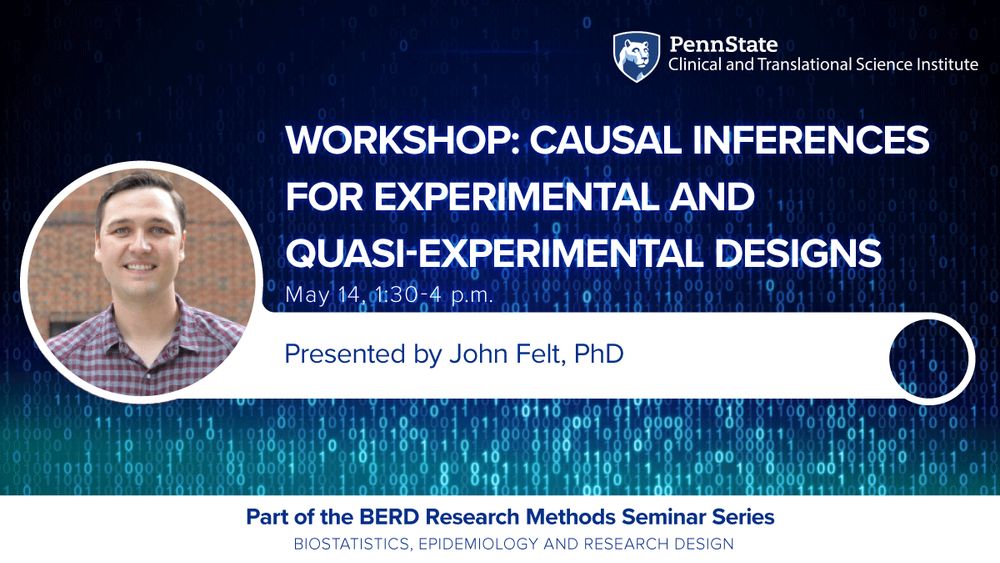
📅 Save the date – May 14 @ 1:30 p.m.! Join us for our BERD Workshop Webinar: “Causal Inferences for Experimental and Quasi-Experimental Designs” |✅ Reserve your spot: bit.ly/4jB2EIU
You can follow along with members of our Early Career Editorial Board through this starter pack: go.bsky.app/7wdxZUn
Have you been telling participants to “git gud” in your studies?
Wow, this is an impressive three to have in one talk!
I once heard someone say that “they didn’t need to randomize because the data were all collected so close in time to each other”

Check out this new one from JAMA Pediatrics that I did the analyses for
jamanetwork.com/journals/jam...
We used Synthetic Control Method to evaluate the effectiveness of a coordinated county-level child sexual abuse prevention intervention program
Definitely this paper. It is written so clearly without a lot (or any equations). It helped me also see that the whole DAGs framework also fits with the threats to validity and the Rubin’s causal framework