

Sometimes you gotta split the difference. From Aaron Roth's (@aaroth.bsky.social) plenary talk at #ALT2026
24.02.2026 16:44
👍 18
🔁 4
💬 0
📌 0
Sometimes you gotta split the difference. From Aaron Roth's (@aaroth.bsky.social) plenary talk at #ALT2026

New paper! The Linear Representation Hypothesis is a powerful intuition for how language models work, but lacks formalization. We give a mathematical framework in which we can ask and answer a basic question: how many features can be stored under the hypothesis? 🧵 arxiv.org/abs/2602.11246

📢 Our last TCS+ talk of the season will be Wed, Dec 3 (10am PT, 1pm ET, 19:00 CET): Natalie Collina (@ncollina.bsky.social), from UPenn, will tell us about "Swap regret and correlated equilibria beyond normal-form games"!
RSVP to receive the link (one day before the talk): forms.gle/utLgSxLpqvpx...
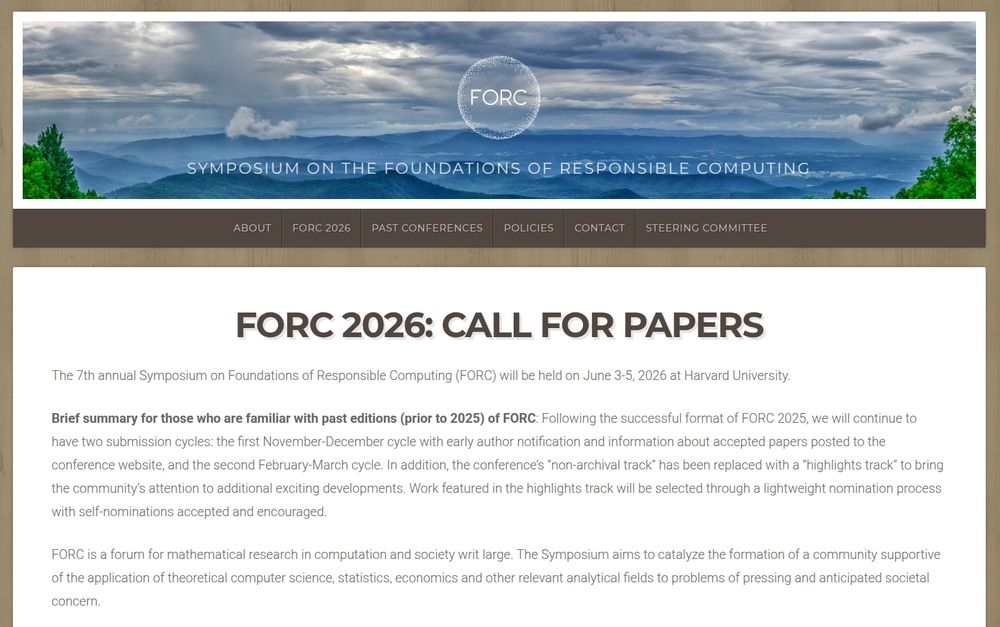
📢 In case you missed it: the first-cycle deadline for FORC 2026 is *tomorrow*, November 11. Submit your best work on mathematical research in computation and society, writ large.
Too soon? We'll also have a second-cycle deadline on February 17, 2026.
CfP: responsiblecomputing.org/forc-2026-ca...

Our paper on algorithmic collusion was featured in a Quanta article! www.quantamagazine.org/the-game-the...
where is this good coffee 👀
Could you provide a citation or reputable news article for this? I am not seeing anything claiming this yet elsewhere online.
Or, if you prefer, you can think of it as a generalization of the Bayesian information aggregation and Aumannian agreement literature!

This characterization looks a swap regret guarantee that you can think of as a multiparty generalization of our swap regret formulation of multicalibration for regression problems from arxiv.org/abs/2301.13767
I'll defer to Aaron's excellent summary thread for the details but tldr, when is collaboration useful if you can only send your prediction and not features? Here we give a precise characterization for boosting in this collaborative setting.
New paper on collaborative prediction just dropped!! This was a ton of fun to work on and the results are ✨nifty✨
The ACLU is looking for trans individuals effected by the recent transphobic Executive Order in order to bring a lawsuit against it. Here is a form if you are comfortable submitting your info to potentially be represented by the ACLU to fight this EO.
www.aclu.org/transpasspor...
Like, the text of this isn't about illegal immigrants at all by my reading, it is about *any* immigrants except green card holders maybe? It feels very disingenuous to report on this as if it isn't.
I am incredibly baffled why standard reporting agencies (eg NYT) are leading w illegal immigrants in all their articles about this, when by my reading it is a huge swath of people not usually targeted by the "illegal immigrant" rhetoric who are additionally impacted.
Extending this logic from theoretical physics to theoretical CS and math, you could probably make the argument that any smart person who chooses to do obscure math theory is guilty of this kind of brain drain. And that seems at least somewhat silly.
That's a lot different than having huge grants and for social science projects w junk statistical analysis. Like maybe the intellectual clout is still there for string theory and but the funding isn't. So worst case is you get brain drain from other subareas that would benefit from it.
I think there are also big differences in funding between string theory and your social science examples. I haven't found a nice presentation of eg grants in physics broken down by subject, but anecdotally it is very hard for grad students to get into string theory bc funding is vanishing.
Including to the emails to my letter writers? I'm not even sure if my letter writers all know my legal name.
The beautiful irony of this postdoc application I'm filling out that is specifically for minority applicants and which asks lots of questions about my gender identity also being the only one I've submitted thus far to specifically require my legal name all over the form. 😆
I know the real world is filled with ambiguity and that there is value in consistency, which relying on precedent aids. But I struggle with the logic of the justification of decision making being consistency itself. I'm sure I'm missing something, so hmu if you have any favorite resources.
Does anyone have any favorite resources about the reliance on precedent in US law? It's something I've never fully grasped. As a silly computer scientist, my impulse is to say that correctness of logical reasoning should be independent of that which came before.
Maybe? I'm not sure how this would work w precedent in copyright law. Eg even if something becomes public domain, I believe there is currently nothing that requires the owner to make it actually accessible. For instance, if I own an old painting, I don't need to show it publicly.
I shouldn't have been horrified in retrospect; I've seen this trick used in Serious Eats' cheese sauces as well.
I regret to report that despite my initial horror of using starch gelation to achieve a good pan sauce, my recreation of this experiment tastes better than any unsuccessful attempt at cacio e pepe I have made thus far.
the idea of using corn starch gives me the heebie jeebies but I am...intrigued by their argument.
How do we combat code obsolescence? In general there aren't good incentives in most companies for maintaining code vs producing new products or services, even though you'd think maintaining existing products would be sort of incentive compatible with a companies goals bc it improves consumer trust.
But fundamentally I don't know how to prevent this kind of problem. What are reasonable regulatory mechanisms to prevent "predatory" subscriptionification? On some level these things are branded as a benefit to the consumer, so idk where the line is.
It's possible it was a resolvable problem, but my roof fell in above the printer a week later so I took the L and just print everything in office now that we're back to in-person.
When I bought a printer in the pandemic, they tried to sign me up to an ink subscription. I was able to opt out, but some of the functionality of the printer was tied to the subscription app. Eventually it stopped working because the phone app wouldn't sync w printer.
Eg you can't easily buy a washing machine that doesn't have digital bells and whistles. Vacuum repair shops used to be commonplace and aren't anymore. Thermostats are iot-enabled, but what happens when the company folds and they drop support? (Happened to my dad, was a huge pain)