

blogs.lse.ac.uk/impactofsoci...
26.01.2026 12:07
👍 2
🔁 1
💬 0
📌 0

Very excited to read Trishula Patel’s new book!!!

A short brief from me on #statelessness and digital identity just published by Caribou; thanks to @emryss.bsky.social & @kerenweitzberg.bsky.social for their inputs and support #legalidentity #digitalID caribou.global/publications...
This is the country we are living in....
Speakers include: @kerenweitzberg.bsky.social @silviahedley.bsky.social @margchee.bsky.social Andreas Hackl @deryaozkul.bsky.social @rachelcoldicutt.bsky.social Sanjay Sharma, Kim Snooks

Given that people is asking me for the numbers, here the table provided by UKRI:
Today, I've been watching Keir Starmer and the Labour Party's pro-Digital ID Twitter campaign implode. 'Reverse Midas touch' really does capture it. It's like they are gunning to lose the next election. And they've managed to fuel BOTH right-wing AND left-wing conspiracy theories. Truly remarkable.

screenshot of Times headlines reading "Software giant Palantir snubs ‘undemocratic’ digital ID scheme. The US-based company, which had been touted as a potential bidder, said that it would not seek any contracts around it"
Wtaf? "Software giant Palantir snubs ‘undemocratic’ digital ID scheme". This would actually be funny if we weren't living in an emergent technofascism powered by the likes of Palantir...
archive.ph/MncRd
such a project now (given the profound challenges this country faces), whose interests it serves, and to what extent it reflects the influence of non-elected bodies (e.g. the Tony Blair Institute).
Assuming it is voluntary, privacy preserving, follows robust data protection principles (non-traceability etc), I wouldn't automatically object to the GOV.UK wallet (though the devil is in the details). It certainly follows EU trends. But it’s perfectly legitimate to ask why the govt is pursuing...
On my end, my main objection is to the 'Britcard'--a compulsory digital ID/credential that will expand 'hostile environment' policies, which looks very much like a reactive response to the moral panic around asylum seekers. Plus no real discussion about how gov't will avoid another Windrush Scandal.
Public criticism of compulsory ID has a long history in the UK, which predates the advent of Twitter/X (in fact, it even predates the Blair-era controversy over biometric ID cards in the early 2000s). Also, criticism of the new scheme is coming from BOTH the right & left of the political spectrum.

As Keir Starmer anounces a new Digital ID scheme, we revisit an article from the summer, warning that past attempts at introducing a national identity card point to a moral minefield without necessarily helping tackle irregular immigration.
blogs.lse.ac.uk/politicsandp...

As I said on BBC this morning, the Britcard isn't a carefully thought-out digitization strategy; it's a reactive policy response to right-wing populism & moral panic about asylum seekers. A piece from earlier this year w/ @margchee.bsky.social & @empo11on.bsky.social
blogs.lse.ac.uk/politicsandp...

You may already have seen her on the BBC this morning, but journalists and policy experts looking for experts on digital ID cards - you need to speak to @kerenweitzberg.bsky.social
This is a post from earlier this year
blogs.lse.ac.uk/politicsandp...

It appears the UK Labor government is moving forward with plans to introduce digital IDs to address complex migration challenges www.ft.com/content/f2b3...
In July, @margchee.bsky.social, @kerenweitzberg.bsky.social and I wrote about the challenges that lie ahead
blogs.lse.ac.uk/politicsandp...
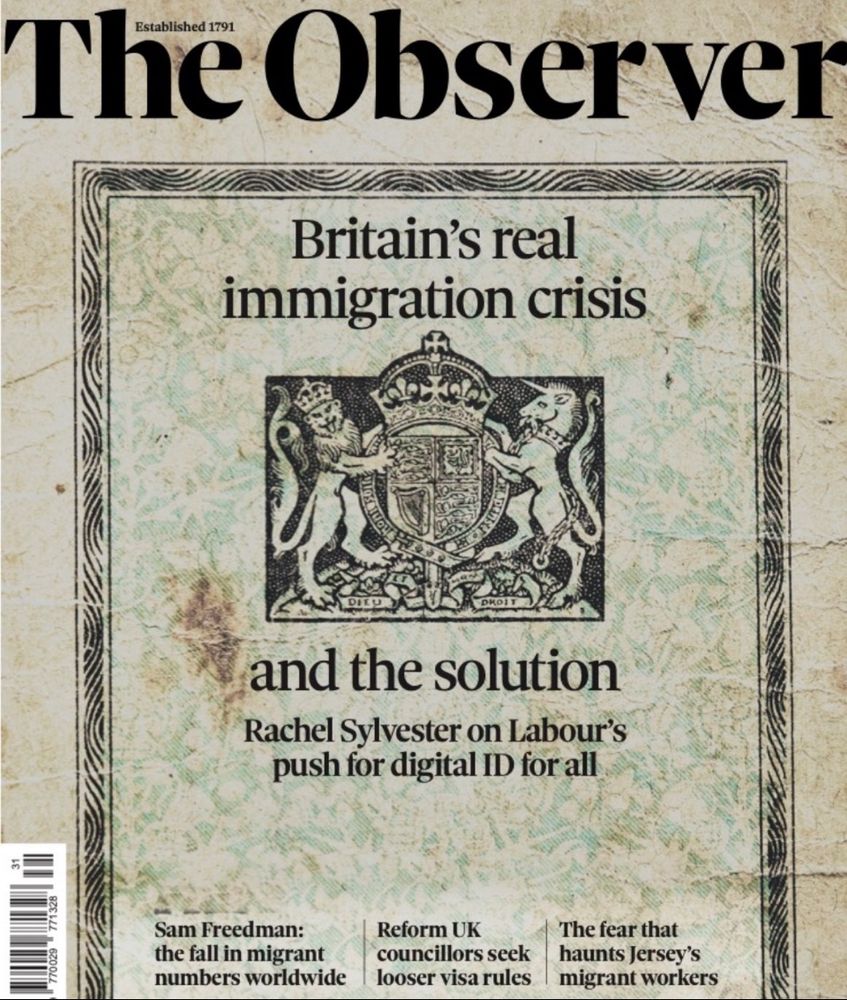
This is a billionaire-funded Tony Blair lobbying project being funnelled unchallenged onto the front page of a national newspaper.
1/
Can't believe that Silicon Valley just brought back layaway and rebranded it as "fintech".

New paper out in @bigdatasoc.bsky.social on #humanitarian #data #sovereignty💥
doi.org/10.1177/2053...
My deep gratitude to @kerenweitzberg.bsky.social, @margchee.bsky.social, @emryss.bsky.social, Quito Tsui, Paul Currion, @sophiebt.bsky.social, and @massimomarelli.bsky.social for the inspiration ❤️

New blog based on our research with humanitarians navigating the current funding crisis.
What should the future of humanitarian data management look like?
caribou.global/publications... @emryss.bsky.social

Our latest on Labour's ill-advised "Britcard" blogs.lse.ac.uk/politicsandp... with @empo11on.bsky.social and @margchee.bsky.social
Excited to share my latest article. It examines how humanitarian data came to be repurposed for citizenship determination, focusing on an often-overlooked form of biometric border-making: the digitized mechanisms for keeping citizens out of refugee camps. tinyurl.com/bde5a6dw
With @kerenweitzberg.bsky.social, I've been exploring the intersection of AI governance & #digitalidentity. In an essay in the new #openaccess 𝗥𝗲𝗶𝗺𝗮𝗴𝗶𝗻𝗶𝗻𝗴 𝗔𝗜 collection, we reflect on how companies like @world.org are resignifying #biometrics in the AI age
libraopen.lib.virginia.edu/public_view/...
Very excited to be part of this volume, “Reimagining AI for Environmental Justice and Creativity,” with Aaron Martin @empo11on.bsky.social. Where we discuss tech companies like 'World' and the quest of biometrically authenticated 'personhood' in the AI age. doi.org/10.18130/03d...
How do grassroots movements resist state collapse in Sudan?
Raga Makawi, Co-Director of Studies for the 2025 Sudan & South Sudan Course, shares reflections on civic politics and community resilience.
Watch full video: youtu.be/YK4IhRGtC8U
More info: courses.riftvalley.net
This report builds on the great work of the Future of Wakimbizi project and the Refugee-Led Research Hub. @qmpoliticsir.bsky.social
As resettlement opportunities diminish & humanitarian aid budgets are slashed, integration into host countries is increasingly being seen as the only durable solution for refugees. Nut how will integration be meaningfully achieved if digital identity systems exclude non-citizens?
How can integration be realized if refugees are denied work permits and Conventional Travel Documents? Are integration schemes just containment by another name? And how do these questions intersect with broader debates about digital public infrastructure?
In the wake of Filippo Grandi’s visit to Kenya and the launch of a new integration scheme for refugees and host communities, it is imperative to ask: How will socio-economic integration be achieved if refugees are not being provided with basic, foundational IDs?

Proud to announce the launch of our report on the challenges that refugees and migrants in Kenya face accessing state-issued identification, generously funded by the Robert Bosch Stiftung, and co-produced w/ Haki na Sheria w/ support from Caribou Digital www.cariboudigital.net/publication/...
