
Started writing it. @radplanets.com you have first dibs on co-authorship. Have time to write a section this month?
21.02.2026 18:58
👍 2
🔁 0
💬 0
📌 0
Started writing it. @radplanets.com you have first dibs on co-authorship. Have time to write a section this month?

James Rogers and Greg Cooke presenting “how much water do sub-Neptunes contain?”
A memorable breakout session at #RockyWorlds4 someday we’ll answer this question; for now it’ll keep us up at night. (After we catch up on sleep from a busy conference week)
Best conference hack: take photos of your friends presenting.
Great talk Hannah!

Frankie mouse made it to Groningen. Coming to #RockyWorlds4 tomorrow! And check out Magrathea for your MR relationship or planet composition needs: github.com/Huang-CL/Mag... v2 live now and v3 already on the horizon

A view of the canal in the city of Groningen, Netherlands. The sky is blue and the trees lining the water are green, so it's *definitely* not taken in January. Credit: https://www.hanze.nl/en/study/living-in-the-netherlands-and-groningen/groningen-is-waiting-for-you

A screenshot from our conference website: https://groningen2026.rockyworlds.org/ The text reads: Rocky Worlds 4 19–23 January 2026, Groningen, Netherlands In-person registrations for the conference are booked up. Registration for virtual participation is open.
Wondering why we've been so quiet this month? That's because we're busy preparing to welcome everyone *next week* to Groningen 🇳🇱 for...
🌋✨🚀 The ROCKY WORLDS 4 Conference 2026! 🪐✨☄️
Updates will be posted throughout the week from this account & others using the #RockyWorlds4 hashtag – stay tuned! 🔭🧪
I was looking for my folder of posters I like, and found the 2019 Sagan Workshop poster page. Wow blast from the past, crazy how well I remember so many of the faces even though many I've only seen once or twice.
nexsci.caltech.edu/workshop/201...
Officially started my postdoctoral fellowship at UW-Madison! Collaborating with Prof. Juliette Becker funded by the university's AI initiative. I haven't watch Big-10 football in ~10 years, but I think I'll have to get back into it (Go Cats!)

Hi all! If you are looking for a conference in exoplanet interiors in 2026, check out "Layers of Understanding: Model Intercomparisons of Exoplanet Interiors": layersofunderstanding2026.github.io
It will take place in MPIA's campus in April 13-17th. The registration deadline is 15 January 2026

Slide of rocks with text.
If you invite me to give a talk, I will bring my rock collection.
Fighting the intrusive thought of sending in "looks all good. QED." for a paper review.
It was so cool reading the work of high schoolers who tested out dark matter and machine learning astronomical classifications for themselves. JEI always needs more reviewers (I think I was/am the only astronomy reviewer); check it out: emerginginvestigators.org!
Two of the first works I reviewed for the Journal of Emerging Investigators got published!
Galaxy rotation curves: emerginginvestigators.org/articles/25-...
X-ray binary classifications: emerginginvestigators.org/articles/24-...
I made a travel map generator ✈️🌍
Drop in a list of country codes or names → see your visited & planned trips on a world map.
Runs fully in-browser (GitHub Pages).
Try it here: davidrrice.github.io/TravelMap/
#Travel #Maps
I think it says something that the "project's" prized fellowship went to a computer scientist. Although I try not to judge people for what postdoc they have to take nowadays.

A graph of pressure and temperature in the hydrosphere for a number of planets with varying surface temperatures. The curves go through the various regions of the phase diagram
Our new hydrosphere phase diagram is live for Magrathea: github.com/Huang-CL/Mag.... H2O ices, liquid, vapor, and supercritical. Largely inspired by the AQUA phase diagram from Haldemann et al. 2020, but with a couple of our own tweaks and ready to update with future EOS measurements.
Now if the eccentricity is greater than (1-q)/(1+q) where q is the mass ratio, the orbits are no longer nested, they form figure 8-like orbits with their ellipses rotated 180 degrees from each other. In this case, and only this case, does it make sense to say they both orbit each other. Rant over.
What does influence the geometry is the mass ratio and the eccentricity. In the barycentric frame, Pluto's apocenter is closer to the barycenter than Charon's pericenter. The orbits are nested, and we can easily say Charon orbits Pluto, and Pluto does not orbit Charon (and they both orbit the COM).
The barycenter’s position doesn’t change the geometry of the system; it’s just any systems center of mass. Inherent in the inside/outside central body definition is the central bodies density/radius something that has next to 0 to do with the orbital dynamics.
I'm not sure why I've decided to die on this hill radius, but Pluto & Charon are not a "binary planet" because the barycenter lies outside Pluto. That’s a misconception. Binary just means two bodies bound together: binary stars, binary black holes, binary asteroids, binary planet.


Once you have these it's easy to draw sillier reference frames like alpha Centauri A centric-frame or even better the Charon-centric frame.
There's a weird obsession with the barycenter being inside or outside the central body in astro-interested communities. I try to highlight here how the center of mass's location doesn't have an impact on the orbital configuration. The important quantity is actually the eccentricity.

The center of mass in the middle of the diagram with Pluto on a small circle and Charon on a larger circle. The eccentricity of near 0 is noted.

Alpha Centauri A and B on ellipses that are rotated 180 degrees to one another with center of mass at a focii. alpha Cen B is on larger ellipse. Makes a figure-8 like pattern.
Spent a day re-convincing myself that I know what an orbit is. Here are the barycentric orbits of Pluto-Charon and Alpha Centauri AB with correct proportions. Fun is that the radii of Pluto and Charon are even to scale with the orbit. #planetsci
Scary how often “I do my own research” means “I am the research subject”
Wait! It smells very strongly of garlic! No stealing internet: who wants to write an April’s fools article about K2-18b keeping vampires away.
What how why
@astrojake.bsky.social your favorite molecule

99.9% pure DMSO in large 16 oz container.
My MIL handed me pharma-grade DMSO for mosquito bites. Not FDA approved, but my self-study found it more statistical significance than DMS on K2-18b. #exoplanets
Great discussion here, just wanted to pipe in that one thing people miss in Liu Cixin's presentation of the DF is the "technological explosion" axiom. That the timescale and degree of a civilization's technological advancement is completely unknowable. In 3BP universe, any prey may become a predator
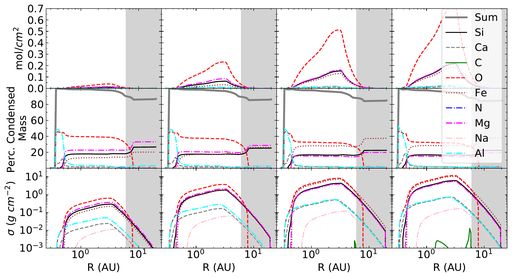
Figure 1
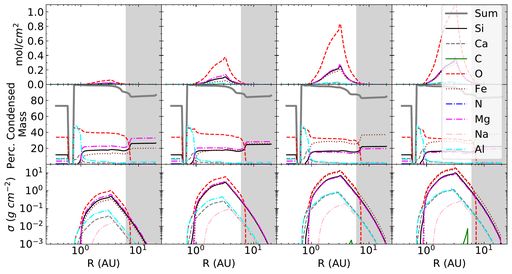
Figure 2
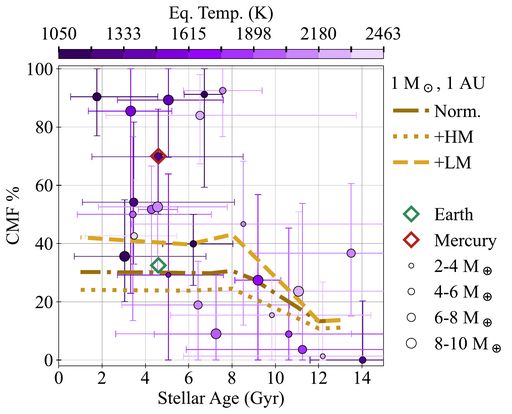
Figure 3
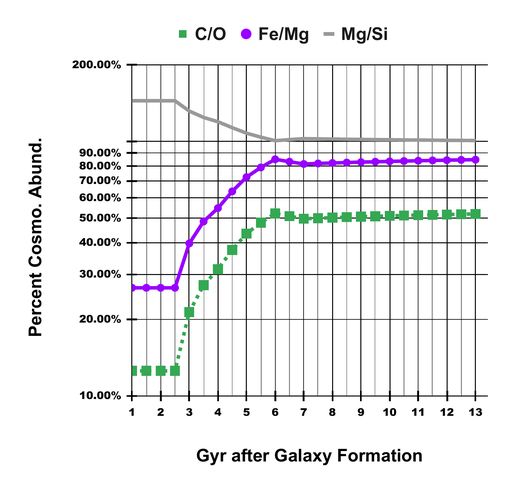
Figure 4
Effect of Galactic Chemical Evolution on Exoplanet Properties. Jason H. Steffen (UNLV) et. al. https://arxiv.org/abs/2507.10942

The core mass fraction of planets with stellar age. Old stars have planets with lower core mass fractions and newer stars have higher core mass fractions.
Our new preprint just hit the arXiv: arxiv.org/abs/2507.10942 💥 We take a look at how the core mass fraction of planets may change through galactic time. My largest contribution is this plot with the planets from Weeks et al. 2025 reanalyzed with our interior model. 🔭🪐
