Common variation in meiosis genes shapes human recombination and aneuploidy - Nature
Analysis of data from pre-implantation genetic testing sheds light on the genetic basis of meiotic-origin aneuploidy, the leading cause of human pregnancy loss, identifying common genetic variants ass...
Pregnancy loss is common in humans, and chromosomal abnormalities are the leading cause. Using genetic data from ~140,000 IVF embryos, we show that maternal variation in meiosis genes influences recombination and aneuploidy risk.
First authors: @saracarioscia.bsky.social & @aabiddanda.github.io
21.01.2026 21:14
👍 121
🔁 55
💬 1
📌 5
IMCBio International PhD Program
IMCBio International PhD Program - Application form
🚨 PhD opportunity in Strasbourg! 🚨
We’re looking for a motivated PhD student to join the @haploteam within the IMCBio program (PhD-2026-17).
🔗 imcbio-phdprogram.unistra.fr
Please spread the word or contact me if you’re interested!
27.11.2025 06:17
👍 5
🔁 6
💬 0
📌 0


Come join us in beautiful Britanny, France in May 2026 for a workshop that I am organizing with @lucievirevolte.bsky.social and @psudmant.bsky.social on Rapid host adaptations to infections:
sites.google.com/berkeley.edu...
23.10.2025 13:20
👍 22
🔁 19
💬 2
📌 1
Huh, cool, does each polymerase only replicate its own linear plasmid? Is there a part of the polymerase protein that’s rapidly evolving that could be defining the specificity?
22.10.2025 04:06
👍 0
🔁 0
💬 1
📌 0
Just imagining research talks in antiquity.
EUCLID: …thus, there does not exist a rational number whose square is equal to 2.
HIPPOCRATES: [grumbling] I fail to see the clinical relevance of any of this
26.09.2025 13:01
👍 3
🔁 0
💬 0
📌 0
Final version of our paper out now on how high-throughput methods can be useful for answering everyday “low-throughput” genetic questions!
11.09.2025 03:08
👍 6
🔁 1
💬 0
📌 0
The 90s was more my radio era than albums, but I’d say each of these are perfect in their own way: RATM, Midnite Vultures, Rangeela, Blackout! (Would have also said 2001, but the skits are terrible.)
06.09.2025 04:05
👍 1
🔁 0
💬 0
📌 0
Now out officially, with the entire kit on @addgene.bsky.social. Great collaboration with @merusadhu.bsky.social, with more to come.
20.08.2025 12:51
👍 2
🔁 1
💬 0
📌 1
What did you think of Gyokeres? Didn’t seem very threatening. Could just need more time to bed in.
18.08.2025 03:01
👍 0
🔁 0
💬 0
📌 0
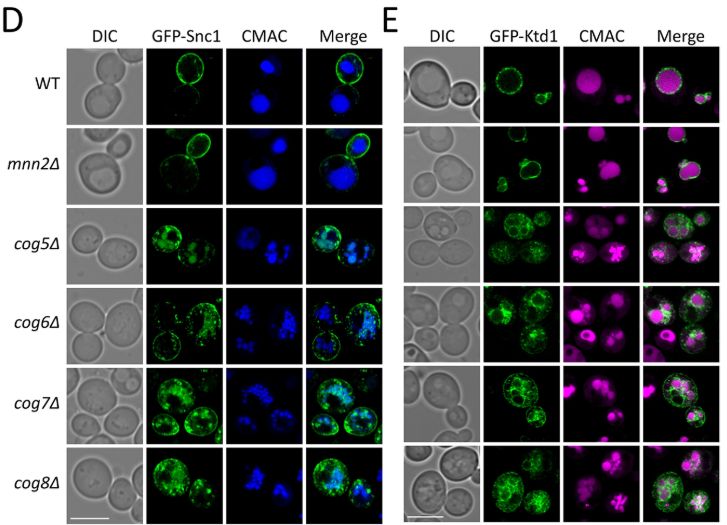
Microscopy images showing that correct localisation of either Ktd1 or Snc1 requires the COG complex.
Kamilla Laidlaw, Hatwan Nadir, Chris MacDonald @yorkyeast.bsky.social and team @biologyatyork.bsky.social discover that killer toxin K28 resistance in yeast relies on COG complex-mediated trafficking of Ktd1.
journals.biologists.com/jcs/article/...
Article: journals.biologists.com/jcs/article/...
21.07.2025 12:25
👍 11
🔁 5
💬 1
📌 1
I’m really rooting for this approach to catch on! Of the papers I’ve been involved in, this is probably the one I most feel is contributing a different way of thinking. Big shoutout to the co-first authors, Molly Monge (now an MD/PhD student at Cornell) and Simone Giovanetti.
14.07.2025 15:18
👍 3
🔁 0
💬 0
📌 0
“High throughput” doesn’t have to mean hard/expensive! At its heart, the difference is that instead of picking a few clones of your transformation, you take all the colonies. And with low sequencing costs and the possibility of pooling sequencing, it will generally be affordable.
14.07.2025 15:18
👍 1
🔁 0
💬 1
📌 0
Second, background mutations. Often in low-throughput approaches, each strain is generated once and split into replicate cultures for experiments. It makes the experiment a lot easier, but any background mutations are shared between replicates! Again, bulk methods can help!
14.07.2025 15:18
👍 1
🔁 0
💬 1
📌 0
First, replicates. It’s hard to do low-throughput experiments on even a modest number of samples with more than a small number of replicates per sample. Not a problem if you make your replicates in bulk using barcodes and test your hypothesis in high throughput!
14.07.2025 15:18
👍 1
🔁 0
💬 1
📌 0
Validate User
New paper from my lab! We describe our idea that high-throughput pooled experimental methods – typically used to test thousands of hypotheses at once – also have huge potential to help in “everyday” experiments testing one or a few focused hypotheses. Why? Two reasons: doi.org/10.1093/g3jo...
14.07.2025 15:18
👍 16
🔁 5
💬 1
📌 0