
Including @colourfulcosmos.bsky.social @cjriseley.bsky.social @astrokatross.bsky.social @georgeheald.bsky.social @nseymour.bsky.social and others!
20.02.2026 01:09
👍 0
🔁 0
💬 0
📌 0
Including @colourfulcosmos.bsky.social @cjriseley.bsky.social @astrokatross.bsky.social @georgeheald.bsky.social @nseymour.bsky.social and others!
The catalogue and mosaic images are available via the CSIRO Data Access Portal: doi.org/10.25919/z80..., and the catalogue is now available via VizieR: cdsarc.cds.unistra.fr/viz-bin/cat/....

An image of the radio galaxy Fornax A and its surroundings at 300 MHz.
We have recently published the 300-MHz component of the GaLactic and Extragalactic All-sky MWA survey (GLEAM-300), with 338k sources covering the sky up to declination +40 deg, with ~120" angular resolution and ~9 mJy/beam noise. The description paper is published via PASA: doi.org/10.1017/pasa....

VLITE Marks 11 Years of Capturing the Dynamic Radio Sky
A collaboration between the U.S. Naval Research Laboratory and the NRAO celebrates over a decade of commensal observing with the NSF Very Large Array. @usnrl.bsky.social
#Astronomy #RadioAstronomy

Today in PASA we published a new image of our Milky Way at low radio frequencies, in unprecedented colour and detail. Here's just a tiny piece of it -- the whole thing is ten times bigger!
We're seeing high energy electrons whirl around cosmic magnetic fields from exploded stars, and more!
If you enjoyed Anacondas: Hunt for the Blood Orchid you'd enjoy it, but if you want more of JP or Lost World then yes just a teeny bit lacking. I like Anaconda though, so I had a good time.
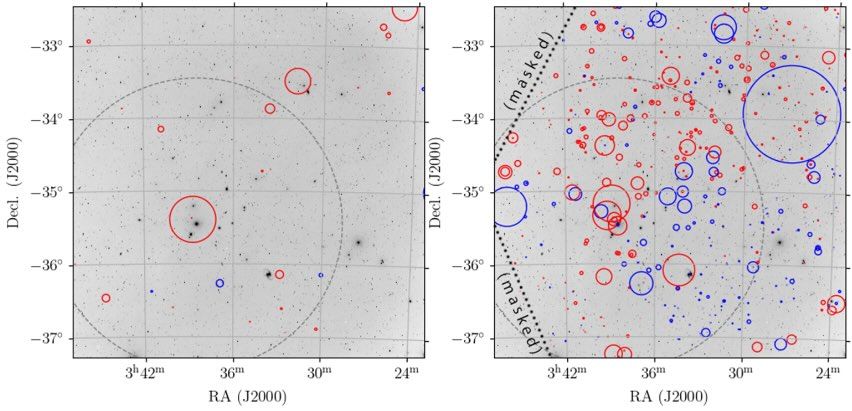
Comparison of NVSS (left; Taylor et al., 2009) and POSSUM (right) Band 1 RMs within the Fornax cluster’s virial radius (grey dashed circle), showcasing POSSUM’s transformative capability to probe magnetised gas in clusters, groups, and many other ∼degree-scale extragalactic objects. The background is a Digitized Sky Survey optical image (greyscale). Solid circles indicate the position, magnitude, and sign of RMs measured by each survey, with diameters proportional to (RM)^2 and colours indicating RM sign (red for positive, blue for negative). While only a few clusters or groups contain >∼ 10 NVSS RMs at sub-virial radii, POSSUM’s RM grid will sample thousands of these systems, including over a dozen with 100 or more RMs.
Recently published in PASA: "The Polarisation Sky Survey of the Universe’s Magnetism (POSSUM): Science Goals and Survey Description", Gaensler, B.M. et al. This is Figure 1. To read the paper visit doi.org/10.1017/pasa...

A day late posting but after a lot of hard work I give you the survey overview papers for the EMU & POSSUM ASKAP surveys #EMU survey arxiv.org/abs/2505.08271 and the #POSSUM survey arxiv.org/abs/2505.08272 🔭

Close-up view of white bougainvillea with some small flowers poking through the bracts.

Magenta bougainvillea with small white flowers. More bougainvillea leaves and flowers are out of focus in the background.

A close-up of a magenta bougainvillea, with its small white flowers hiding under a green leaf.
Some bougainvillea in the garden. After 13 years of use, I've finally replaced my trusty Canon 1000D - still using the same 60mm and 50mm lenses (for now), but the new camera is a very nice upgrade.

I like this tool for making (or modifying) colourmaps for use in e.g. matplotlib: github.com/eltos/gradient.

The latest data release for the Rapid ASKAP Continuum Survey (RACS), this time at 1655.5 MHz. Here's the paper describing the RACS-high images and catalogue. You can find links to the data products in the paper: arxiv.org/abs/2501.04978

Technical but important paper for anyone doing work with interferometers arxiv.org/abs/2309.00533