Thanks Jamie for co-leading this with Luca. It was a truly insightful experience to be part of this knowledgeable team.
17.02.2026 11:15
👍 2
🔁 0
💬 0
📌 0

@veralis
Computer vision for pollinators 🌻🐝 & nature. Sometimes, for me, some cats make more sense than some people 🐾 💻 github.com/valentinitnelav 📍 @idiv-research.bsky.social 🔗 linkedin.com/in/valentin-stefan/ 🔗 scholar.google.com/citations?user=8HlgXLYAAAAJ&hl=en
Thanks Jamie for co-leading this with Luca. It was a truly insightful experience to be part of this knowledgeable team.

Insect monitoring without pitfalls: Seven steps for robust insect sensing systems
Sensors and AI can transform understanding of insect biodiversity 🪰📈
BUT we must be wary of the AI hype-train 🚆 and respect existing data and traditional monitoring 🙇
Our new synthetic review lays out seven steps to realise the potential of insect sensing systems 🎥🔭
ecoevorxiv.org/repository/v...
There are now millions of publicly-available AI models – which one is right for you?
We introduce CODA ( #ICCV2025 Highlight! ), a method for *active model selection.* CODA selects the best model for your data with any labeling budget – often as few as 25 labeled examples. 1/
@iccv.bsky.social


Too many mediocre men talk over capable women.
Study of problem-solving teams: Men dominate the conversation, taking 50% more turns and saying 69% more than women. Men with low skill speak more than women with high skill.
It's long past time to value competence over confidence.
📢Please share📢 We have an opening for an exciting fully-funded PhD project on computer vision and machine learning applied to biodiversity monitoring with amazing Serge Belongie @belongielab.org and @aicentre.dk. Application deadline coming up on 15 January!
phd.tech.au.dk/for-applican...

Turns out, a lot of the plants we use for bee habit enhancement are already common and mostly support those darn common generalists!
Thanks @joseblanuza.bsky.social for the help getting this across the line
besjournals.onlinelibrary.wiley.com/doi/10.1111/...


‼️🚨My first PhD paper out in @methodsinecoevol.bsky.social
We built an automated camera system to detect plant–pollinator interactions (day & night) and compared networks from cameras vs. focal observations.
📜👉 doi.org/10.1111/2041...
@annatraveset.bsky.social
@imedea.bsky.social

Excited to share a new paper led by our colleagues at #DLR! We trained AI to recognize 15 European fly pollinator families and estimate how confident it is, helping ecologists use AI more responsibly.
Paper: lnkd.in/dBAWW3hB
Code: lnkd.in/du7dD2hc
#pollinators #aiforgood #aifornature #UFZ #iDiv
#AIForGood #Biodiversity #NatureTech #Pollinators #Research #OpenScience #AI #ObjectDetection #ComputerVision #DeepLearning #MachineLearning #NeuralNetworks
Check out the preprint here www.researchsquare.com/article/rs-6... and the code here github.com/valentinitne...

Our latest research explores how YOLO object detectors, trained on citizen science images, perform on unseen time-lapse images of pollinators captured with a fixed smartphone setup. While successful for larger pollinators, detecting smaller or blurrier flower visitors remains a challenge.
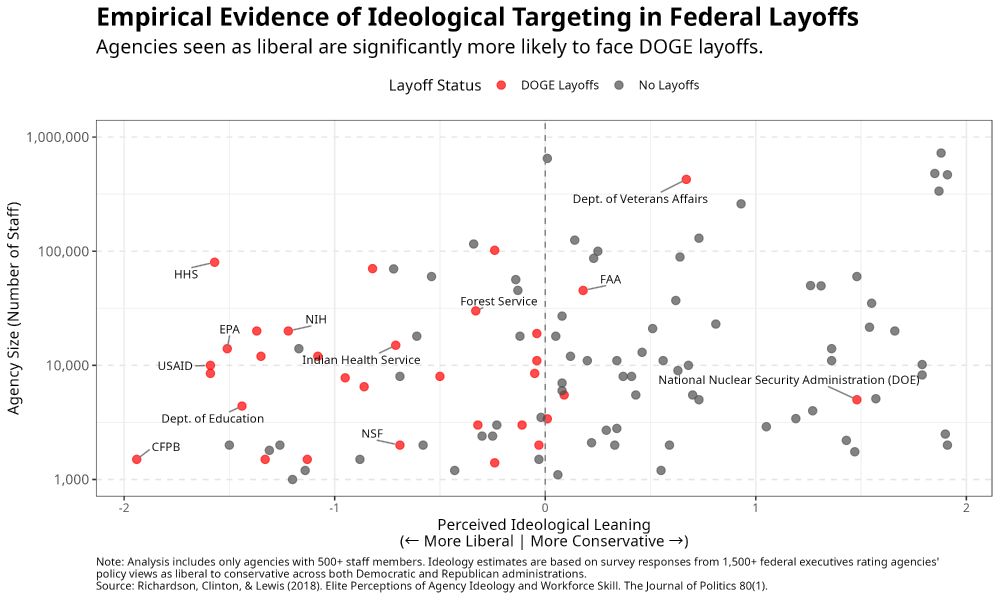
Scatterplot titled “Empirical Evidence of Ideological Targeting in Federal Layoffs: Agencies seen as liberal are significantly more likely to face DOGE layoffs.” • The x-axis represents Perceived Ideological Leaning of federal agencies, ranging from -2 (Most Liberal) to +2 (Most Conservative), based on survey responses from over 1,500 federal executives. • The y-axis shows Agency Size (Number of Staff) on a logarithmic scale from 1,000 to 1,000,000. Each point represents a federal agency: • Red dots indicate agencies that experienced DOGE layoffs. • Gray dots indicate agencies with no layoffs. Key Observations: • Liberal-leaning agencies (left side of the plot) are disproportionately represented among red dots, indicating higher layoff rates. • Notable targeted agencies include: • HHS (Health & Human Services) • EPA (Environmental Protection Agency) • NIH (National Institutes of Health) • CFPB (Consumer Financial Protection Bureau) • Dept. of Education • USAID (U.S. Agency for International Development) • The National Nuclear Security Administration (DOE), despite its conservative leaning (+1 on the scale), is an exception among targeted agencies. • A notable outlier: the Department of Veterans Affairs (moderately conservative) also faced layoffs despite its size. Takeaway: The figure visually demonstrates that DOGE layoffs disproportionately targeted liberal-leaning agencies, supporting claims of ideological bias. The pattern reveals that layoffs were not driven by agency size or budget alone but were strongly associated with perceived ideology. Source: Richardson, Clinton, & Lewis (2018). Elite Perceptions of Agency Ideology and Workforce Skill. The Journal of Politics, 80(1).
The DOGE firings have nothing to do with “efficiency” or “cutting waste.” They’re a direct push to weaken federal agencies perceived as liberal. This was evident from the start, and now the data confirms it: targeted agencies overwhelmingly those seen as more left-leaning. 🧵⬇️

[new paper] EuPPollNet: A European Database of Plant-Pollinator Networks
onlinelibrary.wiley.com/doi/10.1111/... Another wonderful paper of @joseblanuza.bsky.social making open more than >1500 networks and looking at their properties. Come for the data, stay for the cool figures!
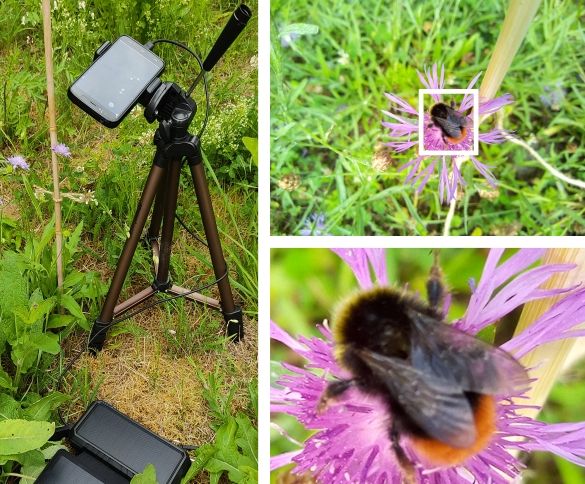
2025 starts with a methodology publication by Ștefan et al. on Utilising affordable smartphones and open-source time-lapse photography for pollinator image collection and annotation - Happy new year!
doi.org/10.26786/192...

Our research center (iDiv) will host a very interesting summer school (25 – 29 August 2025) - Deep learning for biodiversity and ecological research.
More details here: www.idiv.de/events/summe...
#biodiversity #education #aiforgood #technology #idiv