I will present my work with @hannoseebens.bsky.social and @mormoops.bsky.social on forecasting spread of non-native invasive species at this years @guardias.bsky.social online conference from 13th to 14th of November.
28.10.2025 10:03
👍 5
🔁 1
💬 0
📌 0


Starting the week in Bogotá with an exchange with Colombian and European experts on invasive alien species data management.
Amazing to see what has been done in Colombia for harmonising and providing biodiversity.
Next stop #LivingData2025 conference starting tomorrow.
20.10.2025 23:04
👍 3
🔁 0
💬 1
📌 0
On my way to attend the #LivingData2025 conference in Bogotá, Colombia.
Very excited to get in contact to a new community, to meet friends and colleagues and to learn new stuff and advancements on biodiversity data.🙂
17.10.2025 12:40
👍 7
🔁 0
💬 0
📌 0
Very different. We had companies from the food sector, paper production and a bank.
26.09.2025 20:15
👍 0
🔁 0
💬 0
📌 0
Buhuuuu 😭 Our proposal was rejected by biodiversa+ for the transformative change call ☹️☹️☹️
I know that this is not uncommon in science but it always sucks. We put quite some effort into this and it is such a nice one. Maybe next time.
26.09.2025 19:17
👍 1
🔁 0
💬 0
📌 0
Thanks to all contributors @annaroennfeldt.bsky.social Katrin Schifferle @jsarmentocabral.bsky.social
@dylancraven.bsky.social Tiffany Knight @hannoseebens.bsky.social @patrickweigelt.bsky.social
13.09.2025 20:39
👍 5
🔁 1
💬 0
📌 0
Registered for @biogeography.bsky.social conference 2026 and will give a talk about our (@mormoops.bsky.social & @hannoseebens.bsky.social) new model approach to forecast invasive species spread based on traffic gravity model and landscape resistance maps derived from open data. 🥳
08.09.2025 07:40
👍 3
🔁 1
💬 0
📌 0

08.09.2025 03:59
👍 9
🔁 3
💬 1
📌 0

Microsoft Virtual Events Powered by Teams
Microsoft Virtual Events Powered by Teams
There are other workshops coming all in the context of biological invasions:
30th Sep 2025
14:00-17:00 BST
Food, Agriculture, and Forestry Workshop
events.teams.microsoft.com/event/3ed563...
20th Oct 2025
14:00-17:00pm BST
Finance Workshop
events.teams.microsoft.com/event/19c5c4...
06.09.2025 12:56
👍 0
🔁 0
💬 0
📌 0

This week I had the pleasure of presenting our work on #biodiversity #impacts of companies at a workshop by Fauna & Flora, #IUCN and Taskforce on Nature-related Financial Disclosures #TNFD.
A fantastic opportunity to exchange across sectors.
Many thanks for having me! I enjoyed it very much. 🙏
06.09.2025 08:27
👍 4
🔁 0
💬 2
📌 0
What a great paper!
14.08.2025 19:26
👍 2
🔁 1
💬 1
📌 0
‼️🪶The future reference for basic and applied research on #invasivespecies. 🏝️It was an honour and a pleasure to contribute to this important global study from the perspective of the tropical #Pacific #Islands. Thank you for taking me on board!
#biodiversity #conservation #globalchange
15.08.2025 10:52
👍 1
🔁 1
💬 1
📌 0
😊 it was a pleasure to collaborate with you. Thank you for valuable contributions🙏
15.08.2025 16:56
👍 1
🔁 0
💬 0
📌 0
😊🙏
14.08.2025 20:05
👍 0
🔁 0
💬 0
📌 0
This was a massive effort led by the core team consisting of Laura Meyerson, Petr Pysek, Dave Richardson and myself. Their support was incredible, and I am grateful to work with such experienced and dedicated researchers.
The whole author team was fun to work with.
14.08.2025 08:32
👍 3
🔁 0
💬 0
📌 0
Data gaps of the distribution of non-native species are huge and widespread. But quantifying gaps and their influence on results is very challenging.
The comprehensiveness of our assessment allows to provide a good overview of knowledge and lack of knowledge.
14.08.2025 08:31
👍 2
🔁 0
💬 1
📌 0
Main findings:
Non-native species are everywhere, even in remote places (islands, deep sea, Antarctica, high mountains).
Trends are increasing and will increase in the future.
Data gaps are huge. No inventory is complete. Particularly for invertebrates, aquatic species and invertebrates.
14.08.2025 08:30
👍 3
🔁 0
💬 1
📌 0

An invasive alien red-eared slider turtle (Trachemys scripta elegans) photographed by Pablo Garcia-Diaz in Adelaide (Australia)

An invasive alien American mink (Neovison vison) photographed by Pablo Garcia-Diaz in Salamanca (Spain)

A close-up of an invasive alien Canada goose (Branta canadensis) photographed by Pablo Garcia-Diaz in Christchurch (Aotearoa-New Zealand)

A close-up of an invasive alien wolf snake (Lycodon capucinus) photographed by Pablo Garcia-Diaz during his fieldwork on Christmas Island (Australia)
Very excited to share this review. Stemming from the @ipbes.net IAS Assessment, it is the most comprehensive and up-to-date synthesis of the status of invasive alien species globally. An essential reference for anyone interested in #bioinvasions 🌎🌐 🧪 onlinelibrary.wiley.com/doi/10.1111/...
12.08.2025 14:58
👍 40
🔁 12
💬 0
📌 1
LinkedIn
This link will take you to a page that’s not on LinkedIn
The original data is here: lnkd.in/eDtp5Xx5
And the recent publication putting this data into context here: lnkd.in/eGr4w6kh
12.05.2025 13:57
👍 0
🔁 0
💬 0
📌 0
Our World in Data
Research and data to make progress against the world’s largest problems
What an honour! 😊 🤩
I realised that the famous data platform "Our World in Data" has now our data set of first records of alien species on their platform.
I use this platform quite a lot and I am very happy (and proud) to find our data set there as well 🤩
lnkd.in/ePJFEgFk
12.05.2025 13:56
👍 2
🔁 0
💬 1
📌 0
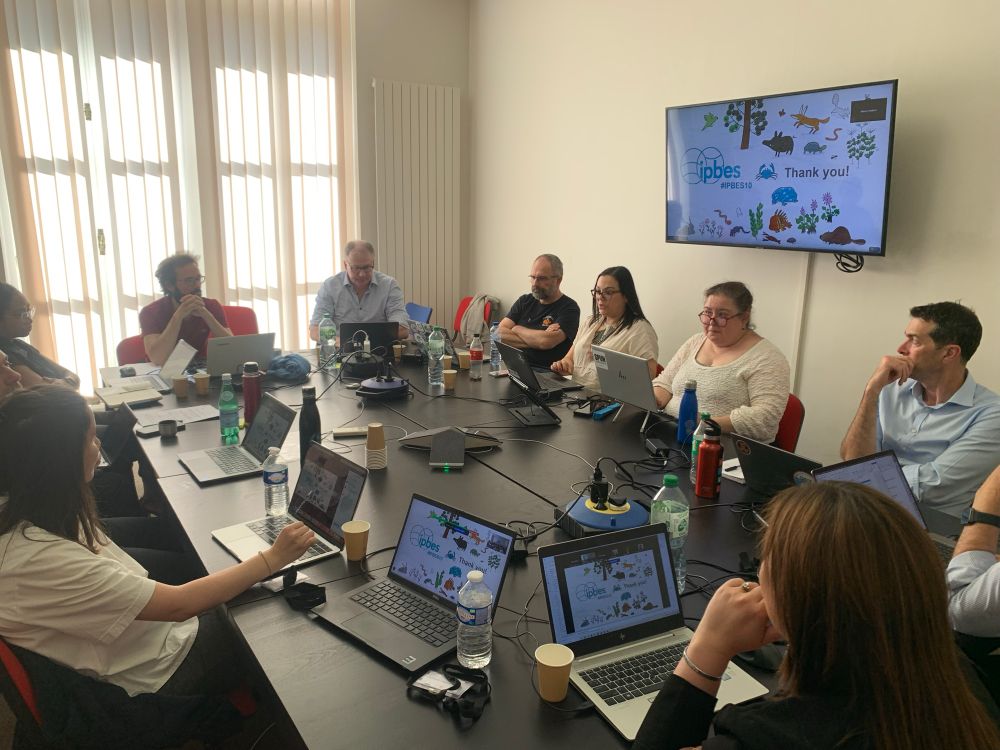
Very interesting meeting of the #CBD inter-liaison group of #invasive alien #species!
A small group but with representatives from very different organisations from sectors of eg trade, tourism, agriculture, biodiversity. Amazing to see how much is going on. But this needs to be coordinated!
30.04.2025 13:41
👍 1
🔁 0
💬 0
📌 0
On my way to the meeting of the #CBD inter-liaison group on #invasive alien #species in Paris.
Looking forward discussing gaps and needs to meet the global biodiversity taget on #IAS
28.04.2025 10:53
👍 0
🔁 0
💬 0
📌 0
Interested in invasive species and biological invasions: Postdoc opportunity in Chile.
Come work with us in the Laboratory of Biological Invasions at the University of Concepción and the Institute of Ecology and Biodiversity @iebchile.bsky.social
11.04.2025 23:08
👍 13
🔁 6
💬 1
📌 0
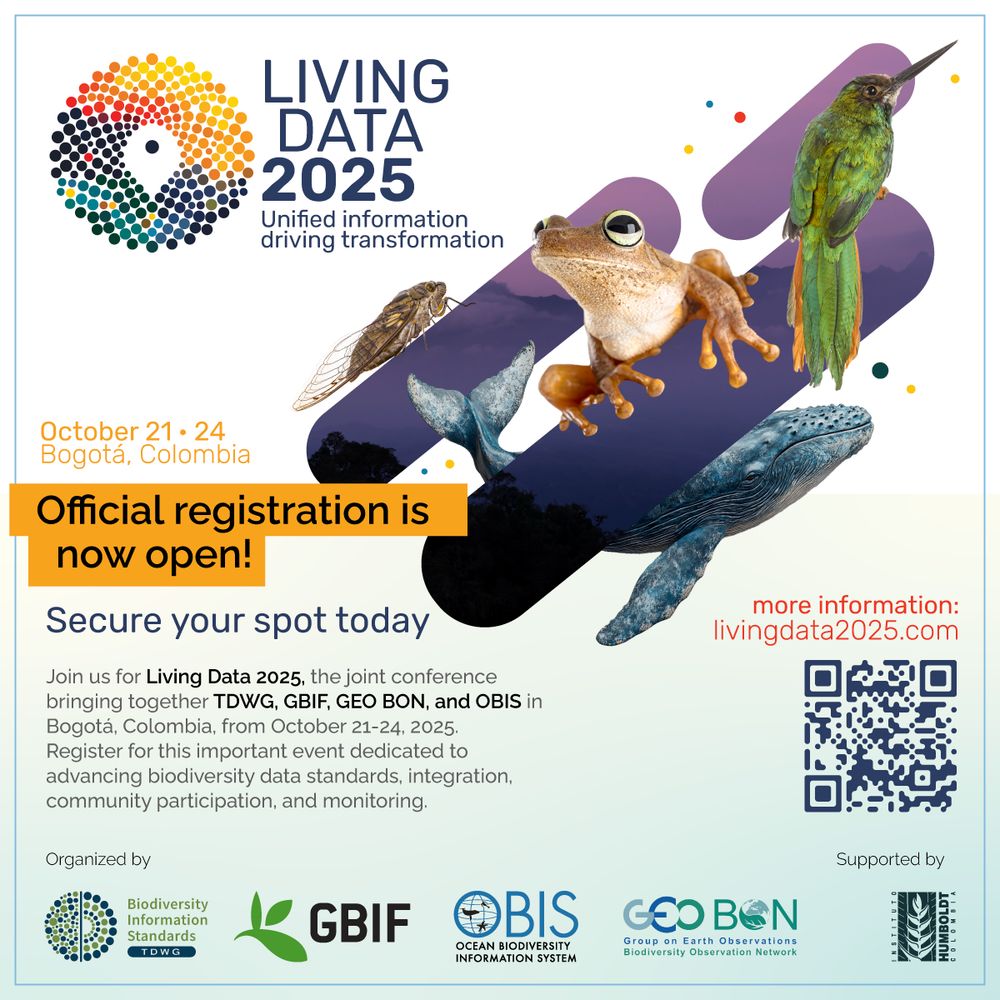
collage of species images, text and logos advertising the living data 2025 conference
⭐ Registrations are OPEN for the #LivingData2025 conference! ⭐
The joint conference hosted by @tdwg.org, GBIF, @obis.org and @geobon.org at the #InstitutoHumboldt in Bogotá, #Colombia will bring together biodiversity networks from across the world. 🐸
www.livingdata2025.c...
#DatosVivos2025
31.03.2025 08:30
👍 11
🔁 6
💬 1
📌 5
✍ Register for the upcoming #LivingData2025 conference taking place in October 2025!
📲 Detailed information here: www.livingdata2025.com/index.html
@tdwg.org @gbif.org @geobon.org @obis.org
31.03.2025 15:08
👍 6
🔁 1
💬 0
📌 0