New working paper from Philipp Jonas Kreutzer’s forthcoming PhD thesis. We find that collaboration networks are conducive for bioeconomy innovation. If policy makers want to stimulate bioeconomy innovation, they should focus on lowering general barriers to collaboration. arxiv.org/pdf/2602.05112
06.02.2026 11:44
👍 1
🔁 0
💬 0
📌 0
(3) where firms are in the product space (what products they have produced) has information about what types of products they will produce next
09.09.2025 15:19
👍 0
🔁 0
💬 0
📌 0
Investigating 100 years of Swedish innovation I find that (1) firms build upon previous knowledge (2) this effect is not large enough to create "winner take all" distribution, but large enough to create advantages for large firms,
09.09.2025 15:19
👍 0
🔁 0
💬 1
📌 0

Long-run patterns in the discovery of the adjacent possible
Abstract. The notion of the “adjacent possible” has been advanced to theorize the generation of novelty across many different research domains. This study
New paper: doi.org/10.1093/icc/... Why do a few firms come to dominate technological progress? Can you predict what types of innovations organizations will make? Why do firms specialize in certain technologies? I try to explain these things in a new theoretical framework. #innovation
09.09.2025 15:00
👍 1
🔁 0
💬 1
📌 0
Most work out there argues that it doesn't pay off for center-right parties to move closer to the far-right.
Using some of the best evidence yet, this paper shows that the same is true for center *left* parties.
Crucial finding as these parties increasingly move in a nativist direction.
05.09.2025 07:29
👍 106
🔁 47
💬 2
📌 4
This means that innovation policy and analyses that focus only on patents and IPR risk ignoring a lot of what is actually happening. Patents will remain the main tool, but if we truly want to understand innovation trends, we have a long way to go to develop and use other measures of innovation(2/2)
27.08.2025 09:49
👍 1
🔁 0
💬 0
📌 0
New paper: link.springer.com/article/10.1... Patents contain a fantastic wealth of information and has become the go-to measure of innovation. But how well do they capture innovation? In a new study on Sweden I found that they at best capture about 15% of all information on innovation. (1/2)
27.08.2025 09:49
👍 1
🔁 0
💬 1
📌 0
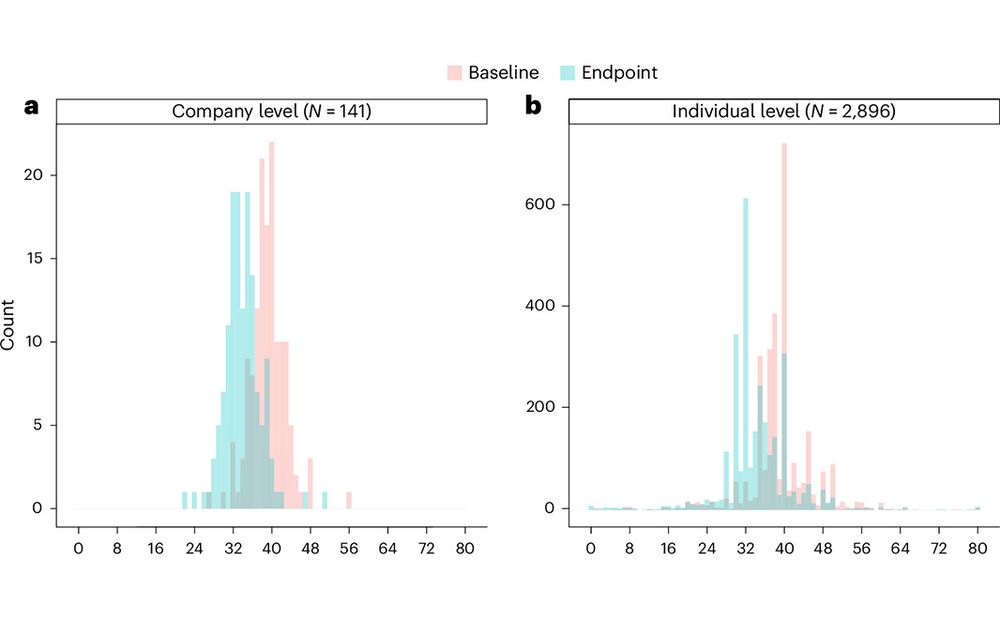
This is figure 2. The plot shows the distribution of work hours at baseline (in red) and at endpoint (in green). Panel a presents company-level average work hours. Panel b presents individual-level work hours.
A study in Nature Human Behaviour finds that four-day work weeks without a reduction in income boost workers’ job satisfaction and physical and mental health, driven by enhanced work performance, lower levels of fatigue and fewer sleep problems. go.nature.com/3Um75MP #econsky 🧪
30.07.2025 01:33
👍 49
🔁 14
💬 2
📌 3
I also discovered that you can have quite a lot of fun with the quiz at Pantheon pantheon.world/game/trivia
29.07.2025 15:07
👍 0
🔁 0
💬 0
📌 0
WEHC Keynote 2. 28th of July 2025. 6pm. AF Borgen Lund.
YouTube video by Lund University
Had the great pleasure of introducing @cesifoti.bsky.social for his terrific keynote on Big Data and Machine Learning as a means of exploring economic history. If anyone missed it, it's up on youtube: www.youtube.com/watch?v=NvF1... #wehc2025 #machinelearning #bigdata #collectivememory
29.07.2025 15:07
👍 5
🔁 0
💬 1
📌 0

The 20th World Economic History Congress in Lund has started - with a keynote of Elise van Nederveen Meerkerk on Work, Race, Gender and Class, #wehc2025 #economichistory #lund #intersectionality
28.07.2025 08:01
👍 9
🔁 1
💬 0
📌 0

Astronomers using a space telescope have found signs of biological activity on K2-18b, a distant water-covered planet that is 8.6 times bigger than Earth. www.ft.com/content/0142...
17.04.2025 06:35
👍 992
🔁 169
💬 94
📌 48

How the electric car almost became the norm, more than a century ago
There's been a huge uptake of electric cars in recent years, but more than 100 years ago, they were arguably even more popular.
Got to speak a bit on my research on the history of electric cars in RNZ's Saturday Morning. In short: (1) yes, we could've gotten electric cars 100 years ago, (2) No one knows the long-run consequences of technology, (3) tech development and how it's used is a question of democratic concern.
06.04.2025 20:17
👍 2
🔁 0
💬 0
📌 0
Opportunities
UNU-MERIT is hiring a Postdoc in AI Innovation Trajectories.
Work within a multidisciplinary team to map and analyse AI innovation pathways using NLP—focusing on their societal impact, especially in sectors like agriculture.
🗓️ Apply by 13 April 2025
🔗 go.unu.edu/m93fc
26.03.2025 06:31
👍 7
🔁 8
💬 0
📌 1
#electriccars #gender #historyoftechnology #STS #economichistory
13.03.2025 18:22
👍 3
🔁 0
💬 0
📌 0