

Let's go NISAR!!! Successful separation - now we wait on the rest of the deployment over the next week or so. #nisar #isro #nasa
science.nasa.gov/blogs/nisar/...
30.07.2025 13:27
👍 35
🔁 6
💬 0
📌 2
Let's go NISAR!!! Successful separation - now we wait on the rest of the deployment over the next week or so. #nisar #isro #nasa
science.nasa.gov/blogs/nisar/...

A photograph of Lake Tahoe with a bright blue sky and a large tree in the center. A small inset of a black and white linocut print of the photograph.
joining bluesky 🦋 | scientist + artist who thinks a lot about the intersection between the geophysical and ecological, climate futures, and resilience
Permafrost is important for so many reasons – it's a natural carbon reservoir, the base for infrastructure, and a home to many species. Understanding how it's changing and the downstream effects of these changes is so important for making good decisions about all these things!

Greening trends appear associated with smaller seasonal subsidence, thinner active layers, and wetter soil:

Burned areas have higher soil water content than unburned areas:

Lower soil moisture (volumetric water content) is associated with deeper active layers, suggesting that Arctic soil may become drier as the climate warms:

Map showing swaths included in the Permafrost Dynamics Observatory's ABoVE: Active Layer Thickness from Airborne L- and P- band SAR, Alaska, 2017
This data set measures subsidence, soil moisture, and active layer thickness of #permafrost at millions of points. This allows us to investigate what processes and relationships from smaller-scale studies hold over larger regions. What do we discover? ⤵️

🚨 New paper alert! 🚨
Permafrost Dynamics Observatory: Remote Sensing Big Data for the Active Layer, Soil Moisture, and Greening and Browning
We analyze a big dataset of airborne L-band SAR data over permafrost in the Arctic-Boreal region
agupubs.onlinelibrary.wiley.com/doi/full/10....
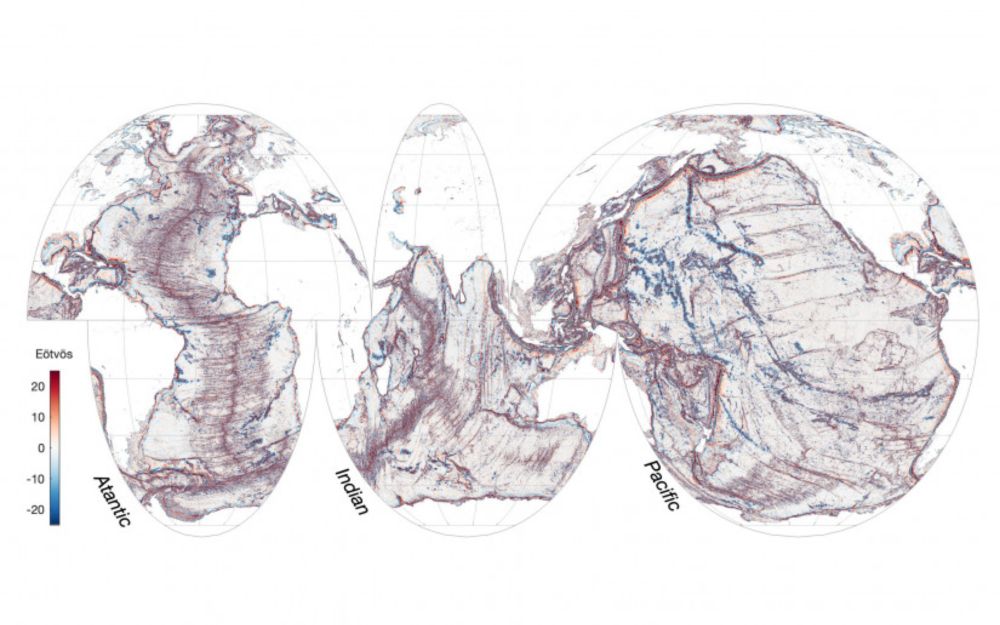
A satellite-mounted instrument has in just one year produced higher-resolution imagery of the global seafloor than that from comparable systems over the past 30 years. 'Sea' for yourself and learn more about the new study led by Scripps Oceanography postdoctoral scholar Yao Yu. ⬇️

Scientific poster titled “Quantifying volcanism on Venus with VenSAR: Comparison with Earth and Suggestions for Targeted Observations”
At #AGU24? Interested in volcanoes? Interested in Venus? Come chat with me at my poster this afternoon! Poster number 3121

Remotely Sensed Fuel Moisture from InSAR Closure Phase on UAVSAR Elizabeth Wig et al, Hall B-C (Poster Hall) (Convention Center) Wednesday, 11 December 2024 : 08:30 - 12:20 InSAR Closure Phase for Fine-Resolution Measurements of Changing Soil and Vegetation Moisture, Elizabeth Wig et al, Marquis 1-2 (Marriott Marquis), Wednesday, 11 December 2024 : 17:00 - 17:10
Happy #AGU24! If you're interested in learning about how InSAR closure phase can be used to measure moisture in soil, vegetation, or wildfire fuel materials, check out my poster Wednesday morning and talk Wednesday evening!

Image of rocket moving through sky from livestream of Sentinel-1C satellite launch
Everything going according to plan in the Sentinel-1C launch so far... excited and hopeful for more InSAR data to come!
Streaming right now at www.esa.int/ESA_Multimed...
Would love to join this community! :)
Interested in joining too, thanks for organizing!
I hope you'll check our paper out if you have any interest in SAR, InSAR, or remote sensing of soil moisture or vegetation -- and please let me know if you have any questions 😊


We also show that systematic bias in the closure phase can be caused by asymmetries in the time series, where wetting and drying happen at different rates. A more asymmetric time series (wetting is much faster or slower than drying) tends to produce a more "biased" time series.

Estimation of soil moisture is poorer over crop land, likely because of changing vegetation. We characterize the accuracy of our estimate across different land cover types.

We show that cumulative InSAR closure phase can be used to estimate soil moisture at 37 sites, validating with in situ measurements in Oklahoma. The estimates can be quite accurate!

We use a model and real data to show that, because closure phase relates to *changes* in scattering properties, you can *cumulatively sum* a closure phase time series -- as a new way to measure soil moisture!

InSAR closure phase is the result of combining radar signals from satellite overpasses from 3 different times. It's particularly sensitive to changing scattering properties on the ground, such as changes in soil moisture.

My first first-author paper is finally published! 🥳🛰️
"Fine-Resolution Measurement of Soil Moisture from Cumulative InSAR Closure Phase"
This is the cumulative work of the 1st half of my PhD, and I'm so excited to be able to share the final product! 😄
bit.ly/closuresoil

Going to IEEE #IGARSS2024?
Come say hi - and check out my presentation on measuring changes in vegetation moisture from InSAR closure phase! Tuesday, 11:40 in the Student Paper Competition session 😎🛰🌲

If you use SBAS or distributed scatterer time series for InSAR, you may be unknowingly aliasing your data! A new paper by my labmate Karissa Pepin explores how aliasing sneaks into InSAR time series & how to tailor temporal baselines to minimize this effect: bit.ly/aliasinsar

B21D-05 Results from the ABoVE Permafrost Dynamics Observatory: What Remote Sensing Big Data Tells Us about the Dynamic Active Layer, Soil Moisture, and Greening and Browning. Elizabeth Wig. 3006 - West (Level 3, West, MC)
…Or to come to watch me present, also tomorrow (Tues) 9:10-9:20 a.m., on what the results from the @ABoVE Permafrost Dynamics Observatory can tell us about the dynamic active layer soil moisture, and greening and browning

G21A-05 InSAR and Fine-Resolution Measurement of Soil Moisture: An Interference Scattering Model for Nonzero Phase Closure. Howard Zebker. 158-South (Upper Mezzanine, South, MC)
AGU23 has me wishing I could split myself in half!
Tomorrow (Tues) from 9:10-9:20 a.m., I encourage you to watch my advisor discuss our work on modelling InSAR closure phase to measure high-resolution soil moisture…

Flyer from AGU: Help us choose the name for the #AGU23 Mascot! Vote for your favorite by 1 December! Photo of stuffed animal sea lion in a blue hoodie.
Voting for this year's AGU mascot name is open, and my office mate's adorable name suggestion, Stella, made it to the final round! Vote here to make Stella the Sea Lion the 2023 AGU mascot! brnw.ch/21wEScL