
Hi- happy to do a few!
16.02.2026 04:49
👍 1
🔁 0
💬 0
📌 0
Hi- happy to do a few!
Excited to see @aoir.bsky.social conducting a multilingual conference! I hope this can provide a model for others like @facct.bsky.social and @4sweb.bsky.social!

At #4S2025 questioning all things "modern" including the earl grey
ps- come to our sessions on Saturday about language technologies!
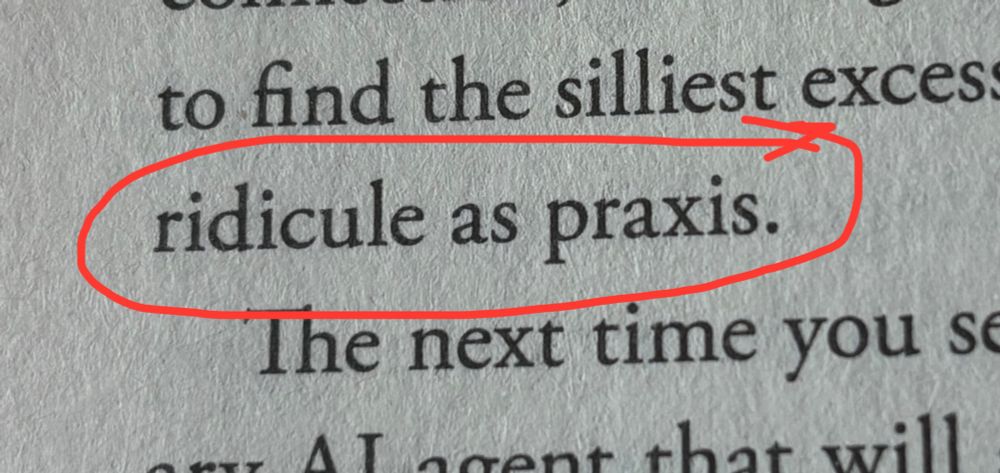
ridicule as praxis circled in book
Academic books are notorious for boring endings, but @emilymbender.bsky.social and @alexhanna.bsky.social hit it out of the park! The last chapter of #TheAICon is full of actionable (pro-labor!) steps for standing up to Big Tech's hype.
Fight silliness with silliness!
Moreover, in elite higher ed, student unions may be the first (and hopefully not only) experience the children of capitalists have to learn about labor rights. Student unions are important pedagogical praxis.
A reminder to @aaup.org faculty to be allies to your grad student worker unions! It has been devastating to see @stanford.edu "justice-oriented" aaup faculty and deans complaining about and belittling union movements on campus.
I am so excited to host a panel with @ajalvero.bsky.social at #4S2025! If you're around next Saturday, join us for discipline-blending sessions and conversation under the theme of "Writing Things Down: Textual Technologies and their Consequences." @4sweb.bsky.social
But differential performance by skin color is not something @flysfo.bsky.social should tolerate, and is one more reason to keep automatic face recognition out of public services...

To be fair, I'm not sure if this is bad or good- not being recognized may be a protective factor, especially under our current federal administration. See great work from @stanfordnlp.bsky.social researchers about
#AI surveillance systems www.nature.com/articles/s41...
So why is #TSA @flysfo.bsky.social using software that works differentially based on skin color? If the feds won't deal with it, can California's gov @gavinnewsom.bsky.social pursue this as a civil rights issue?
When it was my turn I asked the agents if they saw that software worked better on some people rather than others.
Two agents told me it tends not to work on dark skin.
Now, the failure of facial recognition on dark skin has been a known problem for YEARS as documented by @poetofcode.bsky.social.
An #AI story: While going through #TSA at @flysfo.bsky.social I noticed that the facial recognition was not working on the Black man in front of me. The agent asked him again and again to get closer.

The world is a mess. Need a laugh? Check out @ajalvero.bsky.social and my Linguistic Affordances Framework (LAF) for the social study of language technologies! Jokes aside, we hope this will help researchers make sense of social changes associated with new technologies.
doi.org/10.1177/0894...

We wrote about this at the grad/faculty level in scientific publishing. As a raciolinguistic perspective would suggest, academics find new ways to racialize language even after people use AI to "sound" like "native speakers" dl.acm.org/doi/10.1145/...
Grateful to @stanfordhai.bsky.social and @facct.bsky.social for highlighting our work!

Professor Thomas Dee analyzed attendance data from five school districts in the southern Central Valley and found a spike in daily absences this past January and February. These districts, which serve over 100,000 students, saw considerable jumps in all age groups. stanford.io/3HVr6Hb
#EduSky

"Today nearly all states that have sales taxes offer data centers exemptions on computers, wires, air-conditioning units and, in some cases, even the energy required to keep it all running." www.cnbc.com/2025/06/20/t...
thanks Shaily!!
Flattered and shocked for our paper to receive the #facct2025 best paper award.
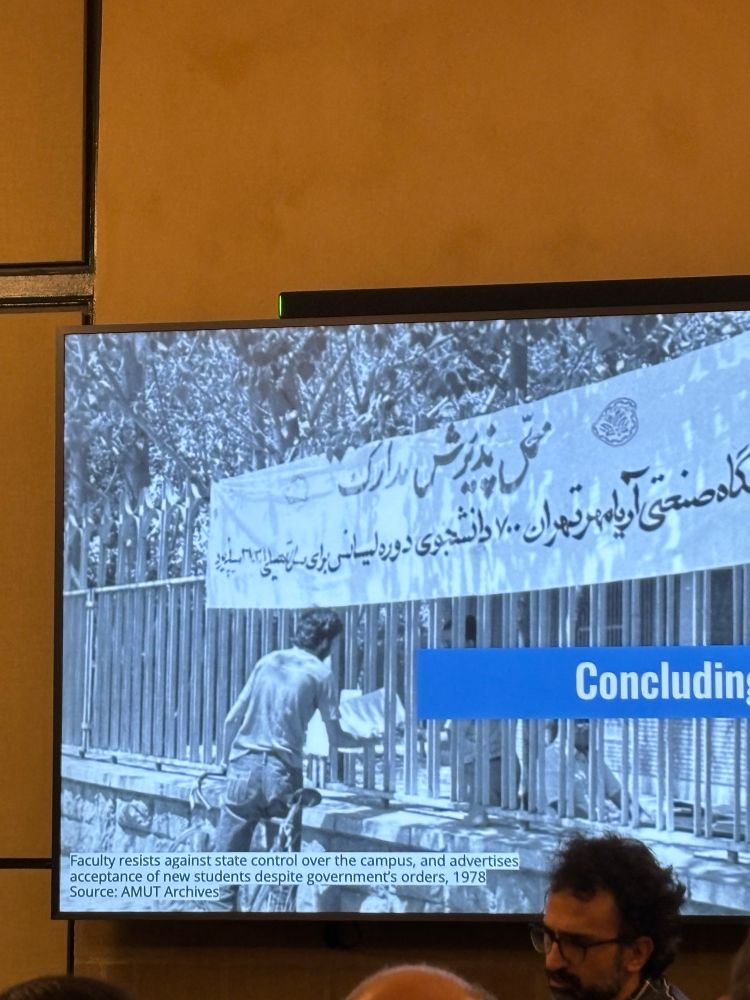
faculty resists against state control over the campus
Brilliant presentation by @sepehrvakil.bsky.social and Mahdi Ganjavi on their new @mitpress.bsky.social book about engineering activism during the Iranian revolution. They close with this picture and caption: "faculty resists against state control over the campus"
Thanks to @stanfordhai.bsky.social for supporting this project!
Our findings offer insight into the role of #ChatGPT in the reproduction of language ideologies which conflate producers of “good English" with producers of “good research." Future work should look into this effect in other writing scenarios, such as #education and #work.
Authors, aware of this development, described removing ChatGPTisms and other clues which could expose their “non-native” status to reviewers.
Though ChatGPT may mask some signs of language background, reviewers explain that they now use ChatGPT “style” and non-linguistic features as indicators of author demographics.
When we asked about their preferences for English *writing style* in scientific papers, interviewees instead indicated how they associate native English *speakers* with the quality of science described.
Descriptively analyzing almost 80k reviews, we find that for the most part, the answer is not really. Changes were subtle and mostly insignificant except in a few cases. To understand why, we interview 14 scientists from around the world.
Using the case of computer scientists submitting manuscripts to @iclr-conf.bsky.social, we ask, do scientists from countries where English is less widely spoken receive fewer writing critiques in peer reviews after ChatGPT becomes available?

Many are lauding the potential of ChatGPT to "help" people with their writing. Looking at writing not as a deficit to be fixed, but as a site of social interaction between writers *and* evaluators, our #facct2025 paper explores how this played out in a real life situation. arxiv.org/abs/2505.08127
