ccing the best of them: @hannahdaly.ie
03.12.2025 09:57
👍 2
🔁 0
💬 1
📌 0
ccing the best of them: @hannahdaly.ie
The mash-up I didn't know I needed, but which I am so grateful for!

For so many reasons.

There's a lot to do here, but one that you might not have heard about is the "Institut du Monde Arabe" (Institute of the Arab World, which has an exhibition of archaeological artifacts from Gaza: www.imarabe.org/fr/agenda/ex...
🥲🥲🥲

There, data suggest that the combustion uses of oil (i.e use outside of petchems) have already reached a plateau, and that there's limited potential for future growth. Most interestingly, on a per-capita basis, this plateau is at a much lower level than in the OECD countries.
The assumption that levels of consumption in low and middle income countries will converge with developed economies underpins the argument that oil demand growth will continue ad-nauseam. China leads us to question this assumption.

There's a big debate in energy circles about if/when demand for fossil fuels will plateau and begin a decline. What's happening in China, which accounted for 60% of the growth in oil demand in 2013-2023, is fundamental. As my @iea.org colleagues show in this commentary: www.iea.org/commentaries...
Much, much lower. The OECD, which collectively matches China's total population, used 4x as much gasoline, kerosene and gasoil as China did last year.

Photo of a fragment of a clay tablet shaped a bit like a diamond. Although it is only a fragment, the cuneiform text on it is well-preserved. There is a vertical line down the centre which indicates it once had at least two columns. The colour is reddish brown
“Do not bend your neck for that which cuts necks.”
A Sumerian proverb, as relevant today as it was thousands of years ago.
Cannot wait to read this.
"Represent" is hilarious and brilliant. "Family Business" is a nice light watch too.
A friend of mine was quite young at the time, and went around the prisons with his mother to look for his dad, who’d been taken in 1990. Eventually they were led to a mass-grave where they found his dad had been buried alive with other prisoners as a birthday tribute for Saddam.

A really devastating piece by Raya Jalabi of the @financialtimes.com on the scramble for information in Assad’s prisons. Really reminds me of Iraq in April ‘03.
Inside the Syrian prison at the heart of Assad’s police state on.ft.com/3Di4Ch7 (gift link, first click first served).

My heart goes out to all the Syrians who are out searching prisons and graves for loved ones who’ve long been disappeared by the regime. Praying they find closure and peace.
timep.org/2024/03/14/c....
Yeah but they still haven’t played anyone. And don’t have any injuries.
The @iea.org 's finest are coming through. Hello to Chief Energy Economist @timgould.bsky.social, supply modeller and analyst extraordinaire @christophemcglade.bsky.social, and the person who makes everything legible, @jethromullen.bsky.social

I spoke about all this a couple of years ago with the excellent Mina Oraibi, Editor in Chief of The National: www.thenationalnews.com/podcasts/ira...
It deprives families of being able to go through normal grieving processes. It makes very rational and empathetic people resentful over seemingly benign things. How is it possible to be envious of people who have suffered "normal" loss?
Forced disappearance is uniquely evil. It leaves scars that even murder does not. "Ambiguous loss", as it's euphemistically called, means not knowing what the final hours of your loved one were like, or even when they were. It means not having a grave to visit.

Twice a year I break my almost iron-clad commitment to not posting personal stuff.
The first is on 30 August, the International Day of the Disappeared.
The second is 19 November, the anniversary of my own father's kidnapping.
Without further action, 645 million people will still lack electricity access in 2030.

The IEA released its new numbers on energy access today. It's a mixed bag. The good news is that the # of people without electricity has fallen, following a few years of stagnation and setbacks. The bad news is that the rate of improvement is 1/10th what it needs to be. www.iea.org/commentaries...
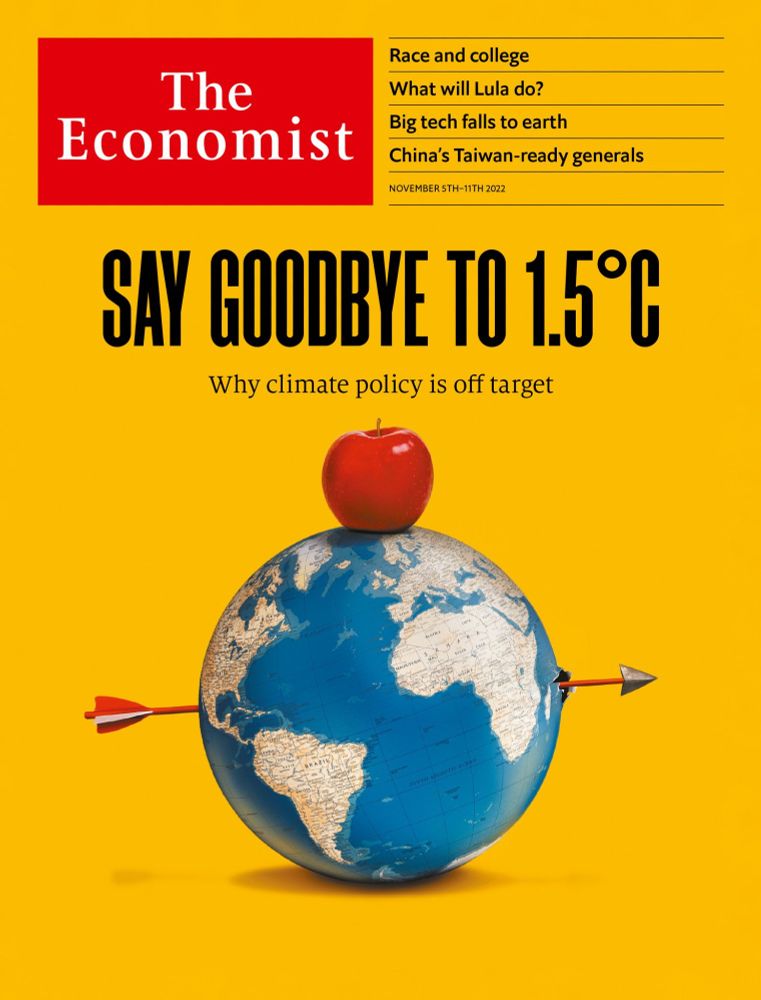
Cover from The Economist from two years ago "Say goodbye to 1.5°C; why climate policy is off target". It has a graphic of the Earth with an apple on its head, and a arrow shot through the Earth.
A gentle reminder that if we miss the 1.5°C target (and we certainly will), the next target is 1.51°C and not 2°C. We need to keep fighting.
Every tonne of CO₂ emitted makes the job of future CO₂ removal harder, and every 0.01°C of temperature increase makes the world more chaotic and dangerous.

Some fascinating reading here in Oxfam's new report on carbon inequality.
policy-practice.oxfam.org/resources/ca...

THREAD
My deep dive on @IEA #WEO24
🌄Solar up 4x by 2030, top ⚡️ source by 2033
🥇Clean energy +44% by 2030, top *energy* source by "mid-30s"
🛢️EVs displace 6mb/d by 2030 (⏫4mb/d last yr)
⛰️Fossil fuels peak by 2030
🌡️Warming 2.4C(🔽 2.6C 2021 ⏬ 3.5C 2015)
www.carbonbrief.org/...
1/13
We cannot afford a bifurcated transition. Left unchecked emissions from existing coal-fired capacity alone would be enough to push the world across the 1.5 °C threshold
The bad news is that what transition is happening is currently horribly skewed. Advanced economies and China accounted for more than four out of every five dollars
invested in clean energy since the Paris Agreement was signed.