It was a real privilege to be invited to present on treatment-resistance in anxiety disorders at the Psychiatry Masterclass 2025 at the Conrad Dubai. Many thanks to the organising and scientific committees for inviting me!
It was great to be there with such excellent speakers!
07.11.2025 07:01
👍 1
🔁 0
💬 0
📌 0
Excellent @liviaasan.bsky.social, well done!
25.10.2025 15:04
👍 1
🔁 0
💬 0
📌 0

Our new Insights article out now in European Neuropsychopharmacology
We argue that poor control conditions in digital therapeutics trials risk misleading efficacy claims.
Let’s raise the bar for DTx trial design.
🔗 authors.elsevier.com/a/1l-8p,L21E...
@ecnp.eu
#DTx #MentalHealth #ClinicalTrials
25.10.2025 14:55
👍 4
🔁 2
💬 0
📌 0


14.10.2025 14:09
👍 0
🔁 0
💬 0
📌 0
It was great to present on placebo and nocebo effects in depressive and anxiety disorders in an educational update session at the ECNP Congress. Many thanks to the educational committee for inviting me! @ecnp.eu
14.10.2025 14:09
👍 1
🔁 0
💬 1
📌 0
Webinar: Nathan Huneke - Toward improved understanding of placebo effects in psychiatric disorders
YouTube video by SFB-TRR 289 "Treatment Expectation"
🎥 Two new #SFB289 #webinars are uploaded on our YouTube channel! 🎥
In September 2025, @nathanhuneke.bsky.social presented his work on placebo effects in psychiatric disorders: youtu.be/Z1pyhXSV5RE
08.10.2025 10:29
👍 2
🔁 1
💬 1
📌 0
Great to collaborate on this with @hvansteenbergen.bsky.social! We found evidence that endogenous opioids mediate attentional broadening after receiving rewards.
02.10.2025 18:27
👍 0
🔁 0
💬 0
📌 0
Really enjoyed the opportunity to present at the SFB289 webinar!
03.09.2025 20:07
👍 3
🔁 1
💬 1
📌 0
Great to be part of this
22.08.2025 15:39
👍 2
🔁 0
💬 0
📌 0
Timely article!
28.05.2025 03:40
👍 3
🔁 1
💬 1
📌 0
Very important initiative!
11.04.2025 09:35
👍 2
🔁 1
💬 0
📌 0

Expectancy Effects, Blinding Integrity, and Placebo Response in Psychiatric Disorders
This narrative review discusses the impact of expectancy effects and functional unblinding on treatment responses in randomized clinical trials of treatments in psychiatry.
Our new review in JAMA Psychiatry: "Expectancy Effects, Failure of Blinding Integrity, and Placebo Response in Trials of Treatments for Psychiatric Disorders"
jamanetwork.com/journals/jam...
Thanks to co-first author Guil Fusetto-Veronesi; and to Samuele Cortese, David Baldwin, Matt Garner
🧵👇
12.03.2025 17:00
👍 4
🔁 4
💬 2
📌 0

Placebo Effects Are Small on Average in the 7.5% CO2 Inhalational Model of Generalized Anxiety
AbstractBackground. Anxiety disorders are highly prevalent and socio-economically costly. Novel pharmacological treatments for these disorders are needed b
3. We should develop readouts that are resistant to expectation effects (e.g. psychophysics, network connectivity). Experimental medicine models appear resistant to expectation effects, & could be used to develop such readouts academic.oup.com/ijnp/article... journals.sagepub.com/doi/abs/10.1...
12.03.2025 17:00
👍 1
🔁 0
💬 1
📌 0
2. Statistical methods to 'account for' or 'correct for' expectation effects in RCTs exist but need testing and validating. Gathering data as in recommendation 1 would allow us to do this.
12.03.2025 17:00
👍 0
🔁 0
💬 1
📌 0
We make the following recommendations:
1. We should systematically record blinding integrity for patients and for clinician raters, and if it fails, why. This would allow us to explore the above question.
12.03.2025 17:00
👍 0
🔁 0
💬 1
📌 0
If blinding fails in active arms in RCTs w/ larger drug-placebo separation, that might be OK, as an effective treatment might unblinds patients/raters. BUT, if blinding failure in placebo arms drives the difference (maybe through 'disappointment'/'know'-cebo/'lessebo') then that would be a concern.
12.03.2025 17:00
👍 0
🔁 0
💬 1
📌 0
i.e. higher expectations = higher treatment efficacy. Treatment effects are larger in open-label trials compared with the same treatment given double-blind. Despite this, effect of functional unblinding on estimates of efficacy has been little explored, partly due to lack of data
12.03.2025 17:00
👍 0
🔁 0
💬 1
📌 0

'Response to treatment' results from 3 broad effects: non-specific effects, placebo-specific effects (expectations, associative learning, maybe unblinding effects...), and the improvement specifically attributable to the treatment itself. These effects appear to be additive:
12.03.2025 17:00
👍 0
🔁 0
💬 1
📌 0
In this narrative review we discuss how expectancy effects and functional unblinding can impact treatment and placebo responses in RCT's treatments in psychiatry.
We finish with recommendations for the field. Here is a summary:
12.03.2025 17:00
👍 0
🔁 0
💬 1
📌 0
Expectancy Effects, Blinding Integrity, and Placebo Response in Psychiatric Disorders
This narrative review discusses the impact of expectancy effects and functional unblinding on treatment responses in randomized clinical trials of treatments in psychiatry.
Our new review in JAMA Psychiatry: "Expectancy Effects, Failure of Blinding Integrity, and Placebo Response in Trials of Treatments for Psychiatric Disorders"
jamanetwork.com/journals/jam...
Thanks to co-first author Guil Fusetto-Veronesi; and to Samuele Cortese, David Baldwin, Matt Garner
🧵👇
12.03.2025 17:00
👍 4
🔁 4
💬 2
📌 0

🧠 Help Us Understand Pain Perception in FND! 🧠
Looking for volunteers with & without #FND for a study in London @kingsioppn.bsky.social. Single lab visit testing pain perception with electrical stimulation.
Interested? Please message me: Livia.Asan@kcl.ac.uk ✉️
Thanks for sharing!
07.03.2025 14:13
👍 12
🔁 9
💬 2
📌 3
Of course!
11.03.2025 18:33
👍 1
🔁 0
💬 0
📌 0
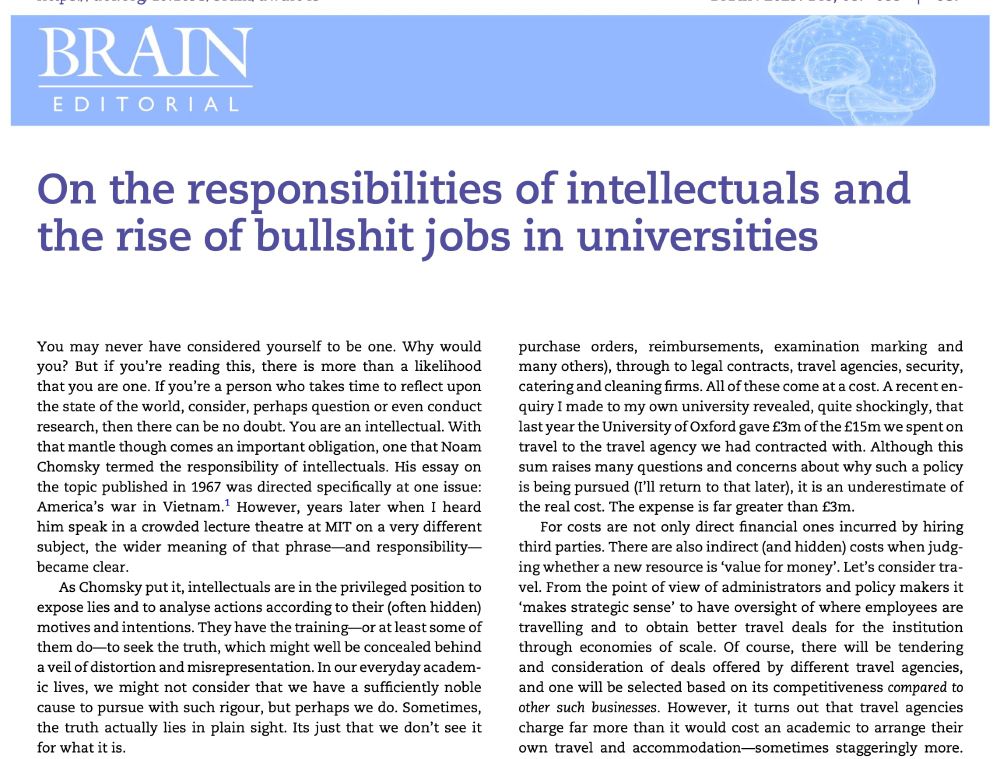
Why academia is sleepwalking into self-destruction. My editorial @brain1878.bsky.social If you agree with the sentiments please repost. It's important for all our sakes to stop the madness
academic.oup.com/brain/articl...
06.03.2025 19:15
👍 540
🔁 310
💬 51
📌 104