Nicole! Yes please! You’re welcome anytime ❤️
07.03.2026 16:21
👍 2
🔁 0
💬 1
📌 0
Nicole! Yes please! You’re welcome anytime ❤️

In this amazing multidisciplinary collaboration, we report our early experience with the @openclaw-x.bsky.social ->
Timeline cleans with snowflake-sized baby lagoon jellyfish.
.
🎥 jelliesfarm www.instagram.com/jelliesfarm?...

Diagram of field LED perturbations of fireflies, showing entrainment patterns and a phase response curve linking phase delay/advance to relative timing.
✨ New preprint from the lab on firefly synchronization, led by Owen Martin (freshly Dr. Martin!), with Nataliya Nechyporenko and Kaushik Jayaram.
Our measured firefly phase-response curves reveal excitatory and inhibitory timing rules that facilitate population synchrony ✨
doi.org/10.64898/202...

⏰ Deadline extension for #EESBioOsc ⏰
You now have until 14 January to submit your abstract for the EMBO | EMBL Symposium 'Biological oscillators: rhythms and synchronisation across scales'! 👉 s.embl.org/ees26-04-bl
Have you ever wondered what you would find if you could keep your eyes on a bee for more than a few meters? Us, too!
preprint (with videos!) + thread 🧵
Precise, individualized foraging flights in honey #bees 🐝 revealed by multicopter drone-based tracking
www.biorxiv.org/content/10.6...
1/9

Event flyer for ‘The Language of Light: Bioluminescence in the Deep Sea.’ Details: Friday, Nov 14, 4:00 to 5:30 pm, Benson Earth Sciences Auditorium, Room 180. Speaker: Sönke Johnsen, Owens Distinguished Professor, Duke University. Reception 5:30 to 6:30 pm at the Earth Sciences & Map Library. Free, open to the public
Boulder friends: if you’re into animal behavior or vision, come to The Language of Light: Bioluminescence in the Deep Sea with Sönke Johnsen (Duke)!
Fri Nov 14, 4-5:30 pm, Benson Earth Sciences Auditorium, Room 180. Reception 5:30-6:30 at the Earth Sciences & Map Library
Free and open to all!
Event flyer for ‘The Language of Light: Bioluminescence in the Deep Sea.’ Details: Friday, Nov 14, 4:00 to 5:30 pm, Benson Earth Sciences Auditorium, Room 180. Speaker: Sönke Johnsen, Owens Distinguished Professor, Duke University. Reception 5:30 to 6:30 pm at the Earth Sciences & Map Library. Free, open to the public
Boulder friends: if you’re into animal behavior or vision, come to The Language of Light: Bioluminescence in the Deep Sea with Sönke Johnsen (Duke)!
Fri Nov 14, 4-5:30 pm, Benson Earth Sciences Auditorium, Room 180. Reception 5:30-6:30 at the Earth Sciences & Map Library
Free and open to all!

I'm really looking forward to hosting this @metagov.bsky.social seminar on the governance of bees, fireflies, and plants with my colleage @oritpeleg.bsky.social: luma.com/pzbp4zq1

#NetSI 's first-year PhD student Chethan Kavaraganahalli Prasanna co-authored a study with Univ. of Colorado Boulder featured in the NYT and published in PLOS Biology (shorturl.at/iHeXb)!
www.nytimes.com/2025/08/26/s...

How do #honeybees adapt their comb-building to different spatial constraints? A new study from @oritpeleg.bsky.social &co uses 3D printed panels and X-ray microscopy to reveal the existence of three distinct construction modes, from tilting cells to building complex 3D structures.🧪
plos.io/4n1g6Hs
Can it please be a quilt?

Close-up of experimental honeycombs built after a challenging 3D printed setup, showing mostly hexagonal cells.
New paper in PLOS Biology: as we raise the difficulty of our 3D printed puzzles, bees keep landing on combs with ever stranger hexagonal order! 🐝
Led by the brilliant Golnar Gharooni Fard, in collaboration with CK Prasanna & FL Jiménez
journals.plos.org/plosbiology/...
❤️🙏
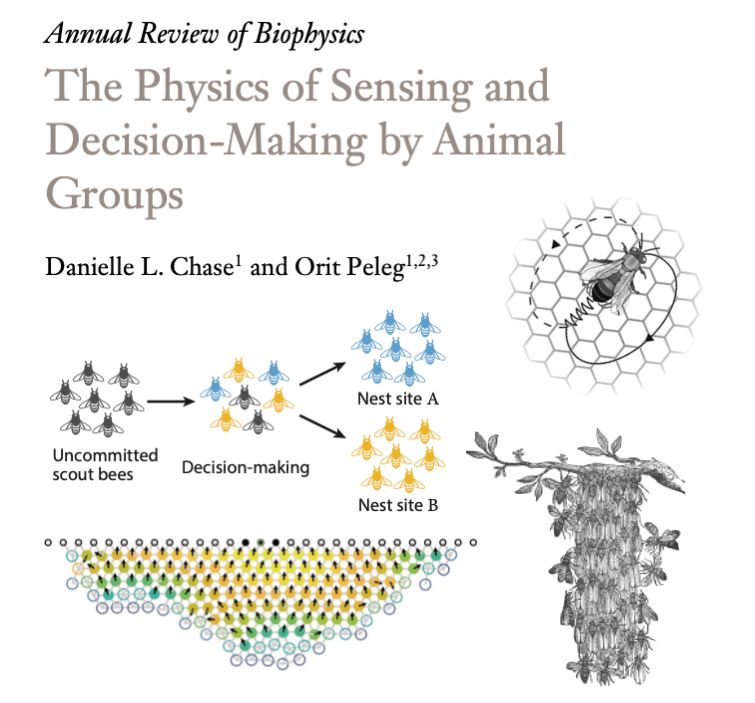
Title page of the review article 'The Physics of Sensing and Decision-Making by Animal Groups' by Danielle L. Chase and Orit Peleg in Annual Review of Biophysics. Includes illustrations of collective behavior in honeybees: a diagram showing uncommitted scout bees transitioning through decision-making to choose between two nest sites; a honeybee on a honeycomb cell; a cluster of bees hanging from a branch; and a schematic of bees forming a layered cluster.
More on collective behavior: Our new Annual Review of Biophysics piece - with the stellar Danielle Chase - explores how animals sense, share information, and make group decisions. In honeybees and beyond 🐝
www.annualreviews.org/content/jour...

It was an honor to write this, but also great fun. A chance to look back at the classics, and think about the path forward. #Physics is a beautiful human endeavor. journals.aps.org/prxlife/abst...
Love this example! The seabird rhythms are a great case of synchronised clocks in the wild. Coupled oscillator entrainment is a whole rabbit hole of its own... A handy overview is here: royalsocietypublishing.org/doi/10.1098/...
We didn’t forget the tangled worms! They make an appearance in our Annual Review of Biophysics piece (with another stellar postdoc, Danielle Chase), where we discuss how blackworms weave themselves into living soft matter and the resilience that brings:
www.annualreviews.org/content/jour...
❤️🪱
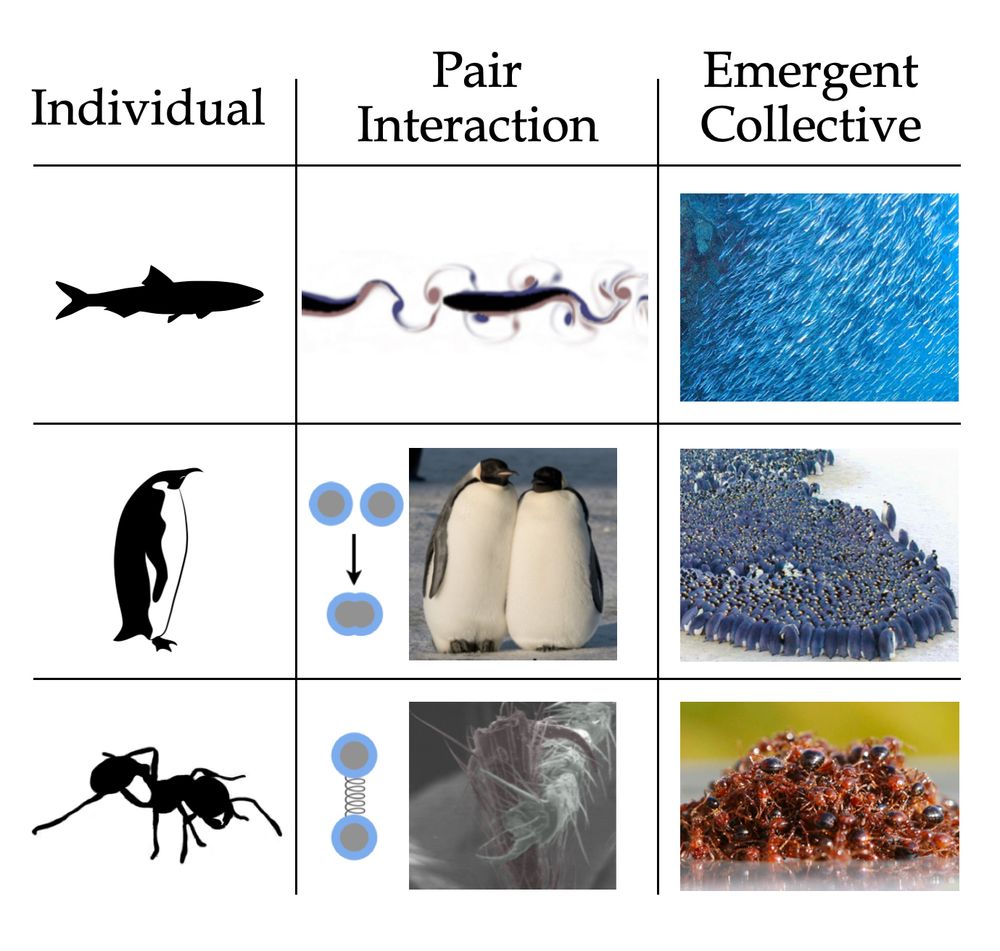
Three‑row table linking scales: fish, penguin, ant. Each row shows an individual silhouette, a pair‑level interaction image, and the emergent collective - schooling fish, penguin huddle, and an ant raft.
New review in PRX Life, where we propose a tangibility scale for the physics of social interactions, and highlight a few tangible examples - from dead fish “swimming” to efficient schooling, warm penguin huddles, and dry ant rafts.
Written with the brilliant Chantal Nguyen 🐟🐧🐜
tinyurl.com/naet5tdh

Fireflies are still generally declining, & light pollution is one big reason why, but a few species are also carrying on in places that are bathed in artificial light. Which is pretty wild!
Featuring Sriram Murali's excellent photography! 🧪
www.nationalgeographic.com/animals/arti...
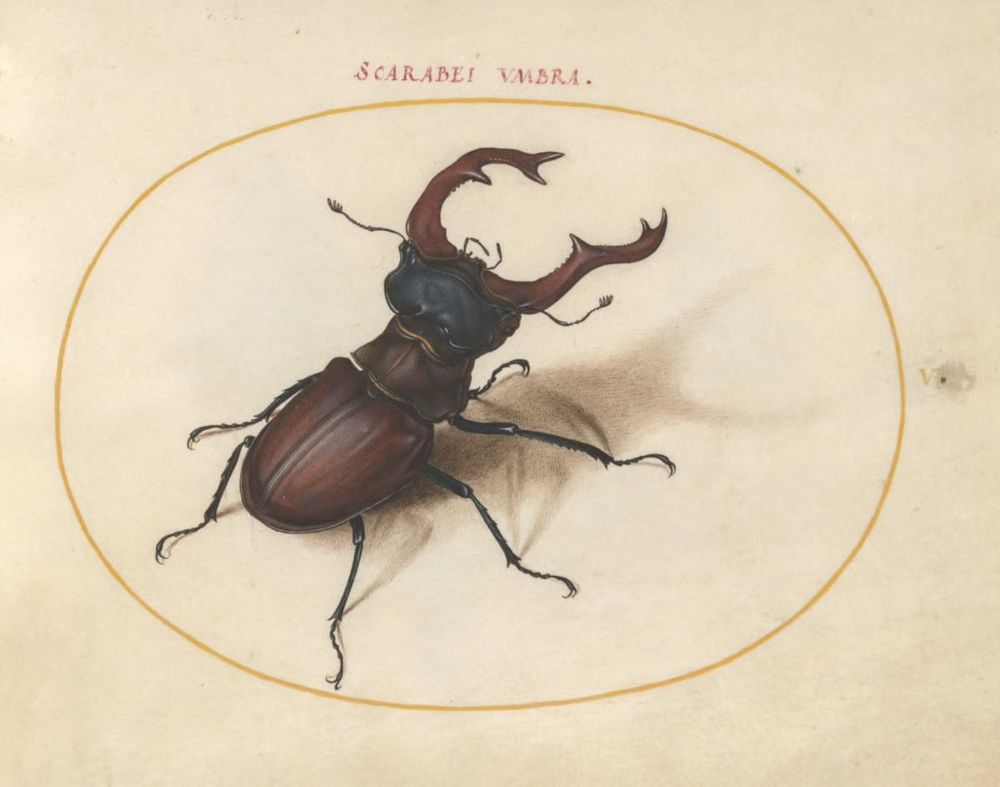
Nearly a century before the invention of the microscope and even longer before entomology became a field of research, Joris Hoefnagel (1542-1600) devoted himself to studying the natural world. He's thought to have created the first compendium of its kind.
🙏❤️
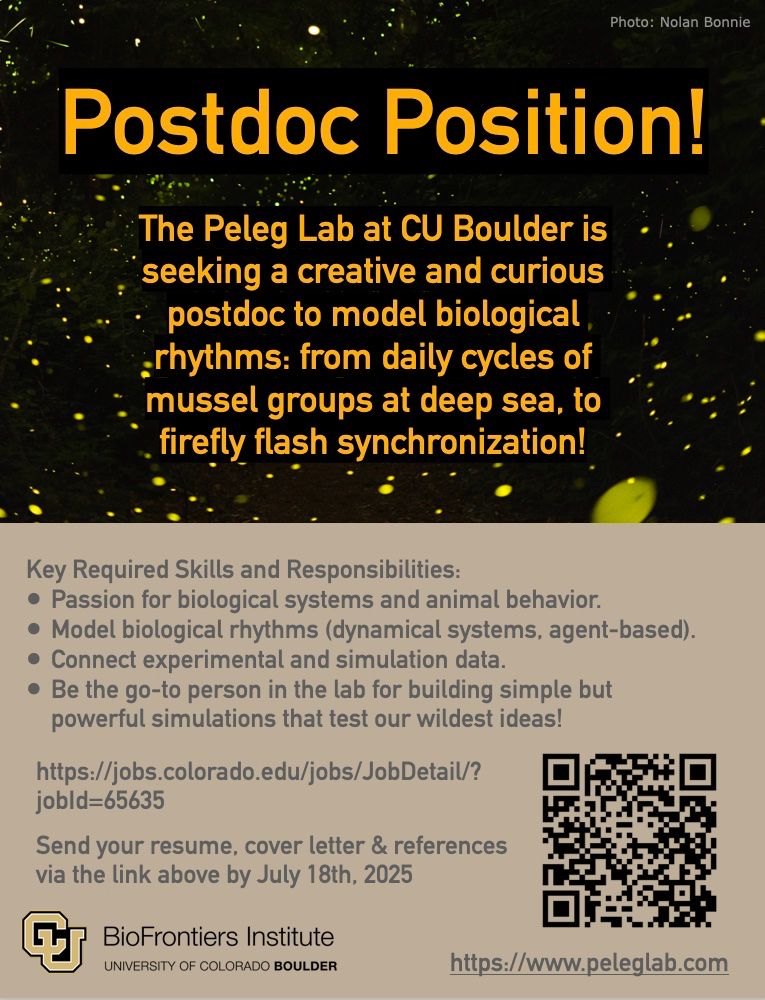
📣 We're on the lookout for a creative postdoc with strong computational skills!
Be the go-to person in the lab for building simple but powerful simulations that test wild ideas on biological rythems: from daily cycles of mussel groups at deep sea, to firefly flash synchronization!
More info below👇
🤩
Thank you so much!
Awesome, thank you!
The longer the better, but even just a few nights would be great 🙏
Whoohoo! Thank you @devonianstone.bsky.social
🙏
Help us record firefly flashes! 👇🙏

