Two and a half exciting updates to my hydroinformatics book (or: data science and hydrology?)
1. The materials all use the updated USGS dataRetrieval package now, yay!
Www.hydroinformaticsbook.com
More below
16.02.2026 19:27
👍 7
🔁 2
💬 1
📌 0

Pb concentration by decade in hair from Salt Lake City region residents. Value plotted for 1940 includes all samples from 1916 to 1959; value plotted at 2022 includes all samples from 2020 to 2024.
Lead (Pb) in archived hair in Salt Lake City.
"Lead (Pb) in archived hair documents a decline in lead exposure to humans since the establishment of the US Environmental Protection Agency "
www.pnas.org/doi/10.1073/...
02.02.2026 23:22
👍 95
🔁 43
💬 2
📌 7

Fig. 1 caption from the paper: "Figure 1. Comparison of two sampling methods: A, three emergence traps located on the pond and one emergence trap located on the creek; and B, workflow of exuviae collection. Diagram created in BioRender (https://BioRender.com/b21n111) by S. Dworatzek."

Fig 2 caption from the paper: "Figure 2. Differences in operational taxonomic unit richness across sample types: A, box plots of operational taxonomic unit richness for each of the six samples, with average operational taxonomic unit richness indicated above each box plot and significant differences indicated by *; B, average overall operational taxonomic unit richness for emergence and exuviae pond samples, with error bars representing the standard error; and C, Venn diagram representing the number of unique and overlapping operational taxonomic units for each location and sampling type."

Fig 3 caption: "Figure 3. Tree map representing the species richness of arthropod taxonomic orders and families in each sample type: A, emergence trap samples; and B, exuviae samples. Insecta is shown on the left; Arachnida is shown on the right; orders are separated by colour; families are separated by label. The size of each box corresponds to the relative number of operational taxonomic units per group."
When aquatic insects emerge, they leave their moulted exoskeletons behind. Why not collect those and sequence the residual DNA to see who was living in the water?
Cool new paper (Open Access) by Dworatzek et al. 🔗: www.cambridge.org/core/journal...
🪲🪳🧪🌎
23.12.2025 17:01
👍 20
🔁 5
💬 0
📌 1

Love aquatic research, teaching, and outreach? Want to join us at our terrific field station and live on Yellow Bay, Montana? University of Montana seeks a new Director for Flathead Lake Biological Station. Position details here: apply.interfolio.com/178916
12.12.2025 21:00
👍 38
🔁 30
💬 0
📌 2
PNAS
Proceedings of the National Academy of Sciences (PNAS), a peer reviewed journal of the National Academy of Sciences (NAS) - an authoritative source of high-impact, original research that broadly spans...
Why has woody plant density been increasing in dryland ecosystems? In a new paper in @pnas.org we show that increasing tree density in pinyon-juniper woodlands could largely be a result of long-term population growth, rather than recent anthropogenic effects. www.pnas.org/doi/10.1073/...
01.05.2025 15:23
👍 46
🔁 15
💬 4
📌 1
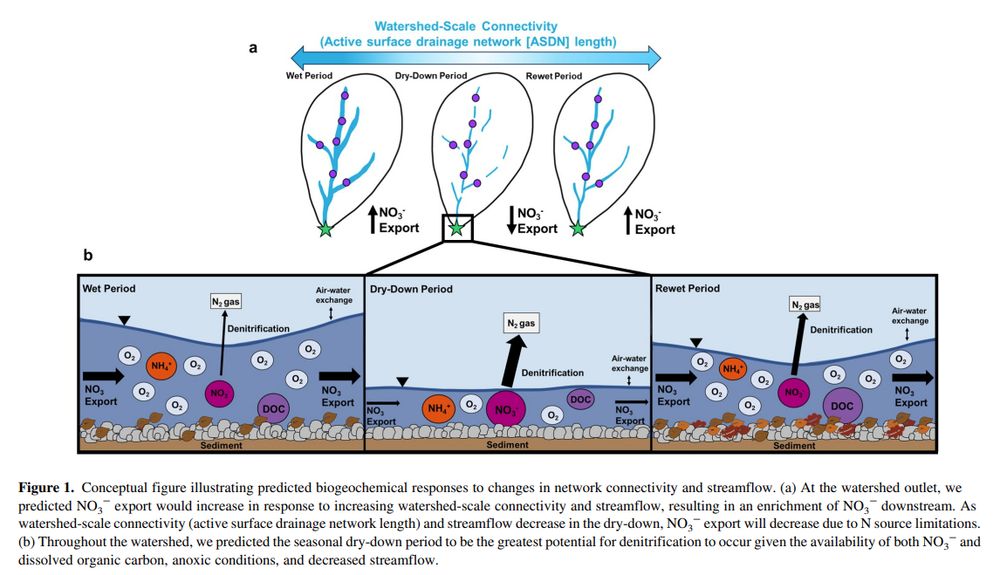
Conceptual figure illustrating predicted biogeochemical responses to changes in network connectivity and streamflow. (a) At the watershed outlet, we predicted NO3− export would increase in response to increasing watershed‐scale connectivity and streamflow, resulting in an enrichment of NO3− downstream. As watershed‐scale connectivity (active surface drainage network length) and streamflow decrease in the dry‐down, NO3− export will decrease due to N source limitations. (b) Throughout the watershed, we predicted the seasonal dry‐down period to be the greatest potential for denitrification to occur given the availability of both NO3− and dissolved organic carbon, anoxic conditions, and decreased streamflow.
Big CONGRATS to @kacizarek.bsky.social!!! Her new paper is out in @agu.org's JGR-B!
The paper has a little bit of everything -- N biogeochemistry, intermittent stream hydrology, concentration-connectivity relationships!
Check it out here: agupubs.onlinelibrary.wiley.com/doi/full/10....
27.03.2025 13:00
👍 42
🔁 12
💬 3
📌 4

EPA Outreach on HABs | US EPA
Information related to the EPA Outreach on HABs
#USEPA Benthic HABs Discussion Group Meeting, March 17, 9-11 am Pacific. Virtual, all welcome. Great talks from California Waterboards, Maryland Dept. of Natural Resources and @joannablaszczak.bsky.social Univ. Nevada Reno.
Subscribe and info: www.epa.gov/habs/epa-out...
22.02.2025 07:08
👍 6
🔁 4
💬 0
📌 1

I'm hiring, two fully funded PhD positions! Come work in Umeå in Arctic Sweden, a leading place for high-latitude ecosystem ecology and carbon biogeochemistry
14.01.2025 14:42
👍 92
🔁 79
💬 2
📌 3

Advertisement for 2025 SFS Special Session: Uncovering the drivers and consequences of benthic harmful cyanobacterial blooms in freshwater ecosystems
If you're interested in benthic harmful cyanobacterial blooms and attending the 2025 Society for Freshwater Science meeting please join our special session "Uncovering the drivers and consequences of benthic harmful cyanobacterial blooms in freshwater ecosystems"!
07.01.2025 23:19
👍 19
🔁 10
💬 0
📌 0
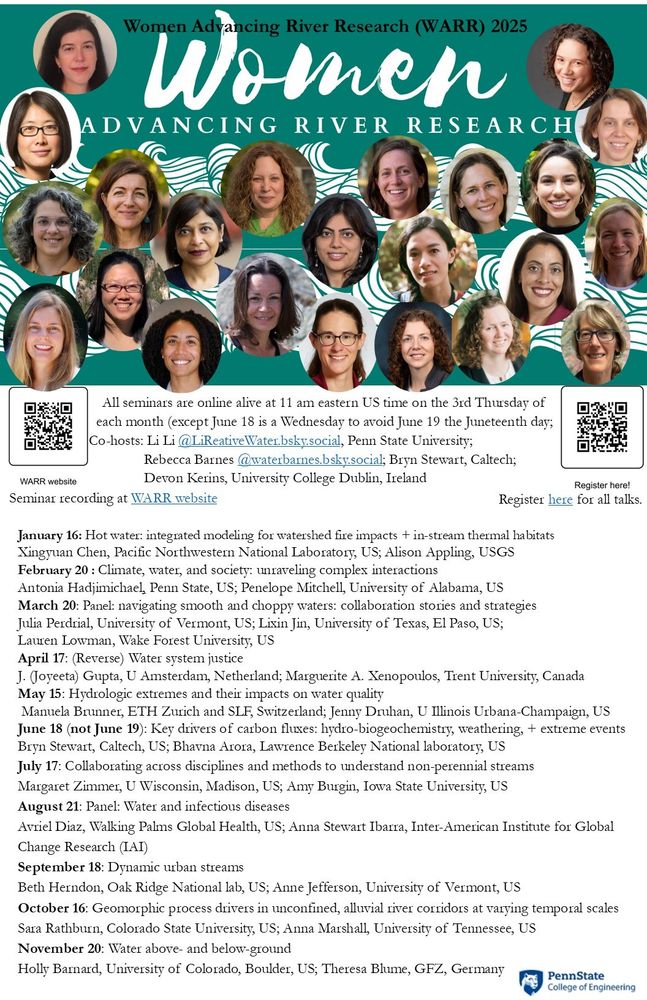
Happy new year!
Thrilled to announce Women Advancing River Research (WARR) 2025, featuring inspiring women on water research from around the world.
11 am, US eastern, 3rd Thursday every month.
Register: psu.zoom.us/meeting/regi...
Recordings 2021- 2024: www.cee.psu.edu/events/women...
03.01.2025 14:53
👍 63
🔁 41
💬 0
📌 5

Matt Church and I are hiring 2 Postdoctoral Associates in oceanographic biogeochemistry and modeling. Project info: tinyurl.com/3vbcnx8j Job and application info: tinyurl.com/4pahvet8. Send me any questions. #FLBSUM
24.11.2024 19:21
👍 17
🔁 19
💬 0
📌 0
Here's a Limnology starter pack! I am sure I left great people out so tag me so I can add them. go.bsky.app/Qv3DLZ6
22.11.2024 18:37
👍 61
🔁 34
💬 32
📌 2

Look forward to our last #WARR talk in 2024!
Drs. Erin Hotchkiss @FluvialBenthos + Joanna Blaszczak
@jrblasz will talk about temporal variation in river ecosystem productivity + respiration, and their recovery under flooding disturbances
Register here: psu.zoom.us/meeting/regi...
12.11.2024 02:55
👍 18
🔁 8
💬 0
📌 2
Left the other place run by Trump's buddy? Here's a starter pack of freshwater scientists to get you started. Also, if you're a freshwater scientist and want to be added, let me know. Still space available.
go.bsky.app/K5ubDhb
11.11.2024 00:24
👍 196
🔁 76
💬 73
📌 8

Biogeofeminists starter pack image with 7 little circles of the over 130 Bluesky accounts included
Starter pack of biogeofeminists (I have missed many if not most - pls add yourself below & I can update 🩵💜 go.bsky.app/784EKsF
10.11.2024 22:47
👍 62
🔁 34
💬 29
📌 0
Me too please!
12.11.2024 16:36
👍 1
🔁 0
💬 1
📌 0

Ecology/Evolution/Marine Biology labs recruiting for Fall 2025 (Responses)
Here is a list of labs in #ecology and #evolution who are recruiting graduate students for next year: docs.google.com/spreadsheets...
PIs looking to recruit can enter information here: t.co/Fn1LRAA5Ip
I believe this list is thanks to @drcarl.bsky.social
#evosky #ecoevo #evolbio #AcademicJobs
11.11.2024 22:52
👍 94
🔁 94
💬 3
📌 1

UM Bio Station, Native Tribe Study Toxic Cyanobacteria in Rivers
New work by Laurel Genzoli is helping us understand where and why cyanotoxins occur across river networks: www.umt.edu/news/2024/10...
02.10.2024 19:02
👍 4
🔁 0
💬 0
📌 0

Alabama Alaska Arkansas Deleware Guam Hawaii Iowa Idaho Kansas Kentucky Louisiana Maine Mississippi Montana Nebraska New Hampshire New Mexico North Dakota Nevada Oklahoma Puerto Rico Rhode Island South Carolina South Dakota US Virgin Islands Vermont West Virginia Wyoming
A new program from NSF is targeting graduate fellowship money to people who received Honorable Mention on a GRFP within the past three years, who are currently enrolled in grad school in EPSCoR states.
here is the solicitation: new.nsf.gov/funding/oppo...
and a map of EPSCoR eligible states:
08.07.2024 20:06
👍 130
🔁 124
💬 2
📌 4

Announcement of "The Society for Freshwater Science 2024 SFS Fellows" with the SFS logo in the upper right corner.
The announcement:
"2024 SFS Fellow
"Dr. Robert Hall
"Flathead Lake Biological Station
"University of Montana"
On the right of the announcement is a photo of Dr. Hall.
Congratulations to one of two new Society for Freshwater Science Fellows elected in 2024: Dr. Robert (Bob) O. Hall, Jr.! freshwater-science.org/2024-sfs-fel...
SFS Fellows are honored for sustained excellence in contributions to freshwater science. We look forward to celebrating you at #2024SFS!💧🌎🧪
30.04.2024 15:00
👍 15
🔁 4
💬 0
📌 0

View of Lake Tahoe at sunset
@jblaszczak.bsky.social and I are recruiting a postdoc in quantitative ecology to model the population and community dynamics of benthic algal communities. Come join us in the beautiful eastern Sierra and Great Basin! Please share! More details here: nshe.wd1.myworkdayjobs.com/UNR-external...
15.04.2024 15:21
👍 15
🔁 14
💬 0
📌 0

Predictors of maximum algal accrual rates. Wider, more frequently disturbed rivers recover faster. Upstream dams suppress recovery rates.
Heili Lowman is not on Bluesky so I want to share our new publication with @bkshriver.bsky.social, Bob Hall, Jud Harvey, Phil Savoy, & Charles Yackulic on macroscale controls on river resilience to flood disturbances out today in PNAS! Yay Heili!
Check it out here: www.pnas.org/doi/10.1073/...
25.01.2024 00:14
👍 25
🔁 11
💬 0
📌 1


We're recruiting a new full-time technician to join the lab ahead of summer 2024! The position involves both field and lab work focused on uncovering controls on benthic cyanotoxin production in rivers. Please share with potential candidates! More info: blaszczaklab.weebly.com/current-open...
20.12.2023 16:36
👍 12
🔁 7
💬 0
📌 0
Looking for a postdoc in coupled biogeochemistry? Come find me at AGU!
08.12.2023 19:20
👍 8
🔁 6
💬 0
📌 0
https://doi.org/10.1002/wat2.1702
Wiley Online Library requires cookies for authentication and use of other site features; therefore, cookies must be enabled to browse the site. Detailed information on how Wiley uses cookies can be fo...
“Catchment concentration–discharge relationships across temporal scales: A review” - A 2020-initiated labor of love 💙Led by Shannon Spier & Lucy Rose, with contributions from Shogren Lab student Michelle Wilford!
08.12.2023 15:01
👍 14
🔁 8
💬 0
📌 1
I have multiple funded positions for MS or PhD students working on data science and hydrology. To apply, send a cover letter, resume/c.v., and contact info for 3 references to jhosen at purdue.edu. For more information go to jakehosen.github.io/DataScienceE... or contact me.
01.12.2023 20:17
👍 14
🔁 17
💬 0
📌 0