So when do authors preprint? Many do long before they submit to a journal (to get feedback to improve the work?); many submit around the same time (just want the work out?). Only a minority are submitting once the paper is under review [evidence against claims by some detractors]. 3/n
26.02.2026 16:08
👍 27
🔁 15
💬 3
📌 2

Apply to become a Preprint Editor
Development
We are inviting experienced researchers to apply to become Preprint Editors, a new type of editorial role responsible for handling our 'In preprints' articles and forging links with preprint literature. #prepints
Learn more and apply before 30 March 2026:
journals.biologists.com/dev/pages/pr...
02.03.2026 14:55
👍 12
🔁 16
💬 0
📌 1
What are fairer ways to judge research without relying on flawed proxies like journal brand or impact factor?Leonardo points to NIH-style grant application panel discussions as a model. Could scientific societies adopt a similar approach to review articles or evaluate preprints? 6/6
25.11.2025 23:32
👍 0
🔁 0
💬 0
📌 0
Peers evaluation remains a cornerstone of scientific research. But the current format of peer-review is ungrateful and opaque. Leonardo's approach to peer-review is straightforward: does the author's data match their claims? If not, it is up to them to change their claims or generate more data. 5/6
25.11.2025 23:32
👍 0
🔁 0
💬 1
📌 0
One disadvantage is in case of patent applications, where public disclosure needs to be carefully times. For career progression in academia, preprints seem to be taken into account, although university policies regarding their consideration for hiring and promoting faculty are often unclear. 4/6
25.11.2025 23:32
👍 0
🔁 0
💬 1
📌 0
The advantages of preprints are overwhelming: opportunity for rapid & free sharing, getting feedback from the community, proof of productivity in grant applications and for trainees to apply to grants and jobs, and generally a great way to network and generate enthusiasm around our science. 3/6
25.11.2025 23:32
👍 2
🔁 0
💬 1
📌 0
For fields where it's become common, such as SynBio, preprinting has become a "no brainer". Preprints are becoming the currency in the field, and the line between pre- and post-peer-review is blurring. Some researchers still resist, for unclear reasons. So what are the advantages of preprints? 2/6
25.11.2025 23:32
👍 0
🔁 0
💬 1
📌 0
How are preprints perceived and evaluated in the life sciences from a PI's perspective? Check our my podcast episode through the @asapbio.bsky.social Fellow's program, where I interviewed @leonardomorsut.bsky.social about his perspective on the topic! My key takeaways: 1/6
25.11.2025 23:32
👍 4
🔁 2
💬 1
📌 0

The Drain of Scientific Publishing
The domination of scientific publishing in the Global North by major commercial publishers is harmful to science. We need the most powerful members of the research community, funders, governments and ...
The Drain of Scientific Publishing details very clearly how for-profit publishers making >30% profit margins have corrupted any solution the research community has attempted.
Let's cut ourselves free.
Drain: arxiv.org/abs/2511.04820
Strain: bit.ly/StrainQSS
Oligopoly: bit.ly/OligSciPub
12/12
11.11.2025 11:52
👍 48
🔁 20
💬 2
📌 1

20251024 Swedlund Benjamin - Reimagining Scientific Evaluation.pptx
Roundtable Discussion: Reimagining Scientific Evaluation Benjamin Swedlund | ASAPbio Fellow 2025
This will be challenging and will require advocacy and persistence, but I believe it is necessary to maintain public trust in science – because we steward taxpayer’s money, and we have a responsibility to use it wisely. 5/5
My slides, feel free to check out or reuse: docs.google.com/presentation...
27.10.2025 17:47
👍 1
🔁 0
💬 0
📌 0

Change is on the horizon thanks to initiatives such as preprints and open peer-review. But scientists need to embrace this change and move beyond the status quo of an outdated system. 4/5
27.10.2025 17:47
👍 1
🔁 0
💬 1
📌 0

Is it working? Not really - the current system struggles to root out scientific fraud in the form of paper mills or questionable research practices. It also lacks transparency in peer-review and editorial decisions. Most people agree that publishers generous profit margins (>35%) are unfair. 3/5
27.10.2025 17:47
👍 1
🔁 0
💬 1
📌 0

How do we do science? When and how are we evaluated as scientists? The enthusiasm in the room was palpable - this is a subjects scientists of all career stages deeply care about. I first introduced the endless cycle of "getting money-doing stuff" that characterises an researcher's career. 2/5
27.10.2025 17:47
👍 1
🔁 0
💬 1
📌 0
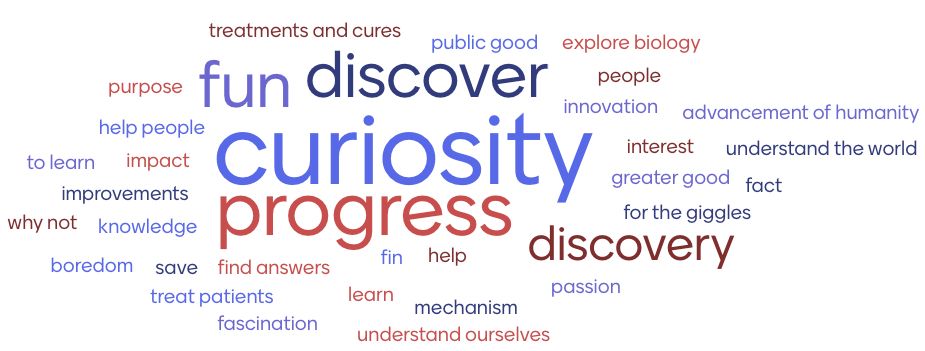
Why do we do science?
This was my opener for a department roundtable “Reimagining Scientific Evaluation: Are we judging a book by its cover?”, inspired by @asapbio.bsky.social’s Fellows program. Now more than ever, we should strive for an academic culture that’s transparent, efficient, and fair. 1/5
27.10.2025 17:47
👍 1
🔁 0
💬 1
📌 0

Epithelial Mechanics Fan Club
🎉🎉 We finally have a website! 🎉🎉
Did you miss a thread?
Want to know who our delegates are?
Do you want to join our big club?
Check it out:
epithelialmechanics.github.io
Huge thanks to all thread-contributors and to you for following us!
23.10.2025 07:00
👍 40
🔁 17
💬 0
📌 3

📣Announcing the 4th edition of the EMBL‑IBEC Conference on “Engineering Multicellular Systems”, taking place 11–13 March 2026 in Barcelona. Exploring organoids, mechanobiology, embryo models, organ-on-chip systems, multiomics and more. Abstracts open now!
events.ibecbarcelona.eu/embl-ibec-co...
22.10.2025 14:04
👍 66
🔁 41
💬 0
📌 2

Finally, someone has solved a real problem with AI! No more having to take a paper in the format for a journal that rejected you, and reformat it for a new journal. Well done!! formatmypaper.com
15.10.2025 06:33
👍 464
🔁 146
💬 17
📌 39

ComFuturo Fourth Edition: ComFuturo iAGE Call - FGCSIC
The Fundación General CSIC (FGCSIC) launches the fourth edition of its ComFuturo programme: ComFuturo iAGE, a postdoctoral initiative co-financed by the Marie Skłodowska-Curie Actions COFUND scheme of...
🚨JOB ALERT
Dr. Buceta at @i2sysbio.es welcome applications for 36-month postdocs on:
👉 Mechanical markers of tissue dysfunction due to ageing – digital twins & machine learning
Details here: fgcsic.es/convocatoria...
📩 Contact javier.buceta@csic.es to shape your proposal!
@epimechfc.bsky.social
13.10.2025 13:03
👍 6
🔁 10
💬 0
📌 5

Sir John Gurdon, 1933-2025 | Wellcome
A Nobel-winning scientist of great modesty and humour, John Gurdon died on 7 October. He made a discovery that opened up the field of cloning research, and created one of the best environments for res...
A Nobel-winning scientist of great modesty and humour, John Gurdon died on 7 Oct. Not only did he make a discovery that laid the foundations for stem cell research, he also created one of the best environments for research at the Wellcome/CRUK Gurdon Institute wellcome.org/news/sir-joh...
09.10.2025 13:39
👍 151
🔁 51
💬 5
📌 6
A bold call to challenge the status quo in scientific publishing: «Science advances through disagreement, through competing hypotheses tested against reality. Why should scientific communication be any different? »
04.10.2025 16:50
👍 1
🔁 0
💬 0
📌 0

The Jane Goodall Institute of Canada has learned this morning, Wednesday, October 1st, 2025, that Dr. Jane Goodall DBE, UN Messenger of Peace and Founder of the Jane Goodall Institute, has passed away due to natural causes.
She was in California as part of her speaking tour in the United States.
01.10.2025 18:14
👍 693
🔁 315
💬 52
📌 145
So how do we judge the quality & impact of a preprint?
What platforms exist for journal-agnostic peer review?
👀 Let’s talk about that next week.
5/5
08.09.2025 16:11
👍 0
🔁 0
💬 0
📌 0
The “pre” in (my) “preprint” is for pre-figurative
Do preprints have to end up in journals? Stefano Vianello boldly says no.
He preprinted his PhD work, then had it peer-reviewed via a journal-agnostic platform — refusing to choose between paywalls or APCs.
A great read: stefanovianello.github.io/posts/2021/0...
4/5
08.09.2025 16:11
👍 0
🔁 0
💬 1
📌 0

Tracking changes between preprint posting and journal publication during a pandemic
During the COVID-19 pandemic, preprints in the biomedical sciences are being posted and accessed at unprecedented rates, but can we trust them? This study reveals that the majority of preprints publis...
Why is preprint uptake so low?
❌ Cons often cited:
* ❓ Lower perceived quality (though studies show minor changes pre vs post vs. peer-review): tinyurl.com/plosbiologyP...
* 📉 Variable recognition for promotions/graduation
* 🏁 Scooping concerns
* ⚠️ Risk of misinformation
3/5
08.09.2025 16:11
👍 0
🔁 0
💬 1
📌 0
When I asked my PI @leonardomorsut.bsky.social why he publishes all our lab’s work first as preprints, he said:
“It seemed like the obvious thing to do.”
In mammalian synBio, we’re lucky: most of the community uses preprints. Why it matters 👇 1/5
08.09.2025 16:11
👍 1
🔁 0
💬 1
📌 0
Different cell types are like oil and water - check out my @epimechfc.bsky.social thread on differential adhesion and its potential applications in tissue engineering!
31.08.2025 15:53
👍 7
🔁 1
💬 0
📌 0
One striking fact: only ~13% of life science articles are first posted as preprints (6). Why so little? That’s what I’ll explore next week! 4/4
26.08.2025 20:19
👍 0
🔁 0
💬 1
📌 0