
Screenshot of LinkedIn post from ARC saying that DP27 EOI outcomes will be released on RMS on the 26th Feb 2026.
The ARC have said (on LinkedIn) they will release outcomes for Discovery Projects Expressions of Interest (2027) tomorrow👇
25.02.2026 03:57
👍 36
🔁 21
💬 1
📌 4
13.02.2026 01:30
👍 1
🔁 0
💬 0
📌 0
Big if true!!
An MSP in close orbit around Sagittarius A* would lead to some incredible tests of relativity
10.02.2026 12:16
👍 4
🔁 1
💬 0
📌 0

Aurora appearing as a hazy green band with hints of pinky-purple streaks above it

Person posing with arms outstretched in front of the aurora

Intense aurora with bright green horizontal streaks below pink and purple pillars of light

Pink pillars of light extending up from the horizon
Incredible display of the Aurora Australis on Jan 20. Never thought I’d get to see the auroral oval this close up from Melbourne!
21.01.2026 11:05
👍 10
🔁 0
💬 1
📌 0

Li et al. monitored a repeating fast radio burst (FRB). They identify a transient excursion of its rotation measure (RM), which increases by orders of magnitude for 2 weeks. Possible causes include a coronal mass ejection from a binary companion star. ☄️ #radioastro
www.science.org/doi/10.1126/...
15.01.2026 20:03
👍 15
🔁 5
💬 1
📌 0
Sleepy 😴
01.01.2026 08:43
👍 1
🔁 0
💬 0
📌 0
Aaaaand the papers are live on the Open Journal of Astrophysics!!
#RadioAstronomy
19.12.2025 12:06
👍 3
🔁 1
💬 0
📌 0

Diagram of a pulsar with different regions of interest highlighted

Cross-sectional cutaway of a pulsar, with different layers and their composition highlighted.
And of course, this meant flexing my Adobe Illustrator skills! Here’s a couple nice graphics that I put together for the SKA pulsar magnetospheres and interiors papers 😁
#RadioAstronomy
19.12.2025 09:21
👍 5
🔁 0
💬 0
📌 0
I was involved in 3/12 of the updates
- Magnetospheres: arxiv.org/abs/2512.16157
- Testing gravity: arxiv.org/abs/2512.16161
- Interiors (I helped out with coordinating this one): arxiv.org/abs/2512.16162
19.12.2025 09:17
👍 2
🔁 0
💬 1
📌 0
No worries!
I’m still within 5 years post-PhD, so not eligible to apply for a Future at the moment.
10.12.2025 00:59
👍 0
🔁 0
💬 1
📌 0
Yep! I’m an ECR and have been asked to review a pair of Future Fellowships.
10.12.2025 00:20
👍 0
🔁 0
💬 1
📌 0
DECRA success rate is the lowest in 14 years, since 2012 (1st year the scheme ran).
What a pathetic system we have for supporting new ideas, new people…
DE26: 13.1%
25: 17.9
24: 19.6
23: 15.0
22: 19.7
21: 17.1
20: 16.0
19: 17.2
18: 16.3
17: 16.7
16: 16.4
15: 14.3
14: 13.6
13: 15.6
12: 12.8
25.11.2025 00:34
👍 54
🔁 28
💬 3
📌 4
Geeze. Surely you know you’ve stuffed up when your former science minister, whom *allegedly* despised Australia’s involvement in the SKA, is grilling your parties lack of support for science funding and cuts to the national science agency.
19.11.2025 11:55
👍 1
🔁 0
💬 0
📌 0

Talk by Wu Jiang (SHAO) showing 2 new 110–120-meter radio telescopes under construction.
China is investing big in #RadioAstronomy.
#EAVN25 🧪🔭📡
17.11.2025 06:59
👍 39
🔁 9
💬 1
📌 1
Sadly a DECRA can only purchase up to 1/3rd of a house in Sydney, let alone a giant radio telescope…
03.09.2025 09:07
👍 1
🔁 0
💬 1
📌 0
Or just refurbished the one already there!
03.09.2025 03:29
👍 1
🔁 0
💬 1
📌 0
Does the telescope actually come with the land? And the buyer could (in theory) do whatever they want with the telescope?
03.09.2025 03:28
👍 0
🔁 0
💬 1
📌 0
Could tell the antennas were all pointed at the same spot and that data was streaming easily enough!
01.09.2025 14:03
👍 0
🔁 0
💬 0
📌 0
There was indeed a large cat. But only a single antenna…
01.09.2025 02:41
👍 1
🔁 0
💬 1
📌 0

Image of a computer screen filled with windows that show various telescope diagnostics and pictures of where they are pointed.
What babysitting a telescope the size of Australia looks like #RadioAstronomy
31.08.2025 09:10
👍 70
🔁 9
💬 3
📌 0
An institute or grant not budgeting for APCs is apparently a legitimate reason to ask RAS for a fee waiver!
I asked for one during a brief period between MNRAS going gold open access and my institution making a deal with them, and it was granted
27.08.2025 12:15
👍 1
🔁 0
💬 0
📌 0

The dynamic magnetosphere of Swift J1818.0–1607
ABSTRACT. Radio-loud magnetars display a wide variety of radio-pulse phenomenology seldom seen among the population of rotation-powered pulsars. Spectropol
Some neutron stars have extremely powerful magnetic field and do all sorts of whacky things. Like emitting beams fast radio bursts 💥
Or behave in totally unexpected ways: doi.org/10.1093/mnra...
And imprint their magnetic fields on the emitted radio waves: doi.org/10.1038/s415...
19.08.2025 12:28
👍 2
🔁 0
💬 1
📌 0
There’s also a unique “double pulsar” that has provided an extremely powerful tool for testing relativity: www.aanda.org/articles/aa/...
And teaching us about what goes on in the magnetic fields of neutron stars: doi.org/10.1093/mnra...
19.08.2025 12:28
👍 1
🔁 0
💬 1
📌 0

The impact of glitches on young pulsar rotational evolution
ABSTRACT. We report on a timing programme of 74 young pulsars that have been observed by the Parkes 64-m radio telescope over the past decade. Using modern
By carefully tracking the rotation rates of 100’s of pulsars, we’ve been able to peer into their insides: doi.org/10.1093/mnra...
And realise that both the rate at which their spins slow down and emit radio waves are A LOT more variable than once thought: doi.org/10.1093/mnra...
19.08.2025 12:28
👍 1
🔁 0
💬 1
📌 0
Apparently it’s #NeutronStarWeek, i.e the things I study for my day (and sometimes night) job!
More accurately I look at pulsars, which are neutron stars that are doing interesting things. Like emitting beams of radio waves from above their magnetic poles.
#Astronomy #RadioAstronomy
19.08.2025 12:28
👍 22
🔁 4
💬 2
📌 0
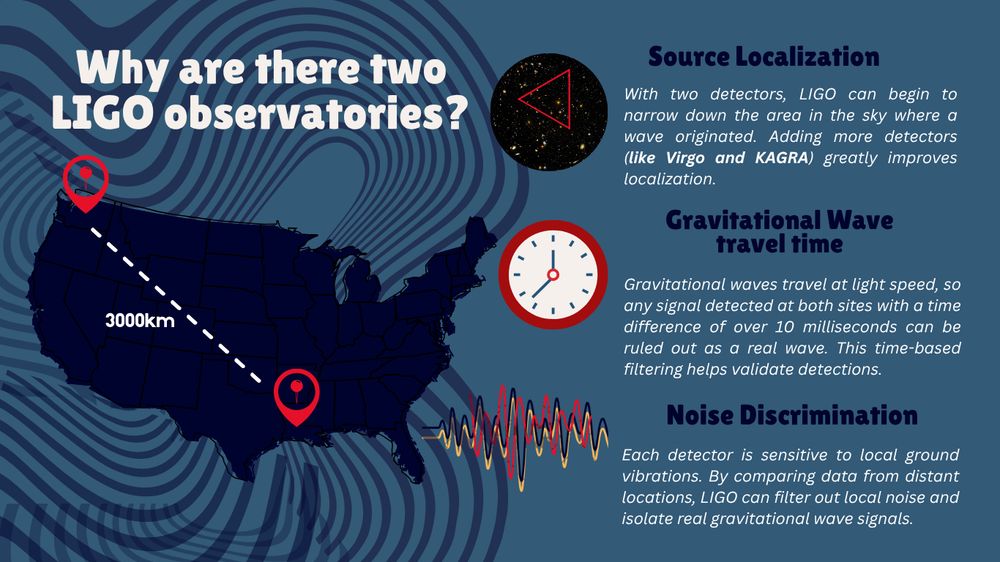
An infographic titled "Why are there two LIGO observatories?" features a map of the United States showing two LIGO locations separated by 3000 km. Three key reasons are illustrated on the right: Noise Discrimination: Each detector is sensitive to local ground vibrations. If both were close together, they’d pick up the same environmental noise, making it difficult to distinguish true gravitational waves. By comparing data from distant locations, LIGO can filter out local noise and isolate real gravitational wave signals.
Signal Timing: Gravitational waves travel at the speed of light, so any signal detected at both sites with a time difference of over 10 milliseconds can be ruled out as a real wave. This time-based filtering helps validate detections.
Source Localization: With two detectors, LIGO can begin to narrow down the area in the sky where a wave originated. Adding more detectors (like Virgo in Italy) greatly improves localization. This was crucial during the 2017 detection of a neutron star collision, where combined data allowed astronomers to quickly identify the galaxy that emitted both gravitational and electromagnetic signals, leading to the most observed astronomical event in history.
Why are there two LIGO observatories?
LIGO has two detectors ~3000 km apart for three main reasons:
🎧 Noise discrimination
⏰ Signal timing
🗺️ Source localization
Find out more www.ligo.caltech.edu/page/ligo-de...
Graphic by Mayara Pacheco 🔭🧪
24.06.2025 13:43
👍 50
🔁 24
💬 2
📌 3

Picture of a large group of Australian radio astronomers on the stage at the SKAO 2025 meeting.
Incredible showing from Australians past, present and future, at #SKAO2025 in Görlitz.
All very excited about getting the first data from the SKAO telescopes!
Aussie, Aussie, Aussie!
#RadioAstronomy
20.06.2025 09:14
👍 21
🔁 3
💬 0
📌 1

