you are not prepared for the soundtrack
03.03.2026 12:58
👍 1319
🔁 263
💬 54
📌 18
you are not prepared for the soundtrack

Registration now open for the 11th UK National Climate Dynamics Workshop.
22-24 June at University of Reading. Abstract deadline is 30 April.
www.rmets.org/event/11th-n...

Book cover of my upcoming book: How Our Climate Works: A Brief Guide in Seven Lessons.
Here's the first look at the cover of my upcoming popular science book on Earth’s climate.
The book explores the core science that shapes the world we live in.
More to come as we head towards publication in autumn. @princetonupress.bsky.social

Satellite image of ripples in clouds that mimic water ripples.
Aiming to significantly advance understanding of atmospheric dynamics and storm prediction, @corwinwright.bsky.social and team @uniofbath.bsky.social develop new tools that will allow us to see the full atmospheric wave field for the first time.
www.flipsnack.com/leverhulmetr...
Featuring a one-page article describing the ideas behind our new project, "Seeing the Unseen".


Summery fieldwork memories to brighten your day ☀️
Photos from TEAMx fieldwork in Italy last July, where we used radiosondes (and radar, research aircraft, and bespoke instruments) to improve weather forecasts around mountains.
1300s fine, 1200s trickier, 1100s bits and pieces. Interesting read.
Last meeting of the week done - 34 straight hours of them since Monday. Going to go and sit in the living room with a cup of chai and quietly jibber.

Significant news out of NASA earth science: They've finally selected two new missions for its explorers competed line, cost capped at $335M: EDGE, a next-gen lidar and successor to Icesat-2/GEDI, and STRIVE, a limb sounder for pollution and more and much-needed successor to Aura.

STRIVE selected :-) Looking forward to continuing working with the rest of the mission science team and hopefully getting some really useful data! www.nasa.gov/news-release...

This specific image is from agupubs.onlinelibrary.wiley.com/doi/10.1029/... and I think the lead author Xue made it, but we make images like this fairly routinely for our work - it's very helpful to help visualise the spatial structure of the wave field mentally.
Yes! It's done in Matlab and actually fairly easy - it's just a set of isosurfaces of constant vertical velocity (w'), combined with a surface image from Natural Earth. Maybe 20-30 lines of code? The hard part is asking a modeller nicely to make the data for you to plot ;-)
Deadline is 22nd of Feb, and all apps received by then will be fairly considered (right now it says apps will close when we have a candidate - this is an admin error and I have asked for it to be removed). Funding is specifically for *this project* rather than as a competition with other projects.

We are currently advertising a four-year fully-funded* PhD project on if we can use stratospheric waves to predict hurricanes and typhoons earlier. If you or someone you know would be interested in this, please get in touch!
www.findaphd.com/phds/project...
* for UK students only, unfortunately
London. (Durham's is about a year older than London's)
It's usually much easier to handwrite mathematically-based subject exams - entering equations is extremely tedious on a computer even with Latex, which many students won't know, and an exam Q would usually need at least a dozen rearrangement steps. This would describe almost all exams in our dept.
Having given my AGU talk on Hunga-induced atmospheric perturbations, I'm now off to the food court to address my own hunger perturbation.

Texte: le calendrier de l’avent interdit Image 1: un pied de biche Image 2: un ensemble de casiers automatiques type « Amazon » situé en extérieur
Got a new grant just in time to not lose my two fantastic postdocs :-) Will also be recruiting for a new PhD student to study whether atmospheric gravity waves can be used to help predict hurricanes - an ad will be coming out probably early next year once the paperwork has worked through the system.
Must be a black hole nearby ;-)

Giving an undergraduate lecture on the outer planets, and it feels weird to introduce Uranus as "discovered near the big Sainsburys'". However, since it was discovered in Bath, they all live here but won't know the street name, and that's the nearest major landmark...

I am currently writing a set of *three* lectures in which I describe the whole atmosphere from surface to geocorona for an audience of electrical engineers. It is ... compressed. After this I get another set of three lectures to cover all solar and space physics, then one lecture for the planets.


Just to contradict the tube strike horror stories, this is my trip from King's Cross to Paddington (Thameslink then Elizabeth Line) at 4.45pm during today's strike. Not quite sure where all the people are - maybe scared off by the crowds earlier in the week?

✨Editor's Pick✨
In JGR: Atmospheres, a new high-resolution global model is used to study predictability of atmospheric circulation from the Earth's surface up to 120 kilometers.
🔗 Learn more in @eos.org: buff.ly/Hbe4kx4
#AGUPubs #Atmosphere
The first time I did fluid dynamics was in my PhD in atmospheric physics...
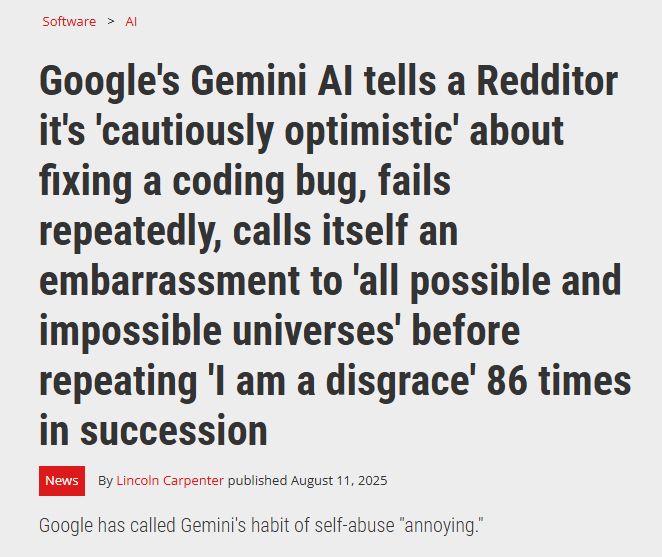
Google's Gemini AI tells a Redditor it's 'cautiously optimistic' about fixing a coding bug, fails repeatedly, calls itself an embarrassment to 'all possible and impossible universes' before repeating 'I am a disgrace' 86 times in succession
I'll admit, I was skeptical when they said Gemini was just like a bunch of PhDs. But I gotta admit they nailed it.
It turns out that satellites behave rather oddly when the Earth is 1000x less heavy than it should be. That was a delightfully challenging typo to find in the several hundred lines of orbit scanning code I'd written.
Exciting! Might be worth a chat about this at some point? I think you discussed it being potentially useful for wave stuff with Phoebe when you were both in Boulder a few weeks ago.
As a result of basically constant work travel for the last few months, I have upgraded the essentially-standard description of my inbox when I beg for forgiveness for delayed replies from "a bit of a bin fire" to "radioactive".
Job alert: we are looking for a postdoc to join the Atmospheric Dynamics group in Oxford to study Arctic atmospheric dynamics. The focus is on energy transfers between scales and implications for predictability. More details here: tinyurl.com/yc6h4b35