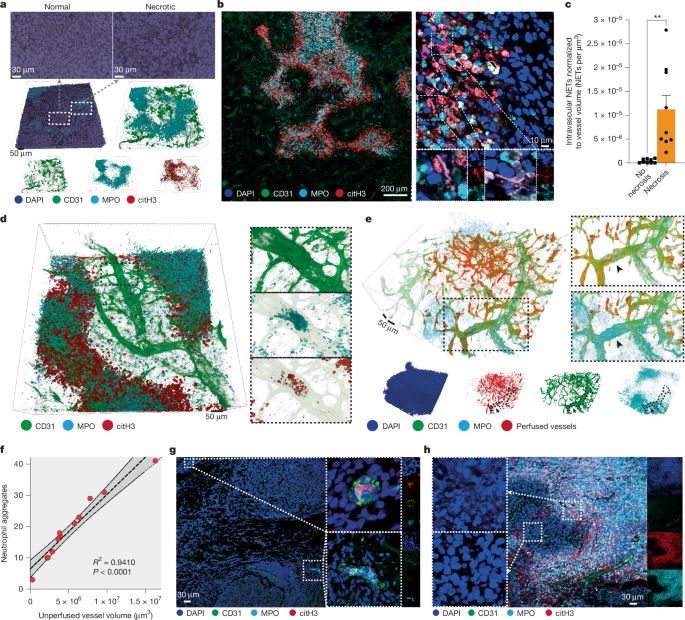
Postdoctoral clinical fellows
Opportunities for postdoctoral clinicians to consolidate their research experience.
Are you a clinician looking for a fully-funded postdoctoral research opportunity?
Check out our postdoctoral career development fellowships for clinicians, and see how you can join our vibrant community: www.crick.ac.uk/careers-and-...
02.03.2026 11:12
👍 9
🔁 11
💬 0
📌 2
Absolutely delighted that our latest paper is out today @natimmunol.nature.com. It has taken five years to uncover a role for cross-presentation in shaping the immune visibility of tumour antigens. A labour of love led by @drjonlim.bsky.social and Oliver Schulz. Great start of 2026!
02.01.2026 17:26
👍 25
🔁 9
💬 0
📌 0
I am deeply honoured to receive the Sue Eccles Early Career Investigator Award @metastasisresearch.bsky.social. Thank you for your continued support of emerging investigators in metastasis research!
07.11.2025 09:29
👍 3
🔁 0
💬 0
📌 0

🏆 MRS Sue Eccles Early Career Investigator Award: Jose M. Adrover
04.11.2025 14:05
👍 8
🔁 1
💬 1
📌 0

This review from Ambreen, @adrover.bsky.social et al. explores cancer-elicited changes to #neutrophil behaviour and proposes ways in which these may contribute to cardiovascular pathology. rupress.org/jem/article/...
📘 In #Cytokines collection: rupress.org/jem/collecti...
#Cytokines2025
01.11.2025 15:15
👍 7
🔁 1
💬 0
📌 1
We're now recruiting early career group leaders at the Crick to lead ambitious research programmes and explore bold scientific questions.
Hear our Director, Edith Heard, explain why the Crick is a unique place for curiosity-driven research.
Apply now ➡️ www.crick.ac.uk/careers-stud...
09.10.2025 14:06
👍 135
🔁 111
💬 1
📌 18

🔥Trio Fatale: Neutrophils, NETs and Necrosis
👉 authors.elsevier.com/a/1lk-k3qNrU...
We summarized for @cp-immunity.bsky.social
"Neutrophils drive vascular occlusion, tumour necrosis and metastasis" published in @nature.com by @megeblad.bsky.social @adrover.bsky.social rdcu.be/eFdau
Congrats!
09.09.2025 15:20
👍 32
🔁 7
💬 0
📌 0

A new model of #TumorNecrosis👹
Tumor CXCL1➡️myeloid skewing➡️
Ly6C-low Neutrophil forms intravascular #NeutrophilExtracellularTrap➡️
Intratumoral vascular occlusion➡️
Pleomorphic Necrosis-to-Metastasis
a role of TGFβ
@adrover.bsky.social @megeblad.bsky.social Nature 2025
www.nature.com/articles/s41...
07.09.2025 19:12
👍 12
🔁 3
💬 0
📌 0

Heart of the matter: #Neutrophils, #cancer, and #CardiovascularDisease. New review from Saira Ambreen, Afshan McCarthy, Andrés Hidalgo, and Jose Adrover @adrover.bsky.social @crick.ac.uk: rupress.org/jem/article/...
#TumorImmunology #CardiovascularBiology #InnateImmunity #inflammation
18.08.2025 13:45
👍 3
🔁 2
💬 0
📌 0

#Cancer patients display an elevated burden of #CardiovascularDisease. This review from Ambreen, @adrover.bsky.social et al. explores cancer-elicited changes to #neutrophil behaviour and proposes ways in which these may contribute to cardiovascular pathology. rupress.org/jem/article/...
11.08.2025 16:15
👍 6
🔁 2
💬 0
📌 0
@cdi-einstein.bsky.social Director @jaguirreghisolab.bsky.social co-leads a study showing how viral infections can trigger via IL6 signaling awakening of dormant breast cancer cells in lungs. CDI's research focuses in part on host variations controlling the timing of residual cancer awakening
04.08.2025 10:40
👍 4
🔁 2
💬 0
📌 0

Single cell proteomic analysis defines discrete neutrophil functional states in human glioblastoma
Neutrophils are vital innate immune cells shown to infiltrate glioblastomas, however we currently lack the molecular understanding of their functional states within the tumour niche. Neutrophils are k...
Happy to share our latest preprint doing low cell number (mini-bulk) and single cell #proteomics on tumour associated neutrophils from human glioblastoma where we find multiple functional states that would be invisible to scRNAseq, some showing pro-tumoural states with potential therapeutic value
27.07.2025 12:28
👍 64
🔁 18
💬 3
📌 3
A fascinating study reports that neutrophils and NETs actively induce tumor necrosis. Congratulations, BDP @megeblad.bsky.social and @adrover.bsky.social on your latest publication in @nature.com.
23.07.2025 14:14
👍 5
🔁 3
💬 0
📌 0
Neutrophils drive vascular occlusion, tumour necrosis and metastasis - Nature
Neutrophils actively induce tumour necrosis, driving vascular occlusion, pleomorphic necrosis and metastasis.
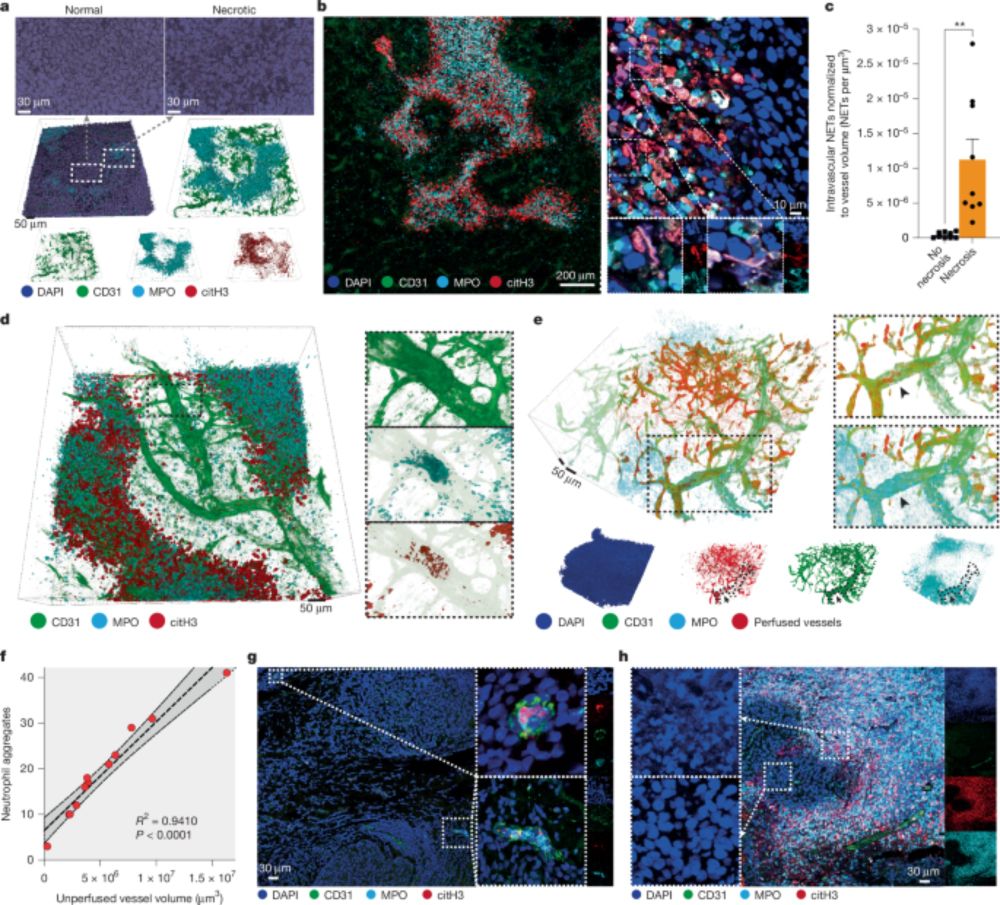
As a new postdoc in my lab (@cshlnews.bsky.social → @jhu.edu) @adrover.bsky.social (now @crick.ac.uk) saw NETs in tumors—I shrugged. But he looked closer in 3D: NETs block tumor vessels, driving necrosis, hypoxia, EMT & metastasis.
🔗 www.nature.com/articles/s41...
@jhu-bdps.bsky.social @nature.com
17.07.2025 19:26
👍 39
🔁 10
💬 0
📌 1
This project started when I joined the @megeblad.bsky.social lab at @cshlnews.bsky.social, and continued at @hopkinsmedicine.bsky.social and at
@crick.ac.uk, with help from many colleagues along the way! It has been an absolute pleasure to work with Mikala and the rest of the team! (13/13)
17.07.2025 11:27
👍 2
🔁 1
💬 0
📌 0
We show, therefore, that tumour necrosis is not a passive phenomenon, but an active phenomenon that we can target by targeting neutrophils or their NET formation ability. And by reducing tumour necrosis we can reduce metastatic spread. (12/13)
17.07.2025 11:27
👍 7
🔁 1
💬 1
📌 0

There, they form NETs and enter a feedforward loop with platelets that ultimately leads to the blockage of blood flow and subsequent necrosis of downstream tumour regions. This induces cancer cells around these necrotic regions to change and become more metastatic. (11/13)
17.07.2025 11:27
👍 0
🔁 0
💬 1
📌 0
In summary, we found that the tumour changes the haematopoietic compartment and drives the production of vascular-restricted neutrophils. Then, neutrophils leave the bone marrow and enter the bloodstream, eventually reaching the tumour vasculature. (10/13)
17.07.2025 11:27
👍 0
🔁 0
💬 1
📌 0

These neutrophils form NETs more efficiently than normal neutrophils, interact more with platelets, and, intriguingly, cannot extravasate and are stuck in the vasculature. We called them vascular-restricted neutrophils (vrPMNs). (9/13)
17.07.2025 11:27
👍 3
🔁 0
💬 1
📌 0
But why are neutrophils forming NETs in the vasculature? We found that the tumour communicates with the bone marrow and changes myelopoiesis to produce a novel neutrophil subpopulation. (8/13)
17.07.2025 11:27
👍 0
🔁 0
💬 1
📌 0

Using spatial transcriptomics, we found that tumour necrosis increased metastasis because cancer cells in peri-necrotic areas gained pro-metastatic traits in a TGFb-driven manner. (7/13)
17.07.2025 11:27
👍 1
🔁 0
💬 1
📌 0

We found that the process was driven by NETs. When we block NETs genetically or pharmacologically, tumour necrosis is greatly reduced. This, interestingly, also reduced metastatic spread. (6/13)
17.07.2025 11:27
👍 1
🔁 0
💬 1
📌 0
These aggregates were blocking blood flow in the tumour, and that caused the necrosis of downstream tumour regions. (5/13)
17.07.2025 11:27
👍 0
🔁 0
💬 1
📌 0

Interestingly, around necrotic regions we found vessels that contained intraluminal aggregates of neutrophils, NETs and platelets. (4/13)
17.07.2025 11:27
👍 0
🔁 0
💬 1
📌 0

We found that the architecture of necrosis was peculiar and intricate in different tumour models (we call it “pleomorphic necrosis”), and these regions were covered by neutrophils and NETs. (3/13)
17.07.2025 11:27
👍 1
🔁 0
💬 1
📌 0