It also features an additional 30 papers from the broader scientific community from both US-based scientists and from scientists around the world.
03.09.2025 20:49
👍 0
🔁 0
💬 0
📌 0

@prima-probe
PRIMA is a far-IR probe concept for the 2030s that will reveal how abundant elements are built up in galaxies over cosmic time, and follow them as they become the molecular building blocks of new planets! https://prima.ipac.caltech.edu/
It also features an additional 30 papers from the broader scientific community from both US-based scientists and from scientists around the world.
This special JATIS issue is focused on the PRIMA mission concept and features authors from the PRIMA team and wider scientific community. The PRIMA team led eight papers in the issue, covering an overview of the mission, its instruments, and key science goals.
The PRobe Infrared Mission for Astrophysics (PRIMA) team is excited to announce the release of a special issue in the Journal of Astronomical Telescopes, Instruments, and Systems (JATIS), Volume 11 Issue 03! This issue was edited by Naseem Rangwala and Matt Griffin.
Associate Professor Ilse Cleeves from the University of Virginia says @prima-probe.bsky.social would help her study how exoplanets form, how much water vapor is available during planet formation, and how many planets are out there! More about the proposed mission: prima.ipac.caltech.edu. #prima2025
Jed McKinney of @utaustin.bsky.social wants to use the proposed @prima-probe.bsky.social far-infrared space telescope to peer deep into the hearts of galaxies and better understand how they formed. prima.ipac.caltech.edu
#prima #prima2025 #astronomy #astrophysics

PRIMA will combine with other observatories to better understand protoplanetary disks
PRIMA will fill an essential gap between ALMA and JWST for understanding disk structure and dissipation

Diagnostic plots for OI in disks
Understanding the radiation environment in disks and its role in their evaporation is key to understanding disk evolution. PRIMA will provide essential information on high-energy radiation through multiple lines like OI, greatly expanding on samples of a few lines measured with Herschel
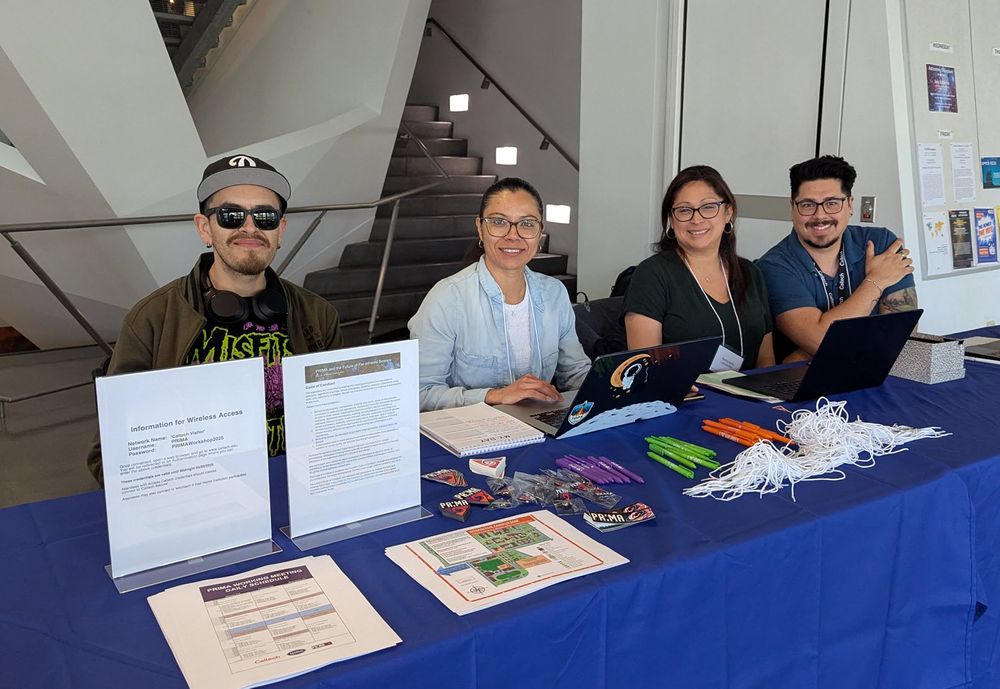
This is a group photo of four people sitting behind the registration table at the PRIMA working meeting, held in the Cahill Center for Astronomy and Astrophysics on the Caltech campus. The table holds brochures, lanyards, and swag (pens, stickers, magnets, etc.) for event attendees. From left to right: Daniel "Pina" Muro, Teresa Molano, Nancy Solis, and Sean Kindt. Image credit: Marcy Harbut, Caltech/IPAC
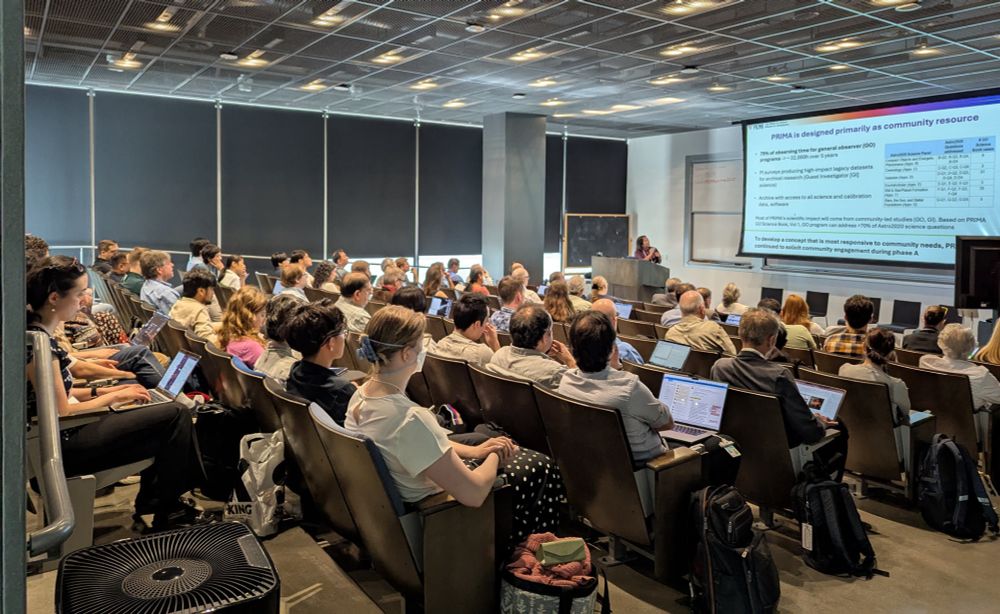
This is a photo of the in-person attendees of the PRIMA working meeting, held in the Hameetman Auditorium in the Cahill Center for Astronomy and Astrophysics on the Caltech campus, May 19-21, 2025. The photo, taken from the rear-right area of the auditorium, shows the audience watching a presentation by Dr. Tiffany Kataria, who is at the front of the auditorium presenting a slide on the proposed PRIMA space telescope. Image credit: Marcy Harbut, Caltech/IPAC
#PRIMA2025 Working Meeting: Day 1!
We're welcoming >350 scientists to discuss
@prima-probe.bsky.social's possibilities! The response to the three-day hybrid event was so outstanding we moved it to a bigger venue. Today's topics: project overview, protoplanetary disks, time domain astro, & stars.

Next up at #PRIMA2025 is BU prof @catherineespaillat.bsky.social talking about how PRIMA can fill in the gaps in our understanding of protoplanetary disk evolution
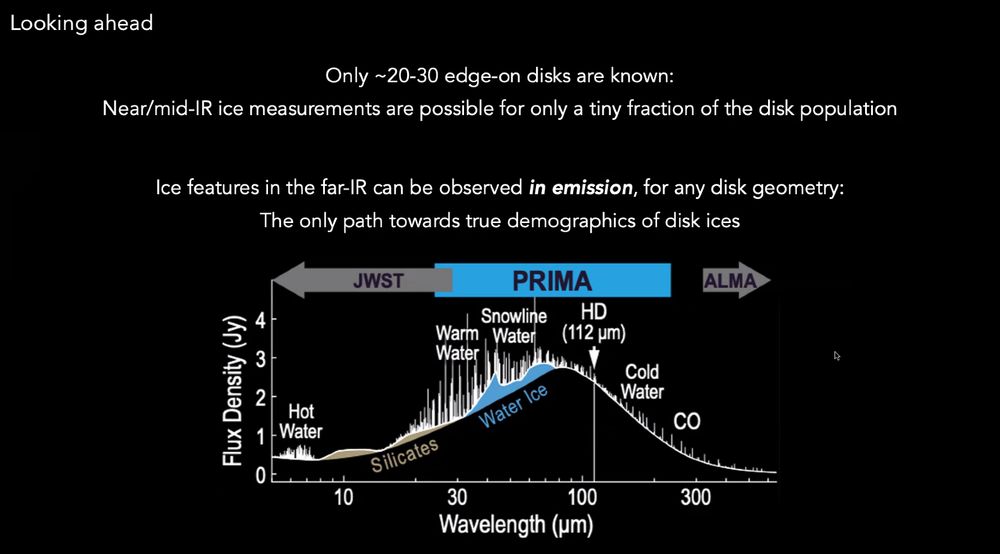
A rich spectrum of ice features in the wavelength range of PRIMA
However, the sample of edge-on disks available for these studies is limited and intrinsically biased. Far-IR observations, which are not restricted to edge-on disks, offer a unique path to a gaining complete understanding of the demographics of icy disks.

Spectra of disk ice features for two different ice models, showing changes in the shape of the spectra
The shape of these protostellar disk ice spectra can yield detailed information about the quantity of ice and its chemical composition and environment.
Near- and mid-IR spectra of disks are revealing ice properties, but these disks must be observed edge-on. Interpretations of these observations are very sensitive to radiative transfer, and require good models of disks and accurate lab measurements of optical ice properties.

ALMA MAPS data: images of dust and gas in disks
ALMA is making great progress characterizing the dust grain content, but we are currently missing a way to characterize the icy component of disks, which carries the bulk of planet-forming materials, including key ingredients like volatiles and prebiotic molecules

Title slide from Jenny Bergner's talk on disk ices
A great afternoon of talks at #PRIMA2025 kicking off with Berkeley prof Jenny Bergner giving us an exciting sneak peek into what PRIMA can do for studies of planet formation

Ways to get involved with PRIMA:see https://prima.ipac.caltech.edu/
As always, we want YOU! There are many, many ways to get involved, and we want to hear your voice! Contact us directly at our new e-mail prima.questions@jpl.nasa.gov

PRIMA is designed to be a community resource. You can help make it a reality by contributing to PRIMA's GO science book.
PRIMA's capabilities are defined by a PI science program, but they are ultimately designed to deliver a powerful and flexible community resource, with 75% of PRIMA's observing time (~32,000 hours over 5 years) open to astronomers everywhere

PRIMA's orders of magnitude sensitivity increase compared to prior missions
Decades of NASA investment have enabled this enormous technological leap forward, yielding an orders of magnitudes increase in observing capabilities in the far-infrared that is equivalent to observing at optical wavelengths at night vs. day
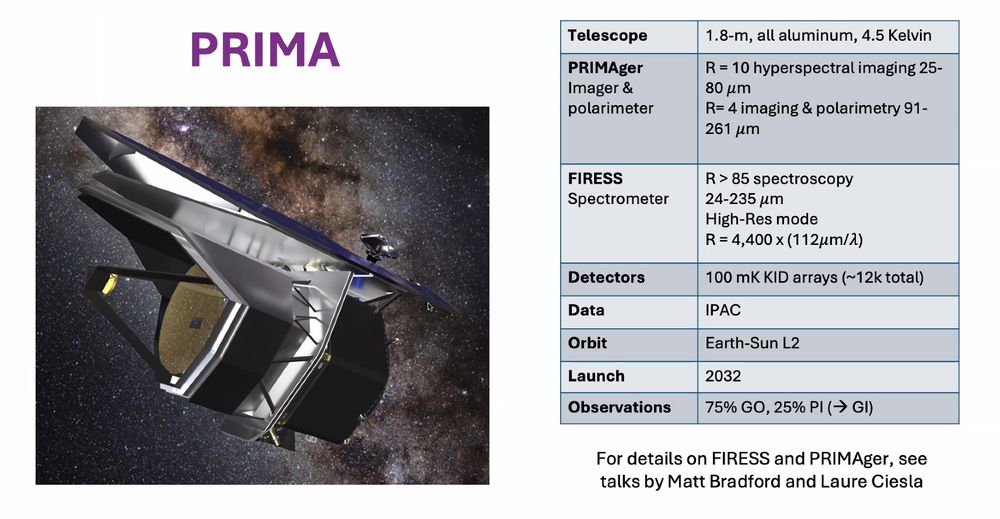
An overview of the PRIMA mission concept
Next, deputy science lead Tiffany Kataria is presenting the science enabled by PRIMA
PRIMA PI Jason Glenn leading off with an overview, showing the timeline for the genesis of the technology and science that has led to the development of the current probe concept
First up at 9:10 PDT is an overview of PRIMA, followed by more detailed presentations of General Observer science and the PRIMA instruments
Working meeting on 'PRIMA and the Future of Far-IR Science' happening today on the Caltech campus hosted by @caltechipac.bsky.social! Agenda here: conference.ipac.caltech.edu/prima-pasade...
Our next P-CAST talk takes place TODAY at 12 PM Eastern (9 AM Pacific). Our speaker is Jochem Baselmans, who will talk about Kinetic Inductance Detectors for PRIMAger
Please visit the P-CAST webpage for a link to join and to see all of our upcoming speakers! prima.ipac.caltech.edu/page/p-cast

This image is a graphic for the PRIMA and the Future of Far-Infrared Science hybrid working meeting scheduled for May 19-21, 2025 in Pasadena, California. The background image is a visualization the Milky Way galaxy observed by the Herschel space telescope.
We invite the future @prima-probe.bsky.social user community to a free, three-day hybrid working meeting hosted by IPAC on the Caltech campus. Spots are limited and registration and abstracts are due March 28. conference.ipac.caltech.edu/prima-pasade...
Our next P-CAST talk takes place TODAY at 12 PM Eastern (9 AM Pacific). Our speaker is Ke (Coco) Zhang from the University of Wisconsin-Madison, telling us about Gas Evolution in Protoplanetary Disks!
Please visit the P-CAST webpage for a link to join and to see all of our upcoming speakers!
If you missed our community webinar on submitting science cases to the GO Book Volume 2, the videos are now posted on our youtube channel!
Session 1: www.youtube.com/watch?v=KH55...
Session 2: www.youtube.com/watch?v=G2-s...
PRIMA will absolutely boop those lil' red dots #NASAWebb is finding

Missed yesterday's spectacular P-CAST talk by @eriniastro.bsky.social? You can catch it on our youtube channel! youtu.be/88HdVbYASHE
Our PRIMA community webinar is happening tomorrow! Get the latest updates, meet and greet our new Exposure Time Calculator, and plan your GO science case ideas! You can still register on our website, and both sessions will be recorded. prima.ipac.caltech.edu/page/communi...
@eriniastro.bsky.social will describe how deep observations with PRIMA's FIRESS instrument can help clear up mysteries of the new AGN candidates discovered with JWST, and how PRIMA's PRIMager and FIRESS can help find the z >4 AGN easily missed by JWST in the first place!
P-CAST talk today in two hours! Erini Lambrides will tell us about "Un-obscuring Obscuration in z>4 AGN with PRIMA" Information on how to join here: prima.ipac.caltech.edu/page/p-cast

