
Joe of all trades
02.02.2026 21:20
👍 1
🔁 0
💬 0
📌 0
Joe of all trades
Love this. Thanks so much for all your work, Jannes.
Sparrow by the Pyrocko team is excellent. pyrocko.org/docs/current...
You just need to convert your catalogue into the native Pyrocko format, but I have some scripts to help if you like?
Kahramanmaraş initiated off the main EAF, too of course.
Hey Andrew, nice work. Is the mainshock lying a little out-of-plane just because it’s not been relative-relocated with its aftershocks, because it has much lower frequency waveforms?
Y-shaped splay-type structure at the northern end?
Are you soliciting emails?
Oh, it’s *that* kind of club …
Super cool--the role of (even very small) earthquakes in subsurface microbiology!

Some coverage from the BBC on our Santorini swarm paper in Science (www.science.org/doi/full/10....). Features an interactive slider graphic showing the imaged magma dike intrusion using @alomaxnet.bsky.social's Coulomb-based seismicity-stress (CoulSeS) method.
www.bbc.co.uk/news/article...
This figure from a perspective piece on our paper by Virginie Pinel beautifully illustrates our proposed magma-pumping mechanism!
www.science.org/doi/10.1126/...

New! We study the disruptive 2025 earthquake unrest near #Santorini using machine-learning derived seismicity as virtual stress meters at depth. We show the unrest was due to a magma dike intrusion, imaging in detail a complex, rebounding process of dike propagation.
www.science.org/doi/10.1126/...
No, 337 degrees was the temperature at the time, of course 🤪
Love it when a plan comes together, and quickly.

In case you hadn't seen yet, this event has sent seismic signals all around the word, with both body and surface waves. Below are Z-components of GSN stations, filtered 25-100 s.
Goran Ekstrom's surface wave detector gives this a surface magnitude = 5.4(!).
A longer sonification with slower sound rate factor (1000) gives a clearer and more detailed impression of the evolution of the "drumbeat" seismicity, which continues with increasing frequency right up to the largeest (landslide failure?) signal, but not after.

The massive landslide + tsunami in Alaska on Sunday (10 August; earthquake.alaska.edu/major-landsl...) has sent seismic waves all around the world. Body waves visible up to 90°, and surface waves beyond. Record section of Z-component seismic recordings from GSN stations filtered between 25 & 100 s 👇
Crazy (horizontal) runup from the large landslide into Tracy Arm fjord, SE Alaska. This is 20 km out the fjord and the wave reached up to 400 m into this side valley. notice how the vegetation was only wetted for the most part (pixels still red) and only the mouth of the river is destroyed.
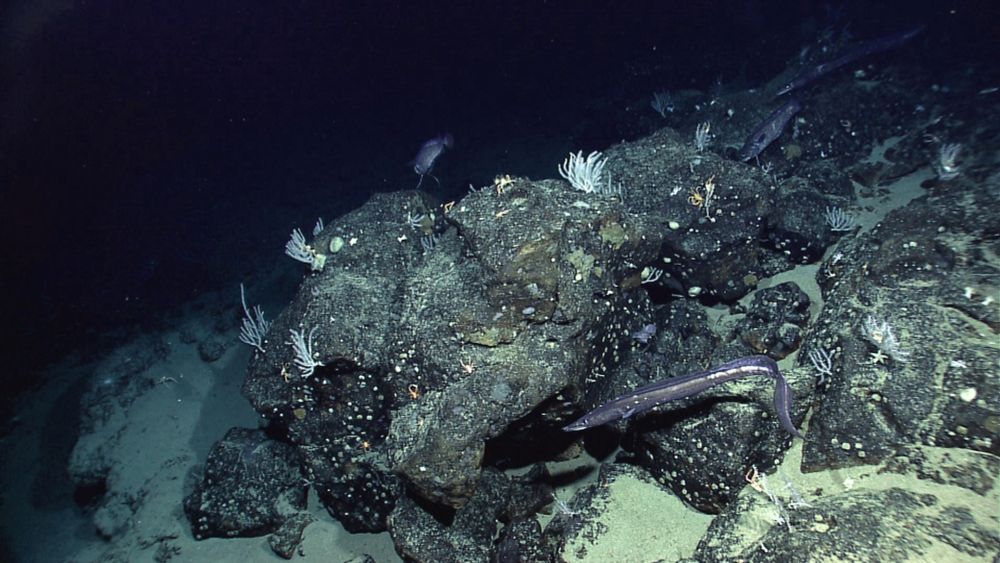
The first Seafloor Explorer seminar on June 17th, 15.00 BST, will cover “Recent expedition reports from Santorini”.
Speakers: Jonas Preine (WHOI, US), Michele Paulette (Imperial College London, UK) and Jens Karstens (GEOMAR, DE).
Registration info: seafloor-explorer.github.io/seafloor/sem...

We're pleased to announce the Seafloor Explorer online seminar series on marine geoscience. The seminars will be on the 3rd Tues of each month. The 1st will be on June 17th 2025 @ 1500 BST, and will on recent unrest at Santorini.
All info, sign-up & speaker suggestions: seafloor-explorer.github.io

Cool to see this paper out that uses a NASA SWOT altimeter to observe the 9-day water sloshing in Greenland triggered by a landslide tsunami that sent seismic waves around the world. A great effort that independently backs-up & substantially builds upon our prev work
www.nature.com/articles/s41...
Nice to see our Greenland seismic-seiche paper still getting some attention :)
Amazing - I think this may be the only footage in existence of real-time slip on a fault.
⚒️ 🧪
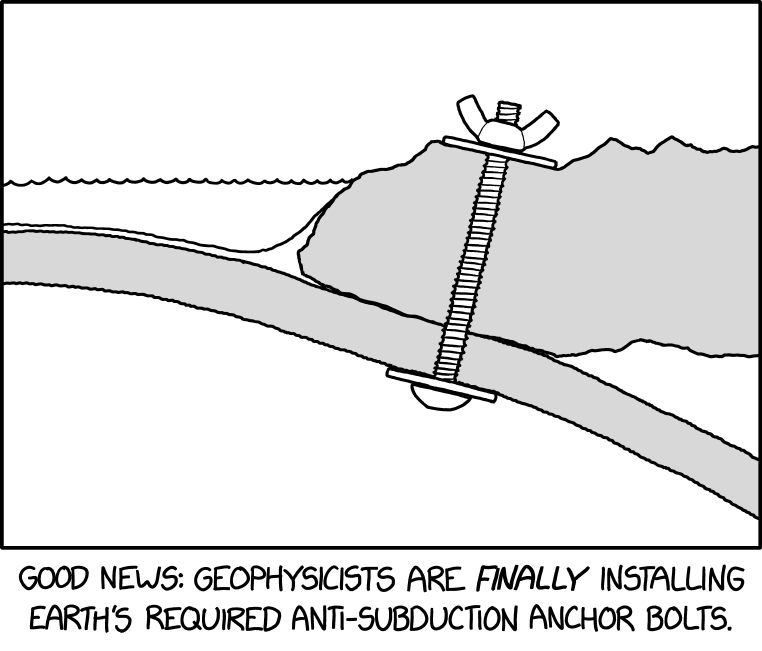
Anchor Bolts xkcd.com/3078

This morning's M6 Istanbul earthquake was preceded by a M3.9 foreshock ~35 minutes before
deprem.afad.gov.tr/last-earthqu...

Detecting whales in the Atlantic Ocean using on-land seismometers in Ireland, including low-cost RaspberryShake sensors. Very cool! www.nature.com/articles/s41...
Who says reviewers can't find the time these days? 😀
#AcademicHeresy
P.s., my angle on this is from ocean bottom seismology where we don’t have constant GPS synchronisation so sometimes have realllllly bad clock drifts 😬
You would think so, but the forum post above implies they might be independent - the BB and SM might be on different dataloggers, for example. In any case, calibrating with a teleseismic P arrival could be a decent fallback option.
So it seems like the BB sensor doesn’t have timing issues? Can the onset of the SM signal be aligned with it?

