PS. Government should invest more in field-based biodiversity research. And regulatory offices shouldn’t make it unnecessarily difficult for Filipino researchers to secure collection permits—esp when the goal is to properly document species & deposit specimens in recognized natural history museums.
05.03.2026 13:08
👍 1
🔁 1
💬 0
📌 0
Camila had to build this piece by piece over the years. Science can be slow. But this is what persistence and commitment to doing it right actually look like.
05.03.2026 13:08
👍 1
🔁 0
💬 1
📌 0
And now the bar keeps moving; people are asking for more genes, even genomic-scale data.
Imagine the burden that creates for #megadiverse countries—many of them in the #GlobalSouth —where most of Earth’s biodiversity exists and is undescribed, but resources for research are limited.
05.03.2026 13:08
👍 1
🔁 1
💬 1
📌 0
The reality is, describing vertebrates today isn’t simple & cheap. Most of the comparative specimens you need are housed in foreign museums. And you can’t really describe a vertebrate “cleanly” anymore without genetic data, which means lab work, sequencing, funding… all expensive and time-consuming.
05.03.2026 13:08
👍 1
🔁 0
💬 1
📌 0
Camila did her Master’s fieldwork on Sibuyan Island back in 2017, right when I was just starting mine at the University of the Philippines Los Baños. We overlapped, but I don’t think either of us imagined how long this would take.
05.03.2026 13:08
👍 0
🔁 0
💬 1
📌 0

A new species of fringed gecko, Luperosaurus alvarezi, from the tiny island of Sibuyan (Philippines), was described by Meneses & Brown (2026).
It’s wild to think it took almost 9 years to formally describe this lizard species!
#taxonomy #Philippines #biodiversity
doi.org/10.7717/peer...
05.03.2026 13:08
👍 0
🔁 1
💬 1
📌 0
CAS - Central Authentication Service NetID Single Sign On
Published today in PNAS:
www-pnas-org.ezproxy.lib.uconn.edu/doi/10.1073/...
Mark Urban, Chris Elphick, and I argue that conservation programs should pay more attention to heritable within population variation, enabling rapid evolutionary response to environmental changes.
20.01.2026 19:36
👍 16
🔁 7
💬 2
📌 0

We explored the bioacoustic differentiation of these frogs, and found clear differences among basically all species, especially those co-occurring at the same elevation. This figure shows cut-outs of a the little whistling calls each frog species makes, and a plot of call duration against dominant frequency for all individual calls recorded, coloured by species.

There is an interesting pattern of both size diversity and elevational distribution among the Stumpffia of Montagne d'Ambre in the north of Madagascar. This plate shows dorsal, ventral, and lateral photos of all species, as well as their body size ranges, and then also a plot of elevational distributions of each species, showing clear stratification. All of the frogs are pretty round and shows some indication of miniaturisation. Most are resplendent in a variety of brown shades above and below, but some, like Stumpffia madagascariensis, have stark colour contrasts or lines, and one, S. megsoni, has orange on the belly.

A photo into the forest at moderately high elevation on Montagne d'Ambre. There is a rather open understory, with tree ferns and low bamboo(?), and quite thin tree trunks. It is a sea of greens and browns.

The tiny Stumpffia madagascariensis upon a bright green leaf in the leaflitter. This species is one of the smallest frogs in Madagascar, and indeed the world. This individual has a thin light stripe along the back, a pale brown dorsum, and stark black border along the flank. You can just make out the teensy tiny toesies, and it is, frankly, adorable.
New publication from my lab, led by @njorisfleck.bsky.social! 🧪 We explore the diversity and origins of a genus of tiny frogs 🐸 on an isolated mountain in north Madagascar. A cool case study of both in-situ diversification and repeated colonisation!
vertebrate-zoology.arphahub.com/article/1664...
21.01.2026 10:42
👍 33
🔁 10
💬 0
📌 1

Application Process
Image
Woman behind a podium presenting.
Jessie Golding, BBCS postdoc, presenting at ICCB 2025.
Apply to become a Lovejoy Fellow by submitting your resume, cover letter, and contact information for three references through the University of Arizona Talent Portal (link upcoming) by the first review date of January 30, 2026.
Your cover letter should:
Identify 1-2 Lovejoy BBCS faculty you would be interested in working with and explain the primary research directions you would want to pursue in collaboration with this faculty member. You are strongly encouraged to reach out to faculty before submitting your application.
Describe your experience with or interest in inter- or transdisciplinary research.
Explain how this experience will positively impact your career trajectory.

New postdoctoral fellowship opportunity! Please pass along. Excited to announce the launch of the Tom Lovejoy Fellowship Program at the University of Arizona for innovative research to protect species, sustain ecosystems, and promote a thriving planet lovejoycenter.arizona.edu/lovejoy-fell... 🧪🌐🌾
19.12.2025 18:11
👍 50
🔁 48
💬 3
📌 2

A tale of homogenisation
I’ve always been intrigued by ecological scaling – it’s literally in my title: Assistant Professor in Ecological Scaling. One of the main reasons we care so much about scaling is that ecologi…
New paper from the MIREN network!
We tested how homogenisation (ecosystems becoming more alike through invasions) changes with scale.
Global = clear pattern
Local = not so simple
Read more: the3dlab.org/2025/10/22/a...
Paper, led by @mbuhaly.bsky.social: onlinelibrary.wiley.com/doi/10.1111/...
22.10.2025 19:33
👍 18
🔁 7
💬 2
📌 1

Transformative change to address biodiversity loss is urgent and possible
Transformative change for a just and sustainable world often appears overwhelming. This Perspective highlights the key messages from the IPBES Transformative Change Assessment and how everyone can be ...
Transformative change for a just and sustainable world often seems overwhelming. @annelarigauderie.bsky.social and the @ipbes.net Transformative Change Assessment co-chairs highlight the roles we can each have in achieving #transformativechange.
🧪 #biodiversity #sustainability
plos.io/3VGKknN
01.10.2025 16:44
👍 15
🔁 6
💬 1
📌 0

Microclimate vulnerability under coupled effects of changing climate and forest structure
Understanding how forest structure affects microclimate is crucial amidst global warming, especially in biodiversity hotspots such as the North Americ…
🥁New paper on microclimate vulnerability under changing climate 🌦️ & forest structure 🌳. Forest structure can buffer or amplify climate warming! Congrats to Joanna Lumbsden-Pinto @sunyesf.bsky.social, @brookhavenlab.bsky.social, @sunyofficial.bsky.social. 🌐🌍
www.sciencedirect.com/science/arti...
03.10.2025 20:38
👍 50
🔁 13
💬 1
📌 0
Gaps and biases in vertebrate wildlife genetics from a global biodiversity hotspot | Environmental Conservation | Cambridge Core
Gaps and biases in vertebrate wildlife genetics from a global biodiversity hotspot
Biodiversity knowledge gaps persist across low-income tropical regions... how does closing these and addressing biases create a more equitable and representative #genetic knowledge base, supporting national #conservation and global #biodiversity commitments?
bit.ly/4merL5A
#conservationscience🌏
05.08.2025 08:57
👍 2
🔁 2
💬 0
📌 1
Global genetic diversity loss & the power of conservation to restore species resilience - Robyn Shaw
YouTube video by ERGA - European Reference Genome Atlas
💬 Missed the #ERGAPlenary this month? No problem - catch up now on the #ERGAchannel with the recorded talk "Global genetic diversity loss and the power of conservation to restore species resilience"
youtu.be/8y0V2pjwd0A?... #conservation #speciesresilience
01.10.2025 08:05
👍 3
🔁 4
💬 1
📌 0
Gaps and biases in vertebrate wildlife genetics from a global biodiversity hotspot | Environmental Conservation | Cambridge Core
Gaps and biases in vertebrate wildlife genetics from a global biodiversity hotspot
Can closing gaps in wildlife genomics - such as the participation of Global South Researchers - create a more equitable and representative genetic knowledge base?
Discussed in this recent Paper by Kier Mitchel E. Pitogo in #EnvironmentalConservation
www.cambridge.org/core/journal...
#genomics
19.09.2025 08:04
👍 1
🔁 2
💬 0
📌 0

In our latest preprint, we show that sampling of herpetofauna in the Philippines is uneven, with natural history collections largely shaping observed species diversity. Also, sampling is biased towards large conservation areas, but not when topographic relief is high. www.biorxiv.org/content/10.1...
19.09.2025 01:48
👍 3
🔁 1
💬 0
📌 0

Joint species-trait distribution modeling: The role of intraspecific trait variation in community assembly
The links between intraspecific trait variation and community assembly remain little studied, partially due to the lack of statistical methods to jointly model intraspecific trait variation and species abundances at the community level. Here, we extend the joint species distribution modeling (JSDM) framework into the joint species-trait distribution modeling (JSTDM) framework to explicitly link species abundances to phenotypic variation in traits for multiple species simultaneously. Using a case study of 65 tundra plant species abundances and 3 key functional traits measured across 325 sites, we show how the JSTDM approach (1) estimates the statistical associations among species abundances, species-level traits, and site-level traits, relative to environmental variation; (2) improves predictions on trait variation by using information on species abundances; and (3) generates hypotheses about trait-driven community assembly mechanisms. The JSTDM methodology presented in this study allows assessing the interplay between species abundances and traits at the community level, providing the much needed modeling tools to quantify the role of phenotypic trait variation in eco-evolutionary community assembly.
An extension of joint SDM to jointly model species abundances and intraspecific trait variation. #ecopubs @esajournals.bsky.social
doi.org/10.1002/ecy....
08.09.2025 11:20
👍 30
🔁 13
💬 1
📌 0
Biodiversity conservation requires integration of species-centric and process-based strategies | PNAS
Conservation science and policy are geared primarily toward the preservation of species
and habitats, with priority often given to the rarest, most...
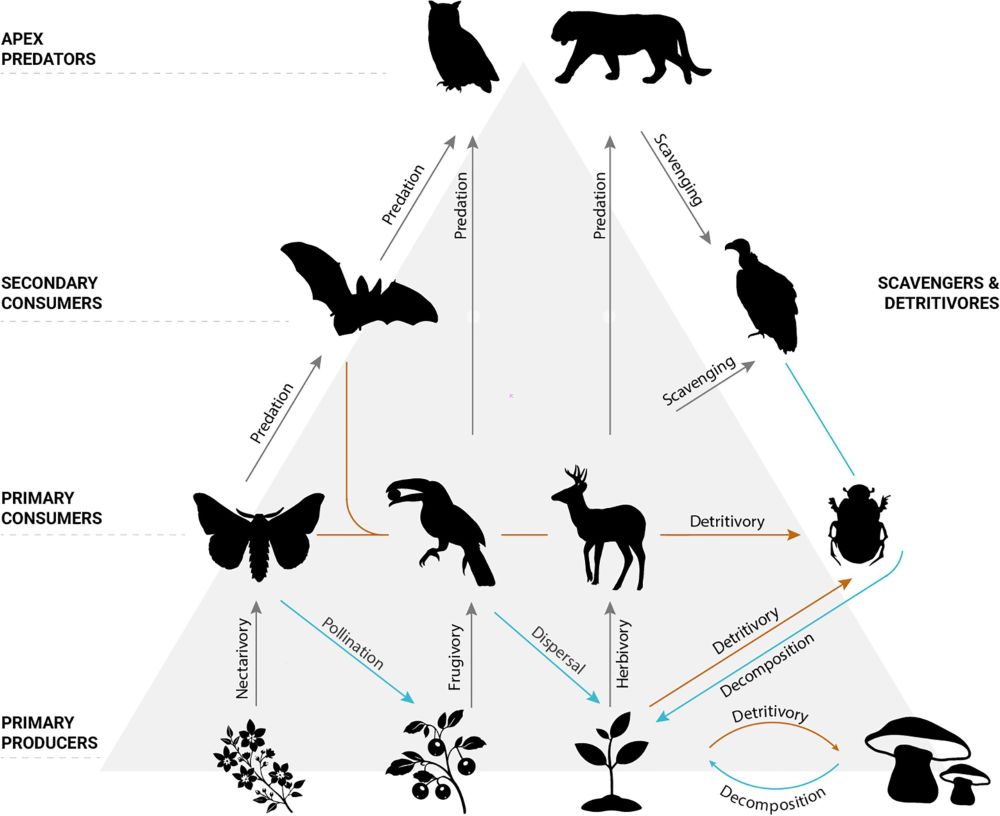
Conservation needs to focus better on maintaining & enhancing the processes that allow ecosystems to function & adapt in a rapidly changing world
In our new paper we explore key processes - such as evolution, movement & biotic interactions - metrics, & how to conserve them
doi.org/10.1073/pnas...
04.08.2025 15:56
👍 33
🔁 14
💬 3
📌 0
Gaps and biases in vertebrate wildlife genetics from a global biodiversity hotspot | Environmental Conservation | Cambridge Core
Gaps and biases in vertebrate wildlife genetics from a global biodiversity hotspot
‘Gaps and biases in vertebrate wildlife genetics from a global biodiversity hotspot.’ A new article by @kmpitogo.bsky.social in #EnvironmentalConservation
#biodiversity #Philippines #Genomics #genetics #vertebrates #Conservation #Conservationscience🌏 #wildlife
bit.ly/4merL5A
27.07.2025 09:43
👍 4
🔁 3
💬 0
📌 0
Cool new paper about terrestrial vertebrates endemic to the 🇵🇭 Philippines ⬇️
25.07.2025 13:43
👍 3
🔁 1
💬 0
📌 0
I've been working in conservation for 22 years. It's disheartening to see there are still foreigners conducting one-off trainings in the Philippines 🇵🇭 with little to no Filipino participants and *zero* Filipino experts as resource persons or facilitators. Seems very 🚩 #ColonialScience 1/2
24.07.2025 12:12
👍 6
🔁 3
💬 1
📌 0
Empowering collaboration avoid perpetuating dynamics associated with parachute science. Research networks must go beyond data extraction to advance science, build local capacity, share credit, and foster trust for advancing science and conservation.
24.07.2025 16:30
👍 3
🔁 2
💬 0
📌 0
The fact that 17.7% of PH endemic vertebrates still lack genetic data, less than the global average of ~24%, is encouraging and suggests strong research activity. However, these activities must be done in collab that is inclusive and empowering—involving Filipino scientists in all research stages.
24.07.2025 16:30
👍 2
🔁 1
💬 1
📌 0


