Thanks to my amazing coauthors Christopher Blume, Caren Cooper, Alia Dietsch, Emma Greig, @the-ot-birder.bsky.social, Tina Phillips, Tammah Watts, and Ashley Dayer for their contributions, as well as all of our focus group participants!
12.11.2025 22:15
👍 0
🔁 0
💬 0
📌 0
🤝 Attendees shared many valuable solutions to the make the project more inclusive, including partnering with outside organizations, creating opportunities to participate in community, increasing representation, creating more educational materials, and removing the fee.
12.11.2025 22:12
👍 1
🔁 0
💬 1
📌 0
🏔️ The project participation fee was a major barrier, as were the general costs of feeding birds, accessibility, and cultural barriers that led to a lack of belonging in participatory science, birding, and the outdoors in general.
12.11.2025 22:12
👍 0
🔁 0
💬 1
📌 0
❤️ Attendees were excited to contribute to science and conservation, keep track of their observations, and explore the data to answer their own questions. The flexible schedule of the project and the fact that it could be done from home made it more accessible.
12.11.2025 22:11
👍 0
🔁 0
💬 1
📌 0
Through focus groups with BIPOC, disabled, and neurodivergent people who feed birds but don't take part in FeederWatch, we explored how the project aligned with attendee interests, what systemic barriers prevented participation, and how the project could become more inclusive.
Here's what we found
12.11.2025 22:11
👍 0
🔁 0
💬 1
📌 0
Our study, out today in Citizen Science Theory & Practice, was done in collaboration with Project FeederWatch, a participatory science project out of the Cornell Lab of Ornithology focused on feeding and observing birds.
12.11.2025 22:11
👍 0
🔁 0
💬 1
📌 0
I'm excited to share a new publication on inclusive participatory science for Black, Indigenous, and People of Color (BIPOC), disabled people, and neurodivergent people!
🧵 Thread below!
12.11.2025 22:10
👍 2
🔁 1
💬 1
📌 0
And a fun post-script - I have now moved to San Francisco and joined one of the gardens I worked with! I’m excited to keep connecting with birds and people there! 💚 🌻 🐦
14.05.2025 05:01
👍 0
🔁 0
💬 0
📌 0

Finally, I’d like to thank all the community gardens, garden leaders and volunteer coordinators, and gardeners themselves! None of this would have been possible without them generously welcoming us into their gardens and sharing their experiences.
14.05.2025 05:00
👍 0
🔁 0
💬 1
📌 0
It was a pleasure to work with my amazing interdisciplinary team of coauthors: @ornithoale.bsky.social, Maya Xu, @flamingmuffinz.bsky.social, Mei Li Palmeri, Meggie Callahan, Nicole Ardoin, and Gretchen Daily
14.05.2025 05:00
👍 1
🔁 1
💬 1
📌 0

This underscores the importance of urban community gardens - not only do they provide habitat for biodiversity and opportunities to access nature, but also many other benefits: social connections, education, and food sovereignty. Let’s work to protect and advocate for urban community gardens!
14.05.2025 04:58
👍 1
🔁 1
💬 1
📌 0

Regardless, these results are exciting - they suggest that community gardens have the potential to provide access to nature across an income gradient! People in both high and low income neighborhoods in San Francisco can have positive interactions with birds in gardens.
14.05.2025 04:58
👍 0
🔁 1
💬 1
📌 0
Why might this be? It could be because birds are highly mobile organisms, the nature of San Francisco (compact, lots of greenspace, heterogenous), regional effects (luxury effect is stronger in tropical and arid environments), or community gardens themselves.
14.05.2025 04:57
👍 1
🔁 1
💬 1
📌 0

For example, we expected lower income neighborhoods to have less canopy cover and therefore less avian species richness, but instead found all three of these variables were unrelated!
14.05.2025 04:57
👍 0
🔁 1
💬 1
📌 0
Instead, we found that avian species richness and abundance were predicted by local and landscape-scale environmental factors, very few of which were correlated with income.
14.05.2025 04:57
👍 0
🔁 1
💬 1
📌 0
Surprisingly, given past studies on the luxury effect that show higher biodiversity in higher income neighborhoods, we found no relationships between any of these metrics and garden income!
14.05.2025 04:57
👍 0
🔁 1
💬 1
📌 0
For each garden, we compared three bird metrics with garden income: species richness, abundance, and a species access metric, a metric for our 10 focal species that was higher where there were more individuals from species people noticed and cared about.
14.05.2025 04:56
👍 0
🔁 1
💬 1
📌 0

We dug into why attitudes differed. While less-popular species had mostly aesthetic disservices, popular species had both ecological and aesthetic services. This suggests that providing education about species’ ecological roles could be an important conservation tool!
14.05.2025 04:55
👍 0
🔁 1
💬 1
📌 0

However, we also wanted to understand how much gardeners noticed each species. When we weighted sentiment scores by recognition, the scores of less-charismatic species like the Black Phoebe dropped.
14.05.2025 04:55
👍 0
🔁 1
💬 1
📌 0

Using these results, we were able to assign each species a “sentiment score” and rank them in terms of positive sentiment. Most species had more positive than negative words associated with them, while corvids were the exception.
14.05.2025 04:54
👍 0
🔁 1
💬 1
📌 0
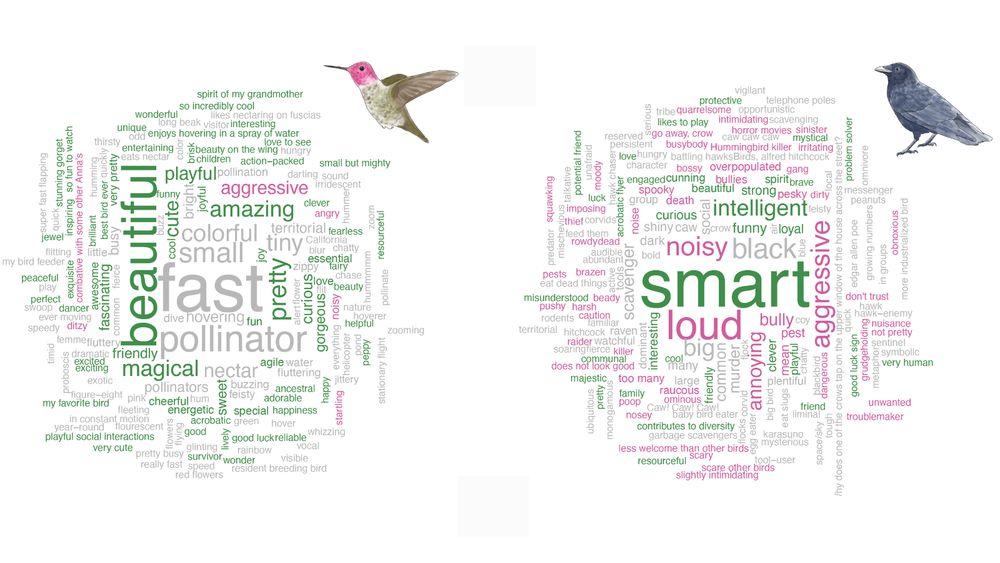
For each species, we performed a sentiment analysis, classifying words into positive, negative and neutral. While species like the Anna’s Hummingbird had primarily positive associations, others like the American Crow, were more controversial.
14.05.2025 04:54
👍 0
🔁 1
💬 1
📌 0
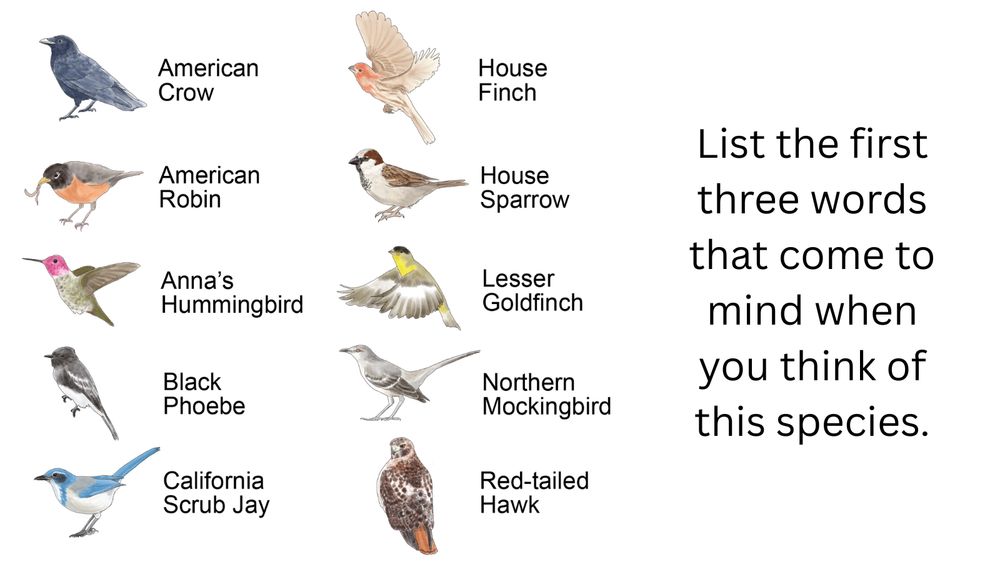
We also examined gardener attitudes towards 10 common garden species, chosen to capture a range of traits, through a word association task.
14.05.2025 04:53
👍 0
🔁 1
💬 1
📌 0

Through our surveys, we learned that gardeners felt positively about birds overall, showing high agreement with a number of positive statements about birds in the garden!
14.05.2025 04:53
👍 0
🔁 1
💬 1
📌 0
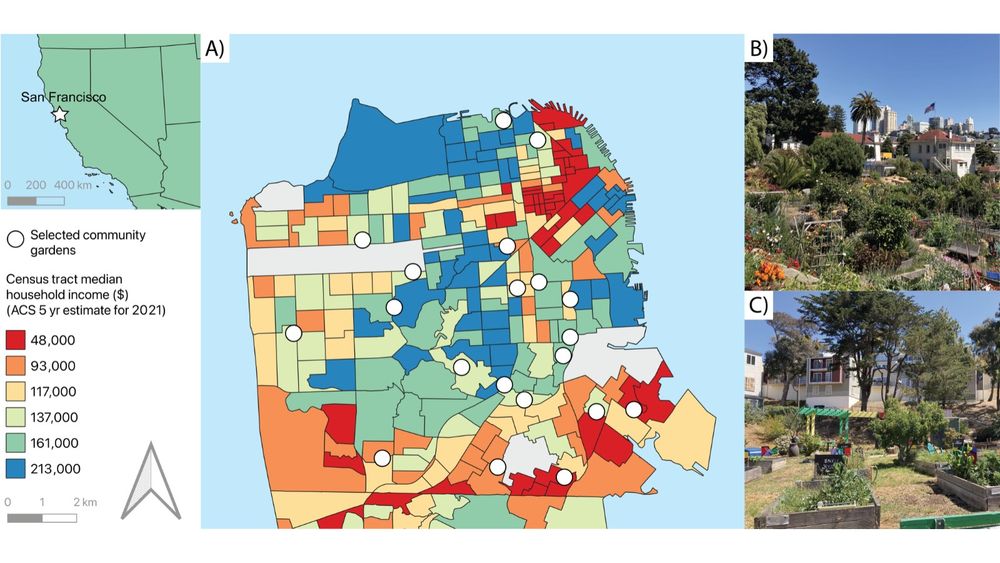
We worked in 20 community gardens across an income gradient in San Francisco, CA, surveying gardeners, performing avian point counts, and survey vegetation.
14.05.2025 04:52
👍 0
🔁 1
💬 1
📌 0

We studied a specific type of access to nature, human/bird interactions, through an interdisciplinary lens. We wanted to understand how people felt about birds overall as well as specific species, and where people came into contact with those species as well as diverse bird communities.
14.05.2025 04:51
👍 1
🔁 1
💬 1
📌 0
This means we miss some crucial components: understanding how specific components of nature (like wildlife!) contribute to access, and understanding whether people actually benefit from and enjoy coming into contact with that nature.
14.05.2025 04:50
👍 1
🔁 1
💬 1
📌 0
Access to nature provides myriad benefits to people, but those benefits are not equitably distributed. In addition, most studies of access to nature focus on physical access to greenspace.
14.05.2025 04:50
👍 1
🔁 1
💬 1
📌 0