Lots of great options for making donations via the site below. MN must not stand alone against this fascist administration. God bless Alex Pretti, Renee Good, and all those who are putting their lives, limbs, and eyes on the line to protect their neighbors 💔
25.01.2026 13:30
👍 2
🔁 3
💬 0
📌 0
Growing phenomenon that you might not be aware of: a lot of community colleges offer bachelor’s degrees! This descriptive piece is the start of a research agenda with my wonderful coauthors @riacton.bsky.social @julia-turner.bsky.social @camilantmorales.bsky.social and Kalena Cortes
20.01.2026 22:10
👍 9
🔁 2
💬 1
📌 0
Happy to have this descriptive piece with @camilantmorales.bsky.social, Kalena Cortes, @julia-turner.bsky.social, & @loismiller.bsky.social out!
Look for more causal work on this topic from our team in the near future 👀
19.01.2026 12:40
👍 24
🔁 8
💬 0
📌 0
Adding Seattle restaurant concierge to my CV!
16.11.2025 00:34
👍 1
🔁 0
💬 1
📌 0
👋 I'm Danielle, and I'm on the #econjobmarket this year!
Let's start with a student describing her segregated school:
"The school felt temporary. Built like a warehouse with aluminum siding . . . I had a slipshod education"
The twist? The student is white, and her school is private.
A JMP 🧵 -->
12.11.2025 15:57
👍 158
🔁 78
💬 5
📌 26
Speaking officially as the host of Jeopardy!, Cal Raleigh is the correct MVP vote.
25.09.2025 04:20
👍 2435
🔁 394
💬 69
📌 45

Political Views and College Choices in a Polarized America
Riley Acton
Miami University & IZA
Emily Cook
Texas A&M University & CESifo
Paola Ugalde A.
Louisiana State University
We examine the role of students’ political views in shaping college enrollment decisions in the United States. We hypothesize that students derive utility from attending institutions aligned with their political identities, which
could reinforce demographic and regional disparities in educational attainment and reduce ideological diversity on campuses. Using four decades of survey data on college freshmen, we document increasing political
polarization in colleges' student bodies, which is not fully explained by sorting along demographic, socioeconomic, or academic lines. To further explore these patterns, we conduct a series of survey-based choice experiments that quantify the value students place on political alignment relative to factors such as cost and proximity. We find that both liberal and conservative students prefer institutions with more like-minded peers and, especially, with fewer students from the opposite side of the political spectrum. The median student is willing to pay up to $2,617 (12.5%) more to attend a college where the share of students with opposing political views is 10 percentage points lower, suggesting that political identity plays a meaningful role in the college choice process.
🚨 New working paper alert! 🚨 #econsky
Emily Cook, Paola Ugalde, and I are thrilled to share "Political Views and College Choices in a Polarized America" — now out with both @iza.org and @annenberginstitute.bsky.social EdWorkingPapers
www.iza.org/publications...
edworkingpapers.com/ai25-1280
08.09.2025 20:24
👍 54
🔁 18
💬 1
📌 8
This action by Lisa Cook is courageous, principled, and deserves broad support.
26.08.2025 03:08
👍 565
🔁 139
💬 2
📌 3


The first “removal” (if this stands) of a Federal Reserve Board Governor in the institution’s 112 year history. Totally unprecedented. No due process. A totally authoritarian move.
26.08.2025 00:46
👍 153
🔁 55
💬 6
📌 4
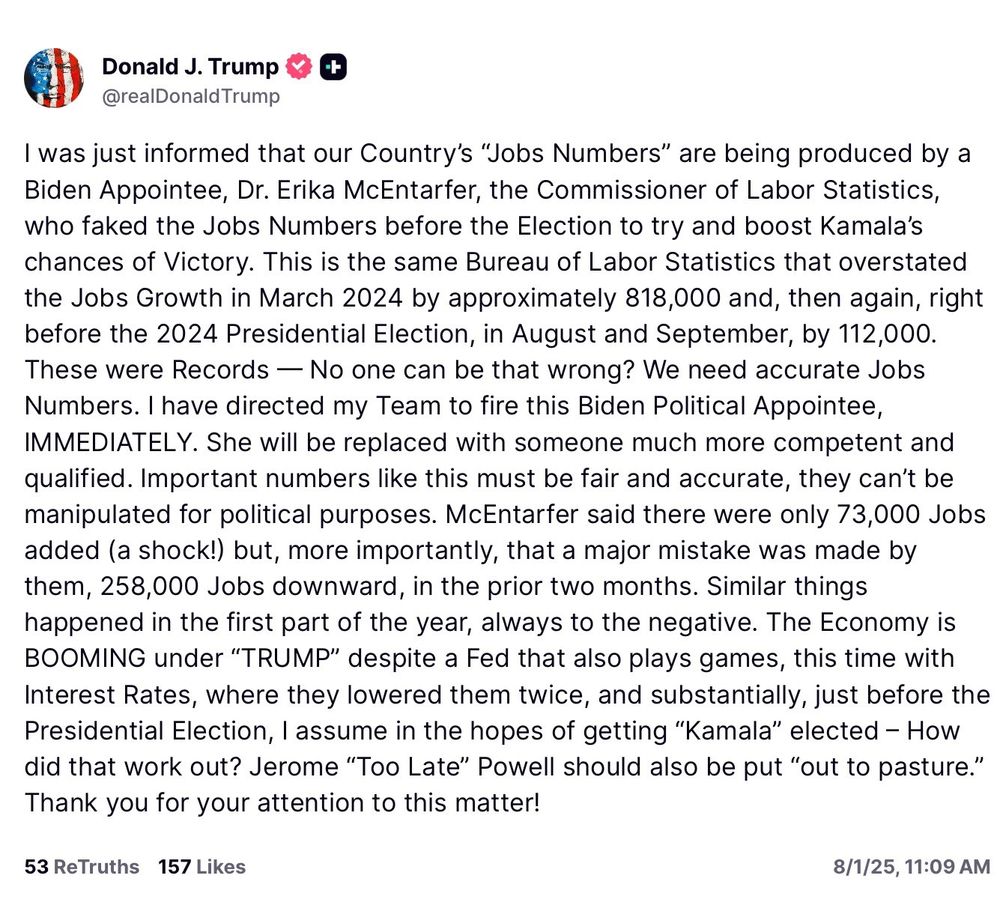
I can't stress how damaging this is.
Destroys trust in core government statistics.
01.08.2025 18:33
👍 136
🔁 27
💬 6
📌 6
@mikegeruso.bsky.social and Dean Spears' book After the Spike is out!
One of the most thoughtful and thought-provoking books on population out there.
11.07.2025 04:07
👍 5
🔁 1
💬 0
📌 0

Scatter plot comparing median program debt (x-axis, $50k-$300k) vs 10-year cumulative earnings (y-axis, $0.5M-$2M) for professional programs. Medicine MD programs (pink squares) cluster in upper right with high debt ($150k-$250k) and high earnings ($1.4M-$1.8M). Law programs (blue circles) cluster in the bottom left corner with lower debt and lower earnings, though some elite programs show medicine-level earnings and somewhat higher debt than other law schools. Veterinary Medicine (green diamonds), Dentistry (plus signs) and Pharmacy (X marks) are distributed across middle ranges of earnings, but across wide ranges of the distribution of debt, with almost all pharmacy programs having lower debt than almost all dentistry programs. Physical therapy and veterinary programs have law-like earnings (between half a million and a million over 10 years), and while PT has law-like debt as well, veterinary debt is generally much higher and closer to medical school.
New at @pseocoalition.bsky.social, @julia-turner.bsky.social & I have a new report on grad school debt & earnings over the medium term. For some key professional fields (🩺⚖️🦷💊🐾), we show the varied patterns both within & across areas of study, looking at the first decade of earnings after graduation
30.06.2025 17:31
👍 23
🔁 12
💬 3
📌 2

A stacked density plot showing distribution of annual graduate program borrowing in 2019 across different programs. Professional programs like dentistry and medicine have highest borrowing ($80k-120k), while master's programs in education and business typically borrow much less ($20k-40k). Programs ordered by average borrowing amount.
Wanted to highlight a new report we have just released at the Office of the Chief Economist at ED: "An Overview of Graduate Borrowing and Outcomes." Below are a few graphs that might entice you to read more. First: distributions of annual borrowing for top 25 credentials in terms of annual volume
17.01.2025 18:17
👍 15
🔁 6
💬 1
📌 3


