Warm congratulations to The Brain Prize winners 2026, Professor David Ginty and Professor Patrik Ernfors, for their pioneering work on how the nervous system detects and processes touch and pain.
Karolinska Institutet
HHMI
#Neuroscience #BrainPrize2026
05.03.2026 15:01
👍 74
🔁 35
💬 1
📌 9
Wow what a neat prep! Those imaging results look awesome for such a simplified fly holder. Thanks for sharing this as a resource!
20.02.2026 15:16
👍 1
🔁 0
💬 0
📌 0
Probably! AOTU019 is directly downstream of PFL3. We can only speculate atm, but it seems likely that AOTU019 is recruited during CX-mediated navigation and may help drive small error corrections. For example, we see that both AOTU cells corr with steering in darkness.
19.02.2026 11:52
👍 0
🔁 0
💬 0
📌 0
Together, these mechanisms allow more robust pursuit performance across diverse and changing conditions, and may offer design principles for adaptive engineered systems as well.
Huge thanks to my advisor Rachel Wilson and my incredible labmates.
18.02.2026 16:15
👍 1
🔁 0
💬 0
📌 0

Our work points to two general strategies for adaptive control in biological feedback systems:
1️⃣ Multiple feedback pathways allow smooth interpolation between control strategies.
2️⃣ Selective state-dependent recruitment or tuning of each pathway allows context-appropriate control rules.
18.02.2026 16:15
👍 0
🔁 0
💬 2
📌 0
This architecture enables flexible control gain and logic. For instance, the central pathway is more flexible and increases steering gain when an object is moving away from the midline, the pursuer is running faster, or during social arousal (I.e. courtship and aggression).
18.02.2026 16:15
👍 0
🔁 0
💬 1
📌 0

Using Drosophila as a model, we identified two specialized, parallel pathways that drive visual tracking. One detects peripheral objects and steers them toward the center of the visual field. The other detects central objects already, steers them toward the midline and drives forward acceleration.
18.02.2026 16:15
👍 0
🔁 0
💬 1
📌 0
How does the brain continuously adjust its own control parameters to match changing conditions? Across species, behavioral studies have shown that visual object pursuit involves adaptive (i.e. flexible) control, but the neural mechanisms behind this flexibility are not well understood.
18.02.2026 16:15
👍 0
🔁 0
💬 1
📌 0
Ooh very cool story! What is this neuron called in FAFB/FlyWire?
05.01.2026 17:09
👍 1
🔁 0
💬 1
📌 0
How does the brain control locomotion? In our new preprint, we uncover a brain circuit in Drosophila that controls forward walking independently of turning. This dedicated locomotor circuit enables flexible motor control and might reflect a shared principle across species. doi.org/10.64898/202...
05.01.2026 16:24
👍 78
🔁 26
💬 3
📌 3

Landing and takeoff sensorimotor pathways illustrated alongside fly drawings showing behavioral responses.
How do animals channel sensory information into motor pathways to generate flexible behavioral output? Excited to share a new preprint addressing this question by leveraging the new #maleCNS connectome, behavioral experiments, and in-vivo recordings: doi.org/10.64898/202.... A long🧵...
19.12.2025 07:02
👍 69
🔁 29
💬 3
📌 1
🤩
16.12.2025 17:38
👍 1
🔁 0
💬 0
📌 0

Always fun designing the most unnecessarily extravagant posters for our department happy hours 😁
04.11.2025 18:20
👍 3
🔁 0
💬 0
📌 0
Our findings in females build on the incredible work from @ceschretter.bsky.social on aIPg cells.
Also big s/o to the team @hhmijanelia.bsky.social and the Lab of @jefferis.bsky.social for generating the male brain #connectome dataset. Such an amazing resource and it was a pleasure to dig into.
03.11.2025 16:58
👍 3
🔁 0
💬 0
📌 0
I could go on with new behavioral, ephys, and modeling data, but I encourage folks to check it out!
Big takeaway is adaptive control in the #drosophila pursuit system emerges from two parallel pathways with specialized roles and different control gain/logic. These pathways are key in both sexes.
03.11.2025 16:58
👍 1
🔁 0
💬 1
📌 0

(A) LC10a cells with dendrites in the lobula (LO) and axons in the anterior optic tubercle (AOTU), color-coded by synapse count onto AOTU019 (left) or AOTU025 (right). Data from females (Flywire-FAFB). Scale bar: 20 μm.
(B) Estimated visual receptive fields for AOTU019 and AOTU025 in males (top, MaleCNS) and females (bottom, Flywire-FAFB), derived from LC10a input density along the LO medial–lateral axis, including 15° binocular overlap. Right: Estimated receptive fields (male) projected onto the anterior–posterior axis of the right retina.
(3) We then show that female AOTU neurons are similar to their male counterparts, in terms of their LC10a connections and visual receptive field properties. These results argue that the core visual pursuit circuit has similar physiological properties in both sexes.
03.11.2025 16:58
👍 4
🔁 0
💬 1
📌 0

Example recordings from AOTU019 and AOTU025 cells before and during arousal stimulation. Effects were similar in males (left: P1) and females (right: aIPg). Right hemisphere recordings were made while flies walked in darkness.
(2) We show that optostimulation of "arousal neurons" in females (i.e., aIPg cells) drives visual pursuit and preferentially depolarizes AOTU019. Previously, we had shown that the same is true in aroused males (i.e., P1 optostimulation).
03.11.2025 16:58
👍 1
🔁 0
💬 1
📌 0

(A) In visual pursuit, the pursuer’s task is to keep the target object (e.g., another fly) at the visual midline (0°). The angular deviation (θ) represents the error from this setpoint, which should drive
corrective turning to re-center the object via feedback control.
(B) Proposed feedback control model of visual pursuit in Drosophila. LC10a cells detect moving visual objects and influence steering descending neurons (DNs), largely via AOTU019 and AOTU025.
(C) Top five AOTU cell types in males (top) and females (bottom) receiving direct LC10a input and providing direct outputs to walking-related steering DNs. DNa03 primarily targets other DNs, including DNa02 (Fig. S1B). Synapse counts averaged across hemispheres. Connectivity in males (MaleCNS) and females (Flywire-FAFB).
To highlight just a few of the newest features:
(1) With the new male connectome, we were able to perform comparative analyses of AOTU cells in males and females. We showed that, in both sexes, AOTU019 and AOTU025 are the key links between visual input (LC10a) and pre-motor outputs (DNs).
03.11.2025 16:58
👍 3
🔁 0
💬 1
📌 0

Specialized parallel pathways for adaptive control of visual object pursuit
To pursue a moving visual object, the brain must generate motor commands that continuously steer the object to the center of the visual field via feedback. The gain of this control loop is flexible, y...
Delighted to share an updated pre-print on how adaptive control in visual pursuit is implemented at the circuit level. New behavior and neuronal data in females (!) shows how two AOTU pathways are key elements in both sexes.
Check it out on @biorxiv-neursci.bsky.social :
doi.org/10.1101/2025...
03.11.2025 16:58
👍 15
🔁 5
💬 2
📌 1

Do flies feel pain?
Spooky new preprint from our lab on the cells and circuits that mediate nociceptive behaviors in adult Drosophila, led by graduate student (and newly minted PhD!) @jonesjes.bsky.social.
🪰⚡👻🎃
www.biorxiv.org/content/10.1...
29.10.2025 18:56
👍 76
🔁 29
💬 1
📌 3

How it feels pushing a pre-print update (thread coming soon!)
23.10.2025 18:04
👍 1
🔁 0
💬 0
📌 0

a group of Drosophila erecta fruit flies on a small food patch. flies on white background
Excited to share our new #biorxivpreprint
We discovered that the fruit fly #drosophila erecta requires food odor to mate and arousal is further enhanced by social group motion.
Cross-species analysis of brain activity reveals a novel gate evolved from within a conserved circuit
shorturl.at/gGYm7
16.10.2025 06:33
👍 83
🔁 44
💬 12
📌 3
Excited to share our new #biorxivpreprint:
“Sexual dimorphism in the complete connectome of the Drosophila male central nervous system” www.biorxiv.org/content/10.1...
We describe the #connectomics reconstruction and analysis of an entire adult #maleCNS #drosophila central nervous system. 1/10
15.10.2025 16:17
👍 123
🔁 67
💬 1
📌 5
Congratulations Sven! Looking forward to having your lab just across the river!
15.10.2025 17:17
👍 1
🔁 0
💬 0
📌 0
😍
05.10.2025 21:51
👍 1
🔁 0
💬 0
📌 0
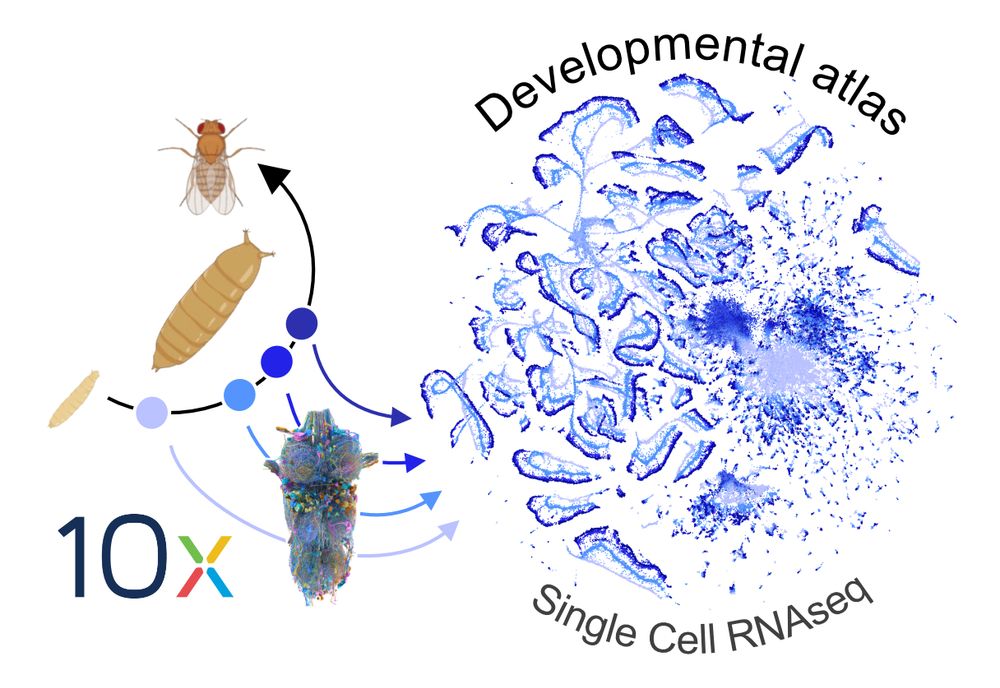
ALT text: A UMAP representation of a single cell RNAseq dataset from the Drosophila ventral nerve cord as well as images of the Drosophila nerve cord connectome and different stages of fly development.
Neuronal diversity is written in transcriptional codes 🧬. But what is the logic of these codes that define cell types and wiring patterns?
To find out we built a #scRNAseq developmental atlas of the Drosophila nerve cord and linked it to the #connectome 🪰🧠
#preprint thread ⬇️1/8
21.08.2025 16:04
👍 121
🔁 59
💬 6
📌 2