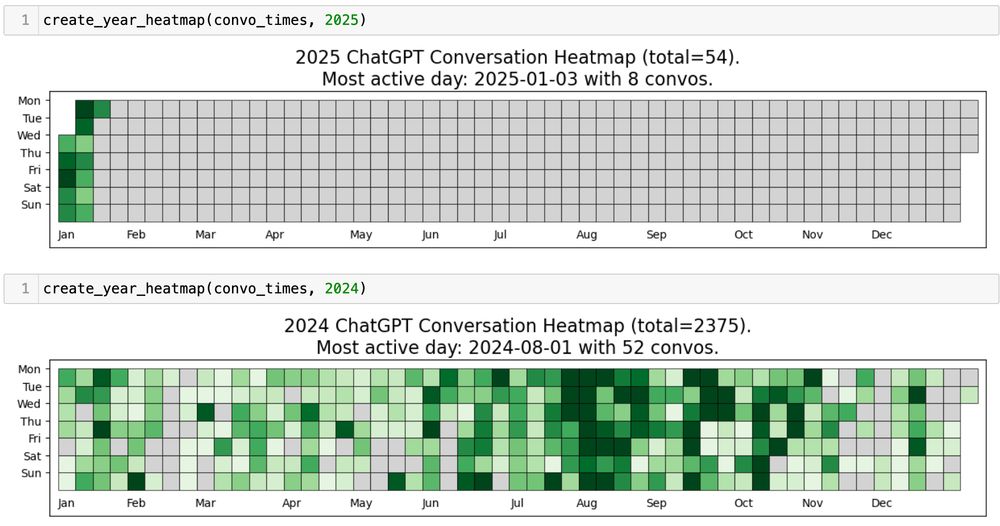
I'm using AI so much for work that I can tell how productive I am by how many conversations I've had with AI.
Script to generate this heatmap: github.com/chiphuyen/ai...
14.01.2025 23:32
👍 55
🔁 1
💬 2
📌 0

Finally got my copy! “AI Engineering” is officially out 🙏 🎉
It’s heavier than I expected (500 pages) and I’m so glad O’Reilly decided to publish it in color.
Thanks everyone for making this happen! Thank you for giving this book a chance!
09.01.2025 16:43
👍 143
🔁 11
💬 13
📌 2

Agents
Intelligent agents are considered by many to be the ultimate goal of AI. The classic book by Stuart Russell and Peter Norvig, Artificial Intelligence: A Modern Approach (Prentice Hall, 1995), defines ...
My 8000-word note on agents: huyenchip.com//2025/01/07/...
1. An AI-powered agent's capability is determined by its tools and its planning ability
2. How to select the best tools for your agent
3. How to augment a model’s planning capability
4. Agent’s failure modes
Feedback is much appreciated!
07.01.2025 18:28
👍 152
🔁 29
💬 3
📌 5
O'Reilly said the first physical copies would appear around Dec 22 but my copies arrive on Jan 7 :(
13.12.2024 07:37
👍 2
🔁 0
💬 0
📌 0

Welcome to the Artificial Intelligence Incident Database
The starting point for information about the AI Incident Database
6. AI Incident Database
For those interested in seeing how AI can go wrong, this contains over 3000 reports of AI harms: incidentdatabase.ai
13.12.2024 04:05
👍 8
🔁 1
💬 0
📌 0

Efficiently Scaling Transformer Inference
We study the problem of efficient generative inference for Transformer models, in one of its most challenging settings: large deep models, with tight latency targets and long sequence lengths. Better ...
4. Efficiently Scaling Transformer Inference (Pope et al., 2022)
An amazing paper about inference optimization for transformers. It provides a guideline to optimize for different aspects, e.g. lowest possible latency, highest possible throughput, or longest context length: arxiv.org/abs/2211.05102
13.12.2024 04:05
👍 0
🔁 0
💬 1
📌 0
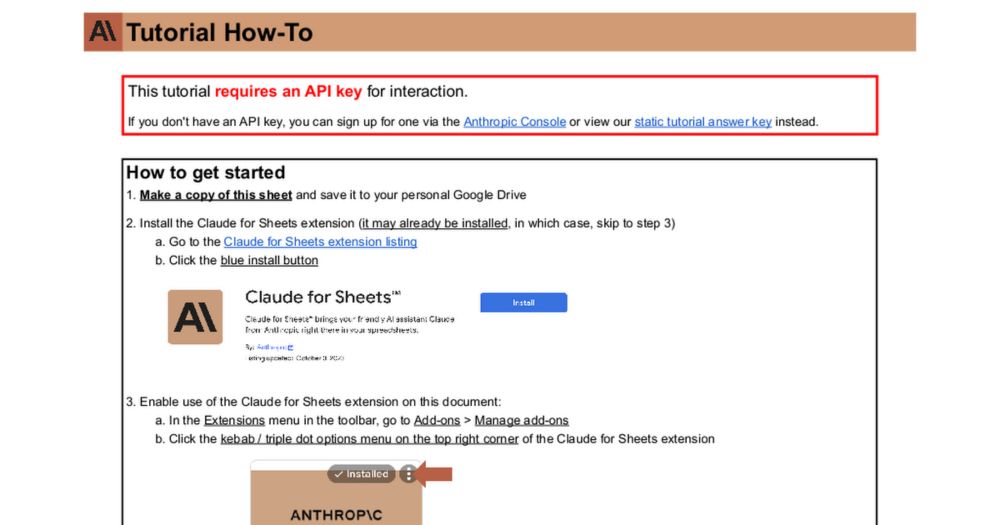
Anthropic's Prompt Engineering Interactive Tutorial [PUBLIC ACCESS]
The highlights:
1. Anthropic’s Prompt Engineering Interactive Tutorial
The Google Sheets-based interactive exercises make it easy to experiment with different prompts. docs.google.com/spreadsheets...
13.12.2024 04:05
👍 2
🔁 0
💬 1
📌 0
When doing research for AI Engineering, I went through so many papers, case studies, blog posts, repos, tools, etc. This repo contains ~100 resources that really helped me understand various aspects of building with foundation models.
github.com/chiphuyen/ai...
13.12.2024 04:00
👍 87
🔁 11
💬 5
📌 0
Where are the AI people? Who should I follow?
06.12.2024 16:27
👍 34
🔁 0
💬 9
📌 0
Hello, world. So I caved and got on Bsky :-)
I finally finished my book, AI Engineering, and I'm excited to get back to building. So many fun applications to build!
What are you excited about?
06.12.2024 00:39
👍 144
🔁 4
💬 14
📌 1