
The Food Assistance Landscape | Charlotte Ambrozek
Chatted with Jenny Ifft this week about the food assistance landscape, overviewing our public and private programs and where they're going
open.spotify.com/episode/26lX...
06.02.2026 18:41
👍 5
🔁 3
💬 0
📌 0

SNAP work requirements reduce participation by increasing procedural denials—a direct marker of administrative burden. Exploiting age-based exemptions for able-bodied adults without dependents, from Jason B. Cook, Elizabeth Cox, and Chloe N. East www.nber.org/papers/w34698
23.01.2026 14:01
👍 6
🔁 3
💬 0
📌 0

Coming soon to Zoom rooms near you!
We're excited to announce a reboot of the Chamberlain Seminar, five years after its 2020 debut
We'll kick things off on 3/21 with a tribute to Gary. More info and future seminars here:
chamberlainseminar.org
Register here: stanford.zoom.us/meeting/regi...
07.03.2025 16:02
👍 36
🔁 8
💬 1
📌 3

Text of letter available here: https://docs.google.com/document/d/1SMkdyaeJWOHN4y-DC5RPY1ZGk9B_SIIk5Tv_Yz5zQRw/edit?tab=t.0

I am hearing that PEPFAR programs are still being stalled, and medication appointments cancelled, despite a waiver in place to allow life-saving programs to continue. Thus,
@belindaarch.bsky.social
and I are sharing the letter we wrote, signed by 110 economists, urging its continuation. 1/4
04.02.2025 14:54
👍 45
🔁 30
💬 2
📌 3
We are now on Bluesky! Follow us for the latest news and updates from JPAM. #EconSky #PolicySky
03.02.2025 19:47
👍 24
🔁 4
💬 0
📌 1
@belindaarch.bsky.social and I have written a letter from economists regarding PEPFAR. Please sign and share with your network. Only economist signatures right now (for more focused impact). Once signed, we will share with the administration, congress, + the media. #econsky
forms.gle/C5roVX5sFF14...
28.01.2025 14:33
👍 38
🔁 34
💬 2
📌 8
Broader agreement that it to applies to discretionary spending payments (Head Start, WIC, etc).
28.01.2025 03:52
👍 637
🔁 117
💬 50
📌 81

Background: Food security, defined as consistent access to sufficient food to support an active life, is a crucial social determinant of health. A key dimension affecting food security is position along the rural-urban continuum, as there are important socio-economic and environmental differences between communities related to urbanicity or rurality that impact food access. The COVID-19 pandemic created social and economic shocks that altered financial and food security, which may have had differential effects by rurality and urbanicity. However, there has been limited research on how food security differs across the shades of the rural-urban community spectrum, as most often researchers have characterized communities as either urban or rural. Methods: In this study, which linked restricted use Current Population Survey Food Security Supplement data to census-tract level United States Department of Agriculture Rural-Urban Commuting Area codes, we estimated the prevalence of household food security across temporal (2015-2019 versus 2020-2021) and socio-spatial (urban, large rural city/town, small rural town, or isolated rural town/area) dimensions in order to characterize variations before and during the COVID-19 pandemic by urbanicity/rurality. We report prevalences as point estimates with 95% confidence intervals. Results: The prevalence of food security was 87.7% (87.5-88.0%) in 2015-2019 and 88.8% (88.489.3%) in 2020-2021 for urban areas, 85.5% (84.7-86.2%) in 2015-2019 and 87.1% (85.7-88.3%) in 2020-2021 for large rural towns/cities, 82.8% (81.5-84.1%) in 2015-2019 and 87.3% (85.789.2%) in 2020-2021 for small rural towns, and 87.6% (86.3-88.8%) in 2015-2019 and 90.9% (88.792.7%) in 2020-2021 for isolated rural towns/areas. Conclusion: These findings show that rural communities experiences of food security vary and aggregating households in these environments may mask areas of concern and concentrated need.
📈📉 New Census Working Paper: "Food Security Status Across the Rural-Urban Continuum Before and During the COVID-19 Pandemic" by Patrick J. Brady, Melissa N. Laska, Rachel Widome, and Sruthi Valluri www.census.gov/library/work...
14.01.2025 14:26
👍 2
🔁 2
💬 1
📌 0
Hello World! The Editorial Board of Health Economics is pleased to announce that we are now live on the happier, friendlier, and all-together Blue-er place. Please follow us (and repost) for updates on articles and journal issues as they come out.
15.01.2025 21:42
👍 59
🔁 28
💬 2
📌 6
PSA to job market candidates: if you didn't get a particular flyout, it may have had nothing to do with the quality of your interview. Departments have a myriad of internal constraints and goals that are unobservable to you, and the process is a lot more complex than you think.
10.01.2025 15:23
👍 112
🔁 30
💬 1
📌 1

Lastly (for now): IV hotel by Phillipa Gowdy-Jaehnig
03.01.2025 19:50
👍 5
🔁 0
💬 0
📌 0

The "woman yelling at a cat" meme format. Above the woman, it says "`You will never be able to isolate the relationship between those variables, there are too many other variables!'" Above the cat, it says "Me using fixed effects in a simple linear regression"
Next, can't argue with fixed effects, by Michael Pliscott:
03.01.2025 19:50
👍 1
🔁 0
💬 1
📌 0

A four panel comic. In the top left panel, a brain has a speech bubble that says "are you going to sleep?". In the top right panel, a woman lying in bed has a speech bubble that says "Yes I am. Now shut up." In the bottom left panel, the brain has a speech bubble that says "did you code your standard errors to be heteroskedasticity-robust?" In the bottom right panel, we see the woman, lying in the dark, with eyes wide open in horror.
First up, losing sleep over your code, by Havy Nguyen:
03.01.2025 19:50
👍 2
🔁 0
💬 1
📌 0
Excited to start the year off sharing some memes made by my students in Intro Econometrics for extra credit on their final. The prompt is to make a meme about an econometrics concept, and then explain to me, as if I am your less econometrically savvy relative, why the meme works.
03.01.2025 19:50
👍 7
🔁 2
💬 1
📌 0

Alfonso Flores-Lagunes watches Judith Liu present their joint research
Judith Liu presenting research with our Alfonso Flores-Lagunes, and Norbert Wilson, on disparities in food insecurities between foreign-born and U.S.-born-headed households. #ASSA2025
03.01.2025 17:28
👍 0
🔁 2
💬 1
📌 0

Screenshot of paper title and abstract
🚨Closing out 2024 with a new paper with @hristakeva.bsky.social and @leofeler.com: How GLP-1 medications like Ozempic are reshaping food demand and changing the rules of the game for the food industry.
31.12.2024 15:29
👍 37
🔁 13
💬 2
📌 2
Casey is on BlueSky! @casemcnich.bsky.social
Keep an eye out for her work in public and labor in the next couple of years.
12.12.2024 14:57
👍 1
🔁 0
💬 0
📌 0

NEW: Reps. Adrian Smith and Chuck Edwards wrote Trump a letter today urging him to terminate the IRS’s new free tax filing service, otherwise known as Direct File, on “day one” through an executive order.
It’s co-signed by 27 House Republicans
The technical term for this move is “some BS” … the only tax program that scored higher in reviews from users was the pre-populated tax return pilot in California … also targeted by massive for-profit tax preparer lobbying …
12.12.2024 01:01
👍 30
🔁 6
💬 1
📌 1
🚨 New @apsrjournal.bsky.social Paper! 🚨
In “When Migrants Mobilize against Labor Exploitation: Evidence from the Italian Farmlands,” I study how empowering undocumented migrants can reduce labor exploitation and even weaken organized crime.
Thread : 🧵
11.12.2024 18:04
👍 116
🔁 47
💬 2
📌 2
Data on farmworkers and program participation is hard to get, so we're trying not to let the perfect be the enemy of the good here.
Really hoping that some folks who administer SNAP will find this useful.
Working paper coming soon!
Pictures by Casey McNichols, my excellent PhD student 3/3
10.12.2024 20:30
👍 3
🔁 1
💬 1
📌 0

Panel a of a figure showing the number of non-farmworker households in Fresno County churning (re-entering SNAP after being off the program for between 1 and 3 months) and participating in SNAP in every month from April 2016 to February 2020. Churn varies sort of randomly between 600 and 1,000 households per month. Participation is declining pretty smoothly from 95,000 households at the start to 80,000 households in June 2019, then picking back up to 85,000ish households and staying pretty constant for the rest of the sample. The spike in participation is caused by the end of SSI cash-out in California. Churn increases in the first 6 months of the sample as the number of households regularly observed stabilizes.

Panel b of a figure showing the number of farmworker households in Fresno County churning (re-entering SNAP after being off the program for between 1 and 3 months) and participating in SNAP in every month from April 2016 to February 2020. Churn varies very seasonally, with lows in February of 125 households per month and highs in November of 250ish households per month. Participation is declining over time (from 11,000 households at start of sample to 8,500 at end), but also has seasonal variation, with highs around January ~7% higher than lows around August.
Farmworkers could be seasonally attached to the safety net because:
(a) their eligibility really changes, or
(b) because they don't have the time or bandwidth to re-cert during harvest
We find suggestive evidence for (b) ➡️ outreach and admin changes could help farmworkers use SNAP! 2/3
10.12.2024 20:30
👍 4
🔁 0
💬 1
📌 1

Screenshot of the title, author list, and abstract of a policy brief from the UC Davis Center for Poverty and Inequality Research December 2024 issue.
Title: "SNAP Participation Among Agricultural Workers Impacted by Seasonal Employment"
Authors: Casey J. McNichols and Charlotte E. Ambrozek, University of Minnesota; and Timothy K. M. Beatty, UC Davis
The text of the abstract reads:
"The Supplemental Nutrition Assistance Program (SNAP) serves as a safety net for more than 41 million low-income families,
but only about 80 percent of eligible individuals participate. Among SNAP-eligible agricultural workers, take-up is likely
even lower. In a recent study, we explored the seasonality of agricultural employment and the extent to which its associated
administrative burdens impact households’ SNAP eligibility and participation. To measure households’ attachment to SNAP,
we used ‘churn’—exit and subsequent re-entry into SNAP—among Fresno County, CA households. We found a significant
negative correlation between SNAP churn and agricultural employment seasonality. Understanding the relationship between
SNAP churn and the seasonality of agricultural employment would likely improve access to the safety net for a vulnerable
population, as well as reduce SNAP implementation costs for both households and the state."
🚨 new policy brief 🧵
poverty.ucdavis.edu/post/snap-pa...
Farmworkers have high food insecurity AND low SNAP participation (even if eligible).
We show big correlations between harvest timing and farmworkers leaving then re-entering SNAP.
This pattern hurts both households and state budgets. 1/3
10.12.2024 20:30
👍 9
🔁 4
💬 1
📌 0

The results were strikingly consistent: In both places, about half of the people who were offered the flexible interview option chose to use it. In Los Angeles applicants given the flexible interview option (not just those who used it) had 30 day approval rates that were 6.2 points higher than those who were in the status quo scheduled interview-only process. In Boulder, applicants texted about a flexible interview option had an approval rate that was 6-7 points higher than those who only received a mailer with a scheduled interview time.
Mandatory interviews with a fixed interview time are a critical administrative checkpoint for SNAP applicants.
Giving them flexibility in scheduling interviews helps them get past this checkpoint. We ran experiments to increase interview flexibility with Code for America in LA and Boulder, CO.
06.12.2024 15:43
👍 67
🔁 3
💬 1
📌 0
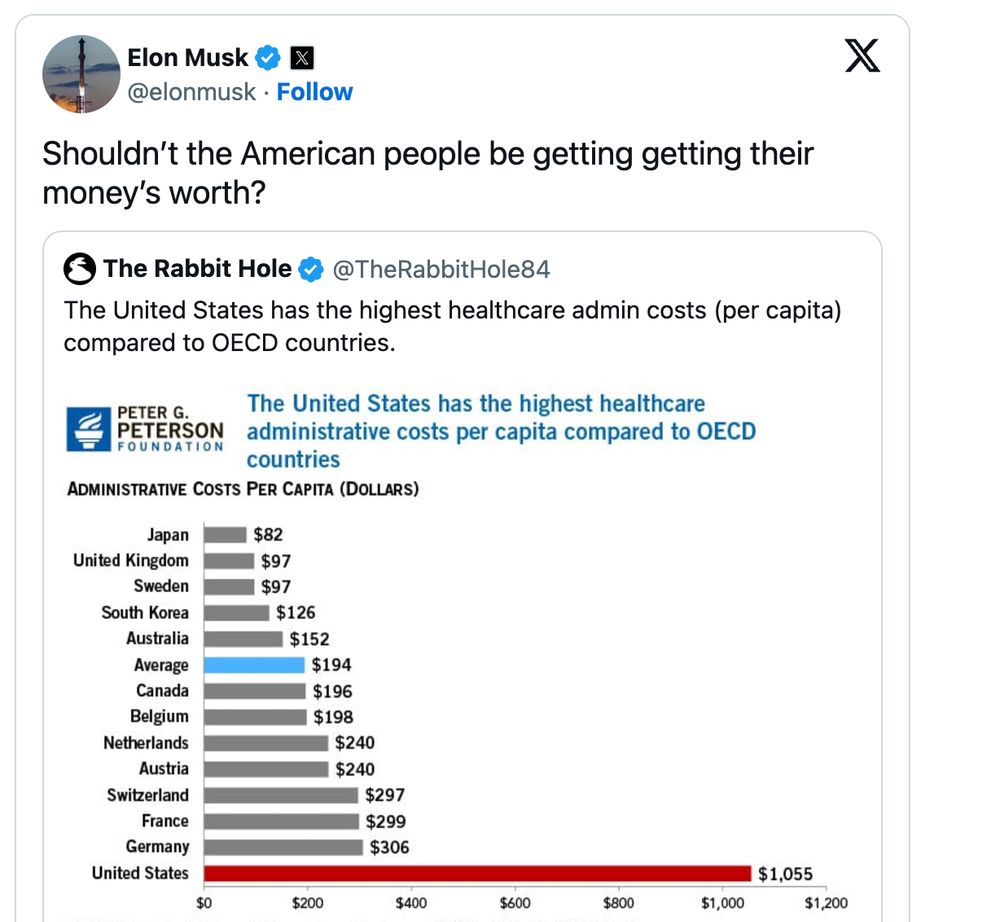
Sometimes the combination of arrogance and ignorance is breathtaking. Yes, US health care has high admin costs; that's because it relies so much on private insurers. Govt-run health insurance has much lower overhead
06.12.2024 11:49
👍 28061
🔁 6947
💬 1274
📌 456
@ #SEA2024 tomorrow and Monday.
Tomorrow I’m presenting new work on the effect of SNAP retailer disqualifications on participation in “Food Insecurity and Food Assistance” from 4-5:45p in Georgetown East
Looking forward to meeting/reconnecting with folks
Come say hi!
24.11.2024 02:21
👍 9
🔁 1
💬 0
📌 0


