
Room-Temperature Decarboxylative Amination of Electron-Deficient (Hetero)Aromatic Carboxylic Acids
Decarboxylative amination reactions offer the opportunity to access (hetero)aromatic amines from readily available carboxylic acid starting materials. However, the reliance of the Curtius rearrangemen...
Curtius without azide!
Very cool transformation from the Hoover Lab @ Minnesota out in #OrgLettASAP with @jesstheligand.bsky.social showings e-poor (Her)Ar-CO2H can undergo a Curtius-type rearrangement to her-Ar amines with NFSI as oxidant at RT!
Wonderful scope - well done all
#ChemSky
12.02.2026 17:46
👍 19
🔁 2
💬 1
📌 0
Let me know if you find a fix...so far, I haven't!
11.02.2026 14:00
👍 0
🔁 0
💬 0
📌 0
Inspired by the way nature modifies tyrosine residues, we've developed a simple method using a hypervalent iodine reagent to perform an umpolung of the phenolic core, generating ortho-quinone intermediates that can be readily trapped to accomplish either skeletal or peripheral modifications!
11.02.2026 11:55
👍 0
🔁 0
💬 0
📌 0
Does anyone else have issues with ChemRxiv's RSS feed after their website's update? I didn't get any content update since last week. I'm using The Old Reader as RSS reader.
#chemchat #chemsky
28.01.2026 08:22
👍 0
🔁 1
💬 1
📌 0
We had a great start of the year 😁 The final version of this work is now published. Congrats once again Michael, Atha, and Cedric!
pubs.acs.org/doi/10.1021/...
08.01.2026 10:59
👍 6
🔁 1
💬 0
📌 0

Fixing A Reaction
some seriously artisanal Derek this morning #chemchat www.science.org/content/blog...
04.12.2025 19:00
👍 35
🔁 5
💬 4
📌 2
#chemsky #chemchat
05.12.2025 00:35
👍 9
🔁 2
💬 0
📌 0
And here it is – Annulative Editing – aka The Monster Mash. What a super collab #PfizerChemistry & @sarponggroup.bsky.social
In 1 pot, activated pyrimidines with bis-nucleophiles like amino-pyrazoles & other small hets to deliver 6/5 hets and other useful products
#MyFirstJACS
#ChemSky #ChemChat
02.12.2025 19:46
👍 22
🔁 5
💬 3
📌 0

Oxygen migration into carbon–carbon single bonds by photochemical oxidation - Nature Synthesis
Heteroatom insertions into chemically inert carbon–carbon single bonds are rare compared to their unsaturated analogues. Now, ligand-to-metal charge transfer offers a promising entry point for oxygen ...
Really excited to see this in print - super work here by the wonderful team here from the @uwyoongroup.bsky.social
It was a real pleasure to watch this work evolve from a "what if" discussion to a @natsynth.nature.com paper
I truly appreciate being included #Chemsky
11.11.2025 00:55
👍 28
🔁 6
💬 0
📌 3

New @chemrxiv.org, a collaboration with @honggen-wang.bsky.social and group alum, now asst prof. Myojeong Kim: the first true catalytic interception of isodiazene-generated primary-amine-derived radicals. The key is an N-F reagent that enables productive chain carrying!
doi.org/10.26434/che...
21.10.2025 01:13
👍 14
🔁 4
💬 1
📌 0

www.organic-chemistry.org/abstracts/li...
A transition-metal-free ring expansion of gem-difluorinated cyclopropyl N-tosylhydrazons provides gem-difluorinated cyclobutenes.
16.10.2025 10:04
👍 0
🔁 1
💬 0
📌 0

🚨New paper🚨We have developed a simple method for the oxidative cleavage of beta-substituted primary alcohols in flow by using a solid-supported hypervalent iodine catalyst and a mild oxidant. Congrats Michael, Atha, and Cedric!
chemrxiv.org/engage/chemr...
14.10.2025 12:42
👍 3
🔁 1
💬 0
📌 1

I’m proud to share that my group has received a Starting Grant from @erc.europa.eu, which will enable us to explore new organophotomediated reactions, and deeply grateful to my group and the many colleagues who helped with the application.
04.09.2025 13:51
👍 20
🔁 1
💬 2
📌 0

Congrats to @fruepp.bsky.social, Vasily Grebennikov, Mykola Avramenko, Marc-Olivier Ebert "Kinetic, Spectroscopic, and Computational Investigation of Oxidative Aminative Alkene Cleavage Reveals an N-Iodonium-Iminoiodinane Pathway" now @chemrxiv.org - chemrxiv.org/engage/chemr...
02.09.2025 19:18
👍 14
🔁 6
💬 1
📌 1

Congrats to Ann-Sophie Paschke, @ybraegger.bsky.social, Bence Botlik, Erich Staudinger, @origreen.bsky.social! "Carbon-to-nitrogen atom swap enables direct access to benzimidazoles from drug-like indoles". www.nature.com/articles/s41.... @natchem.nature.com.
02.09.2025 18:49
👍 22
🔁 3
💬 0
📌 1

As asymmetric sulfur(VI) derivatives become more prevalent in the chemical sciences, especially in aza-derivatives, sulfoximines, sulfonimidamides, we have reviewed "The stereochemistry of substitution at S(VI)"
doi.org/10.1039/D5QO...
with Ollie Symes, @orgchemfront.rsc.org
02.09.2025 07:53
👍 6
🔁 2
💬 0
📌 0

Do Amino-Oxetanes Resemble Amides?
Check out our Matched Molecular Pairs study in
@chemrxiv.org comparing properties and structure.
Congrats @hikaruishikura.bsky.social and coworkers, in collaboration with Pfizer.
doi.org/10.26434/che...
02.09.2025 08:03
👍 8
🔁 5
💬 0
📌 0
Many Thanks for the wonderful highlight!!
20.08.2025 06:31
👍 7
🔁 1
💬 0
📌 0
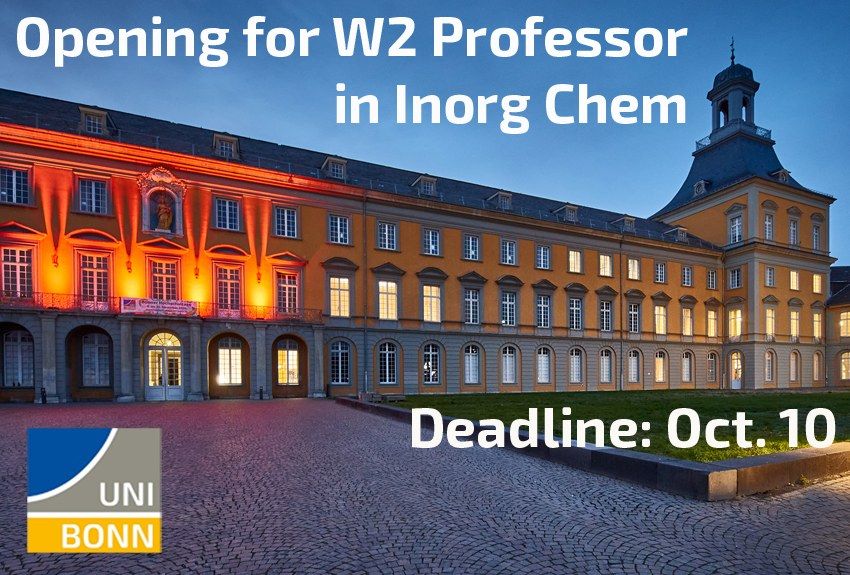
📢pls share
We are hiring! New opening for a W2 Professor in "experimental inorganic chemistry" @unibonn.bsky.social
Deadline Oct. 10 t.co/EqMLA0fCuC
19.08.2025 20:09
👍 33
🔁 24
💬 3
📌 3

Automated Determination of the Molecular Substructure from Nuclear Magnetic Resonance Spectra Using Neural Networks
Nuclear magnetic resonance (NMR) spectroscopy is an indispensable tool for determining the structural characteristics of a molecule by analyzing its chemical shifts. A wealth of NMR spectra therefore exists and continues to amass on a daily basis, at an ever-increasing rate owing to the progressive automation of chemical analysis. This growth and automation have led to the data analysis step in NMR spectroscopy becoming the main bottleneck in the structural characterization of a new chemical compound. In particular, the data interpretation step is slow and prone to error as it requires manual examination by a suitably trained scientist. Machine learning (ML) methods could overcome this bottleneck, pending that they can automatically correlate the collection of peaks in an NMR spectrum with the substructure of its subject molecule. This study explores the art of the possible using three types of ML methods that are based on neural-network architectures: a multilayer perceptron (MLP) + long short-term memory (LSTM) neural network, a convolutional neural network (CNN), and an MLP + recurrent neural network (RNN). NMR spectrum–structure correlations were encoded into each type of neural network using two forms of molecular representation, one employing functional groups and the other using a novel neighbor-based method. These models were trained on 34,503 and 17,311 experimental 13C and 1H NMR spectra, respectively. The influence of incorporating metadata about experimental conditions (NMR field strength, temperature, and solvent) into the neural-network model was also investigated. The models incorporated coupling constants as a proxy for spectral intensities in the case of 13C NMR spectra. We found that the MLP + LSTM model achieved the highest accuracy (88%) when trained on 13C NMR spectra and incorporating experimental metadata (compared to 77% without incorporating it). While the CNN model performance was slightly lower (86% accuracy), it determined molecular substructures in one-third of the computational run time compared to the MLP + LSTM model. Thus, the CNN model emerged as the practically best model when considering performance, time, and cost.
Liu & Cole use neural networks on 50k+ ¹³C/¹H NMR spectra with metadata to predict molecular substructures. Their MLP+LSTM model hit 88% accuracy; CNNs reached 86% in one-third the time, enabling fast, automated NMR analysis for chemistry and drug discovery. pubs.acs.org/doi/full/10....
16.08.2025 14:19
👍 8
🔁 4
💬 0
📌 0

Sulfur fluoride exchange with carbon pronucleophiles
Aryl alkyl sulfones are an important class of compounds in drug discovery; thus, new methods toward their synthesis are desirable. A general sulfur fluoride exchange (SuFEx) method to couple aryl sulf...
SuFEx welcomes new coupling partners - carbon pronucleophiles now in @chemicalscience.rsc.org . Congrats to Ball Lab students Joe Novicku and Matt Teeter and Pfizer colleagues Alistair, Tom, Neil, ans @chrisamende.bsky.social on the great work! #MyFirstChemSci
pubs.rsc.org/en/content/a...
15.08.2025 12:00
👍 10
🔁 5
💬 1
📌 0

Journal Impact Nonsense
No matter how hard you try, you simply cannot guess the journal withe the highest “impact factor” in organic chemistry last year. Really. Nor will you guess many of the other “winners”:
14.08.2025 18:32
👍 76
🔁 26
💬 14
📌 12


