Undergraduate economists, check out the Williams Pier conference. It's a great opportunity to share your work!
02.03.2026 11:55
👍 2
🔁 1
💬 0
📌 0
Undergraduate economists, check out the Williams Pier conference. It's a great opportunity to share your work!
Applications are OPEN for CSWEP’s 2026 CeMENT Mentoring Workshop! 🎉 Come get feedback on your research, practical advice for navigating the tenure track, and a community that will lift you up.
Details & application here 👉 www.aeaweb.org/about-aea/co...
@aeacswep.bsky.social #EconSky

Excellent op-ed from @yanarodgers.bsky.social placing the Summers scandal---and the lifetime ban announced today by the AEA---in context.
theconversation.com/larry-summer...
The AEA has imposed a lifetime ban on Lawrence H. Summers’ membership and participation in AEA activities. See the full statement here. www.aeaweb.org/news/aea-sta...
"lessons from almost dying in childbirth at conference"
The CSWEP newsletter presents interesting testimonies about career and family
www.aeaweb.org/content/file...
Y’all, this CSWEP newsletter is a banger. Five women economists generously share their stories about navigating family and career. 🔥 @jialanw.bsky.social @kmpjones.bsky.social Sarah Hamersma, Kosali Simon, and Sarah Baird. It was an honor to "edit" (which mostly involved sitting back for good reads)
CSWEP strongly condemns Larry Summers’ behavior as revealed in the email correspondence with the late Jeffrey Epstein. While abuse of power in the economics profession is not new, rarely has the intent behind such abuse been so clearly stated.
No reason to think Texas is unique. But we're getting the data to directly test this question soon. Stay tuned!

Fascinating new research from @caitlinmyers.bsky.social and others shows that when laws restrict abortion, we see a jump in property crimes such as car theft, burglary.
It underscores how financially destabilizing unplanned pregnancy can be — and how ill-equipped our safety net is to address it.

@oaldridge.bsky.social @npr.org covered our new paper on the surprisingly large effects of abortion access on crime. Totally agree with Jonathan Gruber: we've got to follow this up and see if it replicates outside of Texas. On it!
(with @erdaltekin.bsky.social , Erkmen Aslim, Wei Fu, and Ben Xue)
Takeaway: When abortion access is restricted, the consequences extend past fertility—into labor markets, family finances, and property crime.
Findings:
- Abortions ↓, births ↑
- Labor force participation ↓
- Debt burdens ↑
- Income inequality ↑
- Housing insecurity ↑
- Property crime ↑ (burglary, larceny-theft, motor vehicle theft)

We exploit a natural experiment: clinic closures in Texas after HB-2 (2013) that sharply increased travel distances to the nearest abortion provider.
This lets us study how access shocks affect reproductive behavior, household economic well-being, and public safety.

Excited to share our new paper on abortion, economic hardship, and crime (with Erkmen Aslim, Wei Fu, @erdaltekin.bsky.social , and Ben Xue).
We study how abortion access affects economic hardship and crime in Texas using clinic closures after HB-2.
www.nber.org/papers/w34245
Any economists out there who might be interested in writing about choosing a childfree life? I'm editing an upcoming CSWEP newsletter on fertility choices and hoping to include this perspective. Shoot me a message if you might be my person!

And I'm going to shamelessly present my very first Sankey diagram (showing flows of OBGYNS between states). Thanks to the awesome bsky.app/profile/asja... for the Stata Sankey package used to make it!

Excellent coverage of our new paper out today @jama network open. Joint with Becky Staiger, @vbolotnyy.bsky.social, Sonya Borrero, @maya-rossin-slater.bsky.social, Jessica Van Parys.
www.cnn.com/2025/04/22/h...

If you're curious about how the economists' amicus brief in Dobbs came to be.... Thanks to @grouchybagels.bsky.social @rooseveltinstitute.org for a great interview!
www.firesidestacks.com/p/abortion-a...

Society members @caitlinmyers.bsky.social; Suzanne Bell, PhD, MPH; Diana Foster, PhD; and Alison Norris, MD, PhD contributed their expertise to a NY Times article spotlighting new research from Dr. Myers and Society Changemaker Mayra Pineda-Torres, PhD.
www.nytimes.com/2025/03/17/u...

Coverage of our new @nber.org working paper @upshot.nytimes.com @sangerkatz.bsky.social. Really appreciate the perspectives of the various folks they interviewed.
www.nytimes.com/2025/03/17/u...
It's taken years to collect these data. More than 40 research assistants called every abortion facility in the country for appointment availability information...repeatedly. Gratitude to these hard-working students and to the Society of Family Planning for funding the data collection. [10/10]

The effects of bans don't appear to decrease after shield laws came online and expanded telehealth access. One explanation is that people substitute from driving to telehealth abortion. The populations who are “trapped” by distance might not be reached by shield law provision. [9/10]
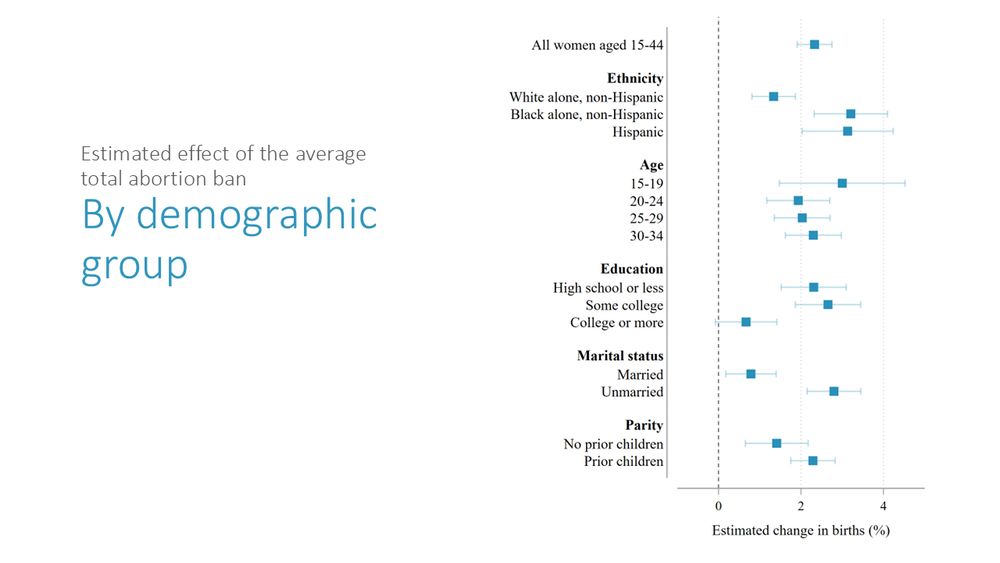
Black and Hispanic women, unmarried women, and less educated women are the most affected by abortion bans. [8/10]
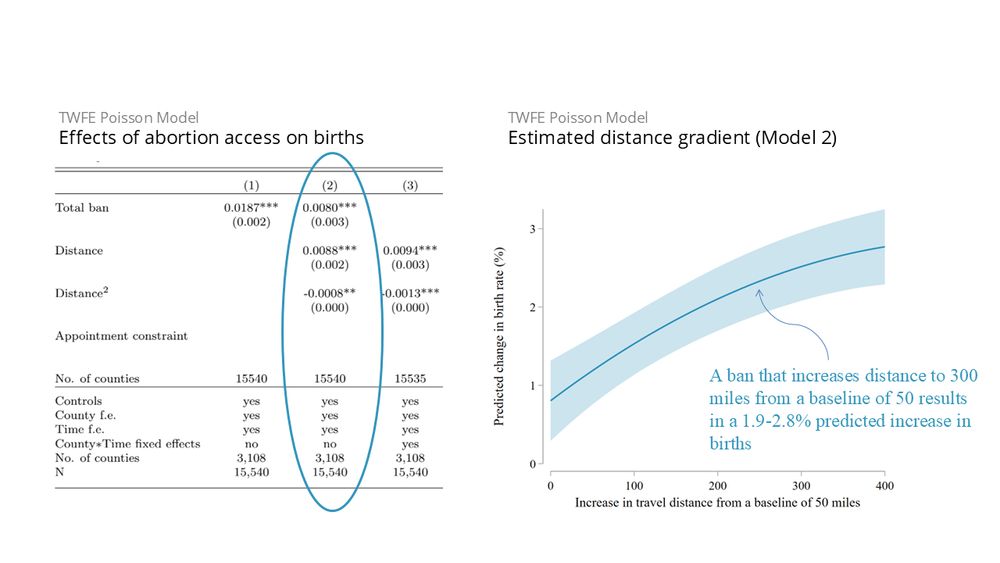
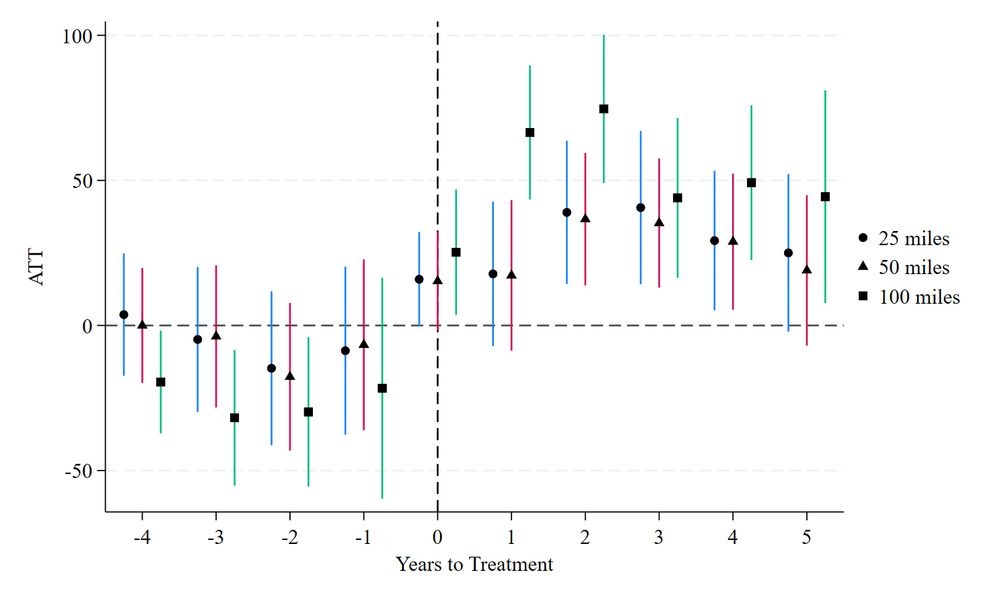
We throw fancier models at the data and essentially see the same thing: distance and appointment availability mediate the effects of abortion bans. [7/10]
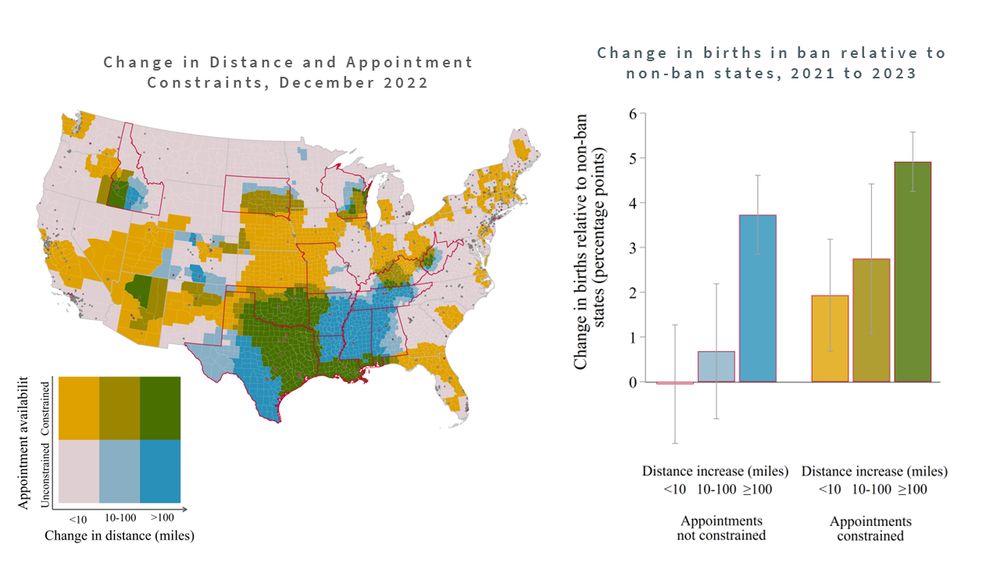
Within ban states, births increased the most where distances increased the most. The effects were additionally mediated by appointment availability in the destination. [6/10]
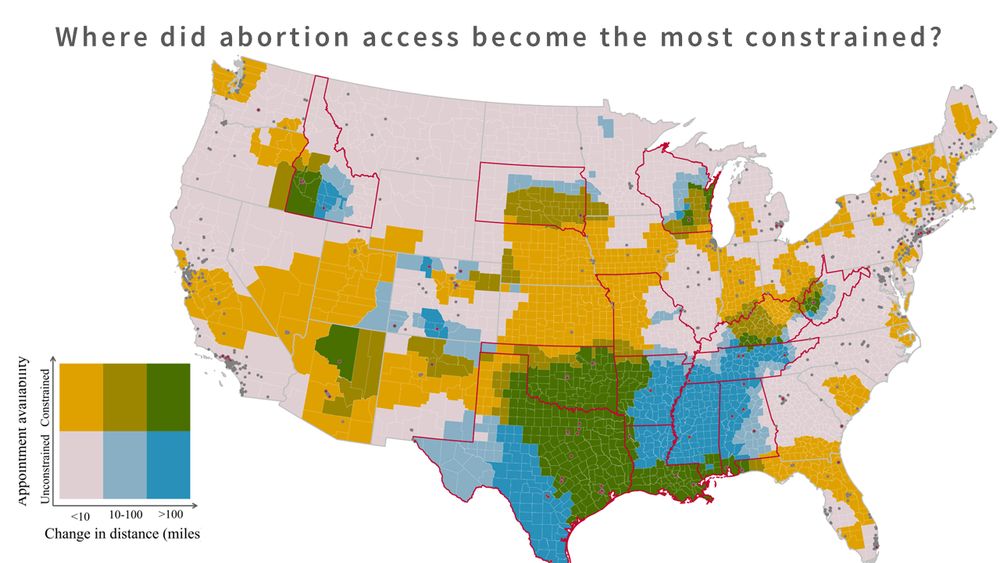
We use a county-level analysis to learn who is most affected by the bans. Texas’ ban left Houstonians with a 600-mile drive to Kansas, where appointment availability was constrained. But residents of El Paso had less than 30 miles to drive to New Mexico, where appointments were available. [5/10]
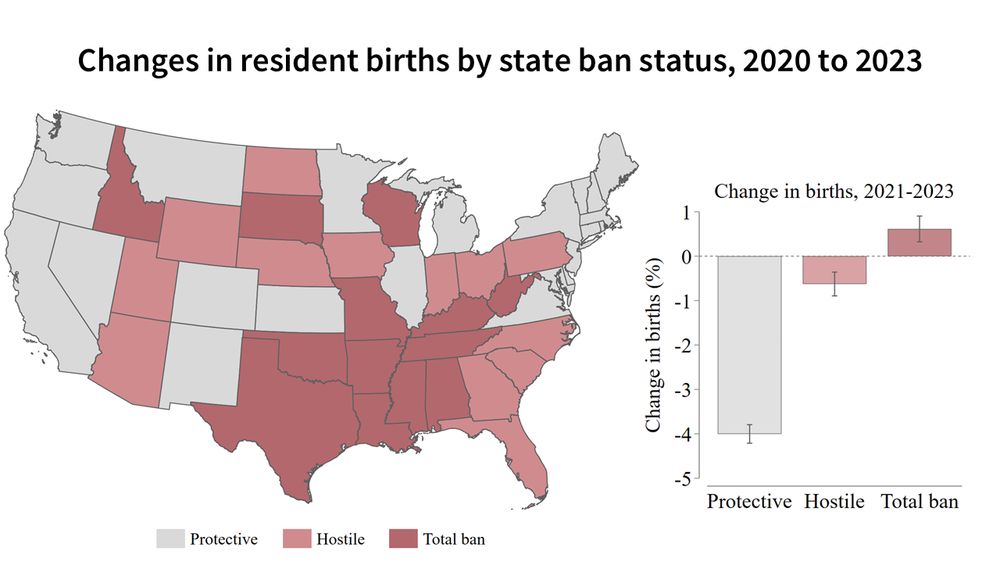
These abortion numbers don't capture abortion pills being mailed into these states. With incomplete abortion surveillance, we turn to births and see a corresponding pattern, suggesting that everyone who wanted an abortion was not finding a way to get one. [4/10]
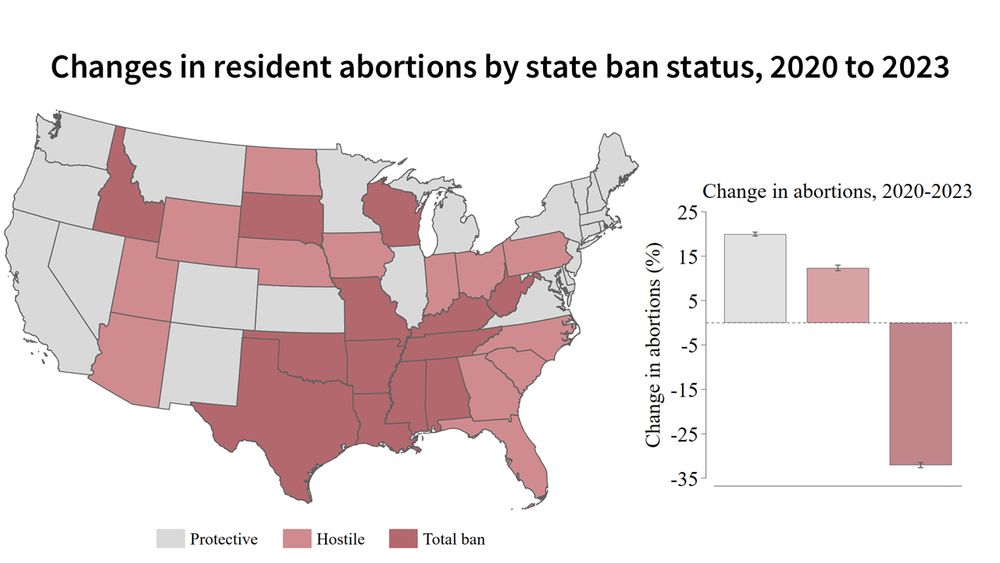
We use estimates of state resident abortions from @imaddowzimet.bsky.social to show that the national rise in abortions is driven by increases in abortions in states where abortion access expanded after Dobbs. Meanwhile, resident abortions fell in states that restricted access. [3/10]
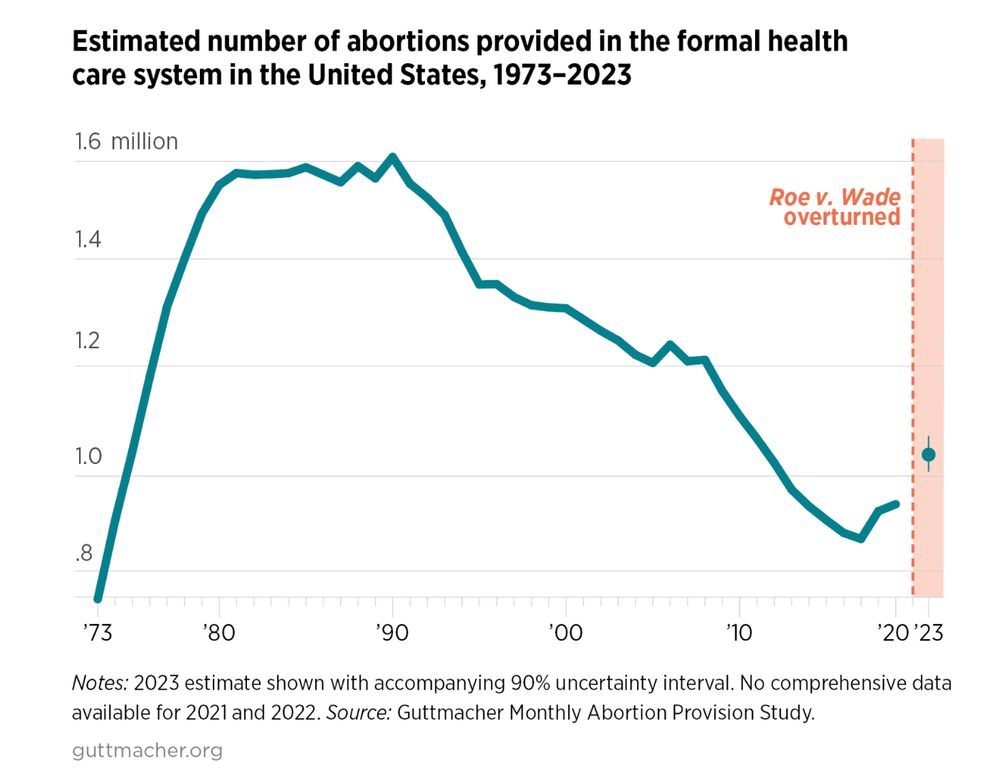
Despite post-Dobbs bans, abortions actually increased 11% in 2023. Do abortion bans actually stop anyone from getting abortions? [2/10] www.guttmacher.org/2024/03/desp...
