
The review process at Geomorphica is #TripleAnonymous, which keeps it as fair and unbiased as possible.
This #factfriday we explore how that works and what you can expect when publishing or reviewing with us.
21.03.2025 15:51
👍 4
🔁 1
💬 0
📌 0
#FountainFriday? #Kīlauea volcano’s episode 12 was a real stunner. USGS video by L. Gallant.
07.03.2025 05:12
👍 106
🔁 29
💬 4
📌 1
Feel good: Intouchables, +Scott Pilgrim. Astérix and Obélix: Mission Cleopatra.
Weird, interesting: Arrival.
Weird, old, funny: The fearless vampire killers (le bal des vampires).
Magical realism take on environmental pollution disasters: Distancia de rescate (Fever Dreams)
06.02.2025 05:41
👍 1
🔁 0
💬 0
📌 0
Watch these snowflake-like dendritic clinopyroxenes twinkle as this thin section is rotated in cross-polarised light!❄️☃️ This is a rare volcanic rock called komatiite, from Gorgona. Credit: Charlie Gordon. #ThinSectionTuesday #Petrology #Mineralogy
17.12.2024 09:25
👍 32
🔁 7
💬 0
📌 2
I know it’s not venomous…but can we get a spotlight for my favorite queen :-)? Zopilota o Clelia Clelia (I don’t know its english name). Natural predator of the Bothrops asper!
31.01.2025 03:25
👍 1
🔁 0
💬 1
📌 0
These are awesome! I was wondering…are you open to special requests? If there are specific volcanoes/color schemes one might be interested in?
25.01.2025 20:58
👍 1
🔁 0
💬 1
📌 0
It's almost funny how we got the first results in a day, submitted to the first journal in a week and took a year to publish 🤔... But I'm glad it's finally out there!
How fun - I hope it will be an enjoyable read! 😊Thoughts welcome of course.
17.01.2025 20:04
👍 1
🔁 0
💬 0
📌 0
Thanks Nick! Only took a year to convince a journal... :)
17.01.2025 19:49
👍 2
🔁 0
💬 1
📌 0

Map of the world showing median proportion of H2O exsolved from magmas. Red and orange locations are sufficiently low to apply this method (i.e., Galápagos, Cabo Verde, Canary Islands, Iceland, East African Rift, Hawaiʻi)
Could this be done elsewhere? H2O mixed with CO2 can affect results, and other volcanoes are not as dry. So, we compiled the proportion of H2O in magmas around the world using >4000 melt inclusions (pockets of magma in crystals). Turns out, it could be useful at many other hazardous volcanoes (5/5)
17.01.2025 18:57
👍 4
🔁 0
💬 0
📌 0

Main results from the simulation. Fluid inclusions were trapped at ~1-2 km depth, which corresponds with the well-constrained Halemaʻumaʻu magma reservoir.
How we did it: HVO personnel mailed the samples. We started at 9 am PT on the day of sample receipt. By 7 pm PT (5pm HT) fluid inclusions showed the crystals had been stored in the upper reservoir of Kīlauea prior to eruption. 2 subsequent days of additional analyses did not change the results (4/5)
17.01.2025 18:57
👍 3
🔁 0
💬 0
📌 0

Graph depicts the relationship between Pressure and Depth of fluid inclusion entrapment with CO2 density at different magmatically relevant temperatures. Increasing pressure and depth mean increasing density of CO2.

GIF Taken from IRIS/Active Earth monitor. Depicts how gases escape (exsolve) from magmas as they ascend towards the surface. CO2 is the first to exsolve, followed by sulfur and water.
As magma rises, gases like CO2 escape. Crystals growing in the magma trap the bubbles forming FI. If not modified, their CO2 density reflects the system’s pressure at trapping. By measuring many with Raman spectroscopy, we calculate the pressure—and depth— of magma storage before eruption (3/5)
17.01.2025 18:56
👍 5
🔁 1
💬 0
📌 0

"Where are the magmas coming from?" is a key question for scientists and nearby communities during eruptions. It helps model the system and assess eruption evolution. Faster than traditional geochemical tools, fluid inclusions were promising but hadn’t been tested in real time – until now (2/5).
17.01.2025 18:54
👍 3
🔁 0
💬 0
📌 0

⚒️ Can we measure magma storage depths fast enough to support volcanic observatories during ongoing eruptions? In our new JPET paper, we teamed up with HVO to simulate real-time rapid-response CO2 fluid inclusion barometry at Kīlauea, HI. We got depths in 1 day! How? Read on! (1/5)
17.01.2025 18:54
👍 33
🔁 7
💬 4
📌 2

Map of the world showing median proportion of H2O exsolved from magmas. Red and orange locations are sufficiently low to apply this method (i.e., Galápagos, Cabo Verde, Canary Islands, Iceland, East African Rift, Hawaiʻi)
Could this be done elsewhere? H2O mixed with CO2 can affect results, and other volcanoes are not as dry. So, we compiled the proportion of H2O in magmas around the world using >4000 melt inclusions (pockets of magma in crystals). Turns out, it could be useful at many other hazardous volcanoes (5/5)
17.01.2025 18:04
👍 1
🔁 0
💬 0
📌 0

Main results from the simulation. Fluid inclusions were trapped at ~1-2 km depth, which corresponds with the well-constrained Halemaʻumaʻu magma reservoir.
How we did it: HVO personnel mailed the samples. We started at 9 am PT on the day of sample receipt. By 7 pm PT (5pm HT) fluid inclusions showed the crystals had been stored in the upper reservoir of Kīlauea prior to eruption. 2 subsequent days of additional analyses did not change the results (4/5)
17.01.2025 17:55
👍 1
🔁 0
💬 0
📌 0

Graph depicts the relationship between Pressure and depth of entrapment with CO2 density of a fluid inclusion at different magmatically relevant temperatures. Increasing pressure and depth mean increasing density of CO2.

GIF Taken from IRIS/Active Earth monitor. Depicts how gases escape (exsolve) from magmas as they ascend towards the surface. CO2 is the first to exsolve, followed by sulfur and water.
As magma rises, gases like CO2 escape. Crystals growing in the magma trap the bubbles forming FI. If not modified, their CO2 density reflects the system’s pressure at trapping. By measuring many with Raman spectroscopy, we calculate the pressure—and depth— of magma storage before eruption (3/5)
17.01.2025 17:53
👍 3
🔁 0
💬 0
📌 0
"Where are the magmas coming from?" is a key question for scientists and nearby communities during eruptions. It helps model the system and assess eruption evolution. Faster than traditional geochemical tools, fluid inclusions were promising but hadn’t been tested in real time – until now (2/5).
17.01.2025 17:46
👍 2
🔁 0
💬 0
📌 0
Please add me! :)
15.01.2025 17:16
👍 1
🔁 0
💬 0
📌 0

Directory of Open Access Journals – DOAJ
DOAJ is a unique and extensive index of diverse open access journals from around the world, driven by a growing community, committed to ensuring quality content is freely available online for everyone...
Not sure if there is a list out there formally for Earth Sciences, but here are some I know of: Volcanica, Seismica, Sedimentologika, Geodynamica, The Sedimentary Record, Tektonika, Geomorphica, Advances in Geochemistry and Cosmochemistry. You can also try searching the DOAJ website! doaj.org
10.01.2025 04:05
👍 10
🔁 6
💬 0
📌 0
Beautiful prints and idea for the series! All linoleum? or some other media too?
09.01.2025 17:09
👍 1
🔁 0
💬 1
📌 0
DEM-CFD simulation to explore the emergence of strain localization and the particle shape fabric in support of open questions in magma mush.
07.01.2025 23:46
👍 10
🔁 3
💬 2
📌 1
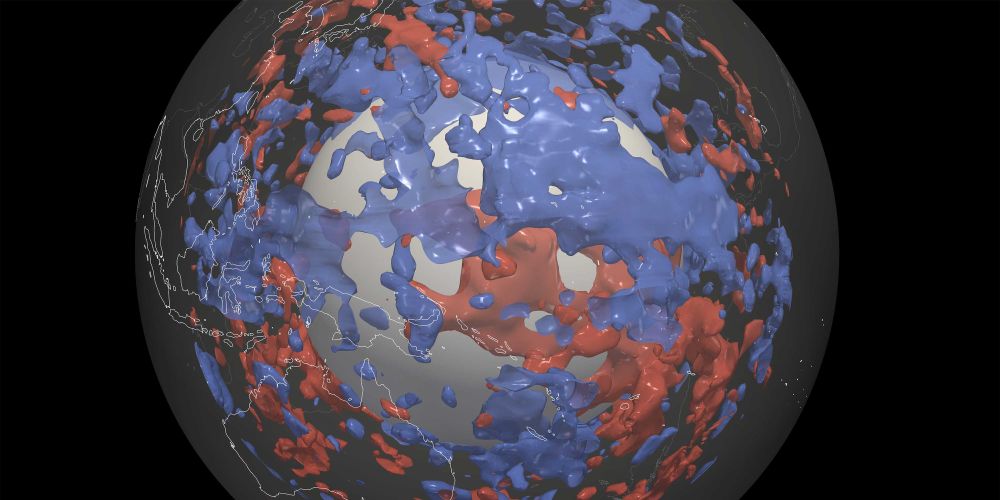
Sunken worlds under the Pacific?
Geophysicists at ETH Zurich are using models of the lower mantle to identify areas where earthquake waves behave differently than previously assumed. This indicates the presence of zones of rocks that...
"Sunken Worlds under the Pacific?" ⚒️ 🧪 🔭
New #press #release on our work in Nature Scientific Reports paper (led by T. Schouten et al.):
New, advanced tools that image Earth's interior reveal plate remnants (?) where there shouldn't be any! 🌏
Curious? Read more here:
ethz.ch/en/news-and-...
07.01.2025 14:57
👍 39
🔁 13
💬 3
📌 1
Please add me too!
10.12.2024 06:00
👍 1
🔁 0
💬 0
📌 0

Esta semana en el #IGEOquiz os hacemos esta pregunta, ¿por qué el agua del mar está salada?, ¿te lo habías preguntado alguna vez?
02.12.2024 07:44
👍 26
🔁 16
💬 1
📌 1

Depths in a day — A new era of rapid-response Raman-based barometry using fluid inclusions
Abstract. Rapid-response petrological monitoring is a major advance for volcano observatories, allowing them to build and validate models of plumbing syste
🔔Pleased to report a new paper for my first Bluesky post! We used CO₂ rich fluid inclusions in very near-real-time at Kīlauea and obtained magma storage depths within 1 day of sample receipt 🌋 Interested in applying it to another volcano? Take a look! academic.oup.com/petrology/ad...
16.11.2024 02:34
👍 19
🔁 4
💬 1
📌 0


