Figure 1 | Choosy dispersal efficiently balances the load of individuals across patches, dramatically reducing kin-competition and thereby promoting the evolution of altruism. (a) The potential for altruism as a function of dispersal rate where each disperser is assigned to a randomly chosen group (‘one option’, grey) versus where each disperser is assigned to the smaller of two randomly chosen groups (‘two options’, black). Analytical results are shown as curves and simulation results are shown as discs. Giving dispersers a choice over their destination promotes the evolution of altruism in viscous populations. (b) The distribution of individuals across patches following a bout of dispersal, where each disperser is assigned to a randomly chosen group (‘one option’, grey) versus where each disperser is assigned to the smaller of two randomly chosen groups (‘two options’, black), obtained by individual-based simulation. Allowing dispersers the choice of two groups dramatically balances the load of individuals across groups. (c) The relatedness of groupmates as a function of dispersal rate and the ability of dispersers to choose their destination; dispersal reduces relatedness according to the analytical expression r = 1/(n-(n-1)(1-d)2), and there is no effect of disperser choosiness on relatedness. (d) The scale of competition—i.e. the proportion of resource competition that occurs locally versus globally—as a function of dispersal rate and the ability for dispersers to choose their destination, as inferred from individual-based simulation data. Individuals are assigned either to randomly chosen groups (one option) or to the smaller of two randomly chosen groups (two options), with intermediate levels of choice being implemented by having a proportion of individuals being given one option and the remainder being given two options. Except for low rates of dispersal and little choice over destination, the scale of competition is rendered negligible.
New paper: "Choosy dispersal promotes the evolution of altruism", with Emilija Barteškaitė (#OpenAccess)
doi.org/10.1098/rsbl...
The 'Power of Two Random Choices' principle of load balancing may explain the evolution of altruism in viscous populations
@royalsocietypublishing.org #OA
17.12.2025 09:14
👍 12
🔁 3
💬 0
📌 0
Figure 1 | Choosy dispersal efficiently balances the load of individuals across patches, dramatically reducing kin-competition and thereby promoting the evolution of altruism. (a) The potential for altruism as a function of dispersal rate where each disperser is assigned to a randomly chosen group (‘one option’, grey) versus where each disperser is assigned to the smaller of two randomly chosen groups (‘two options’, black). Analytical results are shown as curves and simulation results are shown as discs. Giving dispersers a choice over their destination promotes the evolution of altruism in viscous populations. (b) The distribution of individuals across patches following a bout of dispersal, where each disperser is assigned to a randomly chosen group (‘one option’, grey) versus where each disperser is assigned to the smaller of two randomly chosen groups (‘two options’, black), obtained by individual-based simulation. Allowing dispersers the choice of two groups dramatically balances the load of individuals across groups. (c) The relatedness of groupmates as a function of dispersal rate and the ability of dispersers to choose their destination; dispersal reduces relatedness according to the analytical expression r = 1/(n-(n-1)(1-d)2), and there is no effect of disperser choosiness on relatedness. (d) The scale of competition—i.e. the proportion of resource competition that occurs locally versus globally—as a function of dispersal rate and the ability for dispersers to choose their destination, as inferred from individual-based simulation data. Individuals are assigned either to randomly chosen groups (one option) or to the smaller of two randomly chosen groups (two options), with intermediate levels of choice being implemented by having a proportion of individuals being given one option and the remainder being given two options. Except for low rates of dispersal and little choice over destination, the scale of competition is rendered negligible.
New paper: "Choosy dispersal promotes the evolution of altruism", with Emilija Barteškaitė (#OpenAccess)
doi.org/10.1098/rsbl...
The 'Power of Two Random Choices' principle of load balancing may explain the evolution of altruism in viscous populations
@royalsocietypublishing.org #OA
17.12.2025 09:14
👍 12
🔁 3
💬 0
📌 0

@kztwyman.bsky.social & @andygardner.bsky.social mathematically connect the dynamics of natural selection to optimisation to provide formal justification for viewing obligately eusocial colonies as adaptive individuals in their own right—that is, superorganism:
doi.org/10.1093/jeb/...
16.12.2025 12:43
👍 16
🔁 6
💬 0
📌 0

Happy to share that our paper ‘a formal theory of group-level adaptation for obligate eusociality’ (with @andygardner.bsky.social) is now out in @jevbio.bsky.social advances.
doi.org/10.1093/jeb/...
#OpenAccess #Eusociality #GroupAdaptation #FormalDarwinism
18.11.2025 14:57
👍 29
🔁 9
💬 2
📌 0

Every year #ESEB distinguishes a young evolutionary biologist with the John Maynard Smith Prize! Nominations for the 2026 prize are due by January 15th!
Find out more here: eseb.org/prizes-fundi...
11.11.2025 10:50
👍 10
🔁 9
💬 1
📌 1

AI image generated using Google's Gemini.
New paper: "A formal theory of group-level adaptation for obligate eusociality", with Kalyani Twyman (@kztwyman.bsky.social) #OpenAccess
academic.oup.com/jeb/advance-...
#Image #GoogleGemini @jevbio.bsky.social #OA
18.11.2025 10:35
👍 29
🔁 9
💬 2
📌 0

Editorial: Accountability, voice, and trust - responsible use of GenAI in scientific publishing
Over the last few years, the development and rapid advancement of Generative Artificial Intelligence (GenAI) and Large Language Models (LLMs) such as ChatG
Many of us are using LLMs in coding and scientific writing. They are very helpful tools, but we need to be thoughtful as we integrate them into our work flows to preserve accountability, voice and trust. academic.oup.com/evlett/advan.... An editorial at @evolletters.bsky.social for discussion:
22.08.2025 12:52
👍 70
🔁 33
💬 2
📌 3

Join us for Part 2 of the "Advances" symposium today, from 11am in Room 129+130. #ESEB2025
19.08.2025 08:01
👍 3
🔁 1
💬 0
📌 0

Photo of Chedhawat Chokechaipaisarn
And Chedhawat Chokechaipaisarn, whose poster "The consequences of constrained sex allocation under local mate competition" (P02.036) is in Tuesday's session.
This is based on his recent paper in Journal of Evolutionary Biology:
doi.org/10.1093/jeb/...
@jevbio.bsky.social @eseb2025.bsky.social
18.08.2025 07:47
👍 8
🔁 3
💬 1
📌 0

Photo of Kalyani Twyman.
Two other members of the research group have successfully made it to @eseb2025.bsky.social ahead of me.
Look out for @kztwyman.bsky.social, whose poster "A formal theory of group-level adaptation for obligate eusociality" (P01.068) is in this evening's session.
18.08.2025 07:42
👍 6
🔁 3
💬 1
📌 0

Programme for Part I of the Symposium "Advances in technology, mathematical and statistical models and their application in evolutionary ecology: the dawn of a new era", including talks by Hanna Kokko, Szymon Drobniak, Aurelien Tellier, Yuxin Ning and Md Ruhul Armin.
Finally on my way to #ESEB2025, a day late, following flight cancellation...
Disappointed to miss 1st day of talks, but happy that S03.01 "Advances in technology..." is in @ju-morimoto.bsky.social's safe hands.
Starting 10.30am, Meeting Room 129+130, with invited talk by @kokkonut.bsky.social.
18.08.2025 07:36
👍 9
🔁 0
💬 1
📌 0
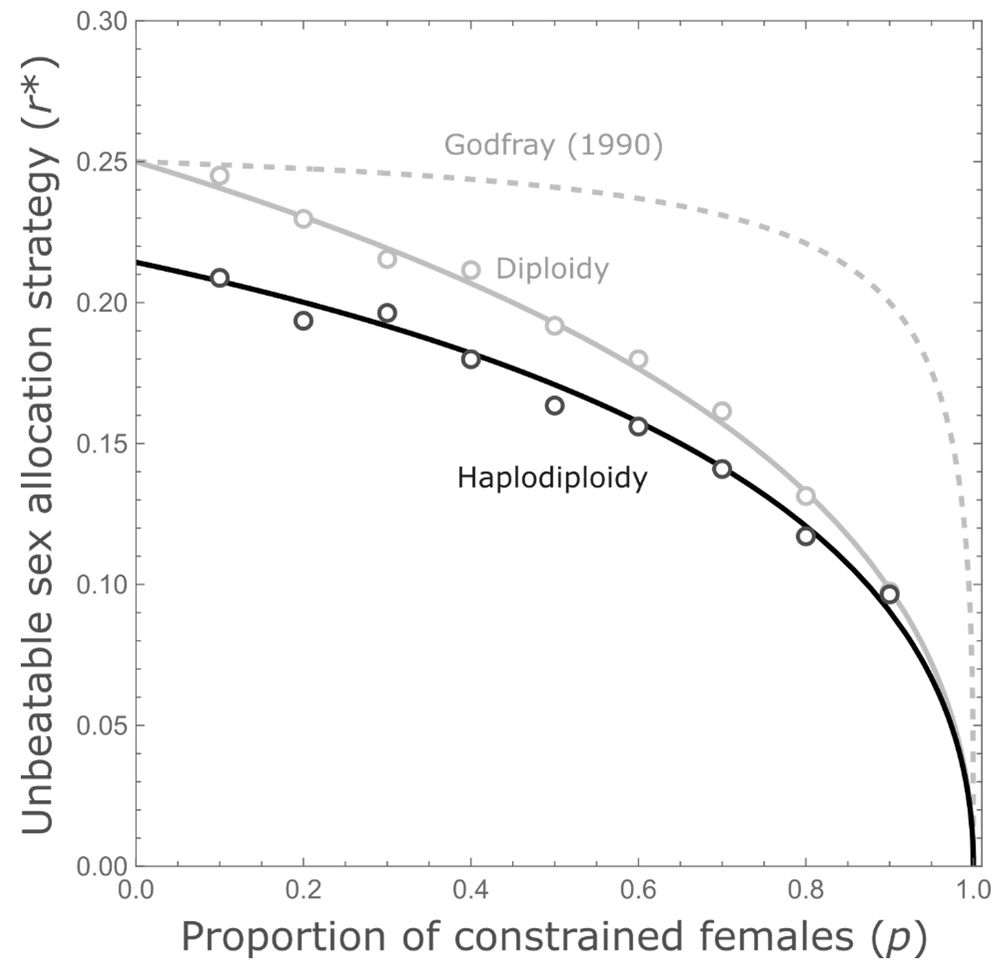
Figure 1. Unbeatable sex allocation strategy of unconstrained females (r*) as a function of proportion of constrained females (p) under local mate competition with two foundresses colonising the patch. Shown are the result for Godfray’s (1990) erroneous diploidy solution (dashed grey line), our corrected diploidy solution (solid grey line), and our haplodiploidy solution (solid black line). Overlaid are results from individual-based simulations (discs).
New paper: "The consequences of constrained sex allocation in diploids and haplodiploids under local mate competition", with Chedhawat Chokechaipaisarn:
doi.org/10.1093/jeb/...
@jevbio.bsky.social
09.07.2025 08:30
👍 20
🔁 8
💬 0
📌 0
Now all typeset and pretty! A little summary:
26.06.2025 14:47
👍 11
🔁 5
💬 1
📌 0
It's finally out! This paper took quite a while but I'm so excited to share now! For anyone who studies sex chromosomes, take note: we found a rare "slower X"! (dN/dS_X < dN/dS_Autos) 👀
11.06.2025 18:24
👍 18
🔁 16
💬 0
📌 0

The clonality window: relatedness and the group covariance effect in the evolution of division of labour
Abstract. Cellular division of labour is closely associated with the emergence of organismality in the evolution of obligate multicellularity. Michod has s
Very excited to share that our paper, ‘The clonality window: relatedness and the group covariance effect in the evolution of division of labour’, is out now in @journal-evo.bsky.social advances. With @andygardner.bsky.social
doi.org/10.1093/evol...
#OpenAccess #Evolution #Multicellularity
08.05.2025 13:27
👍 14
🔁 4
💬 0
📌 1
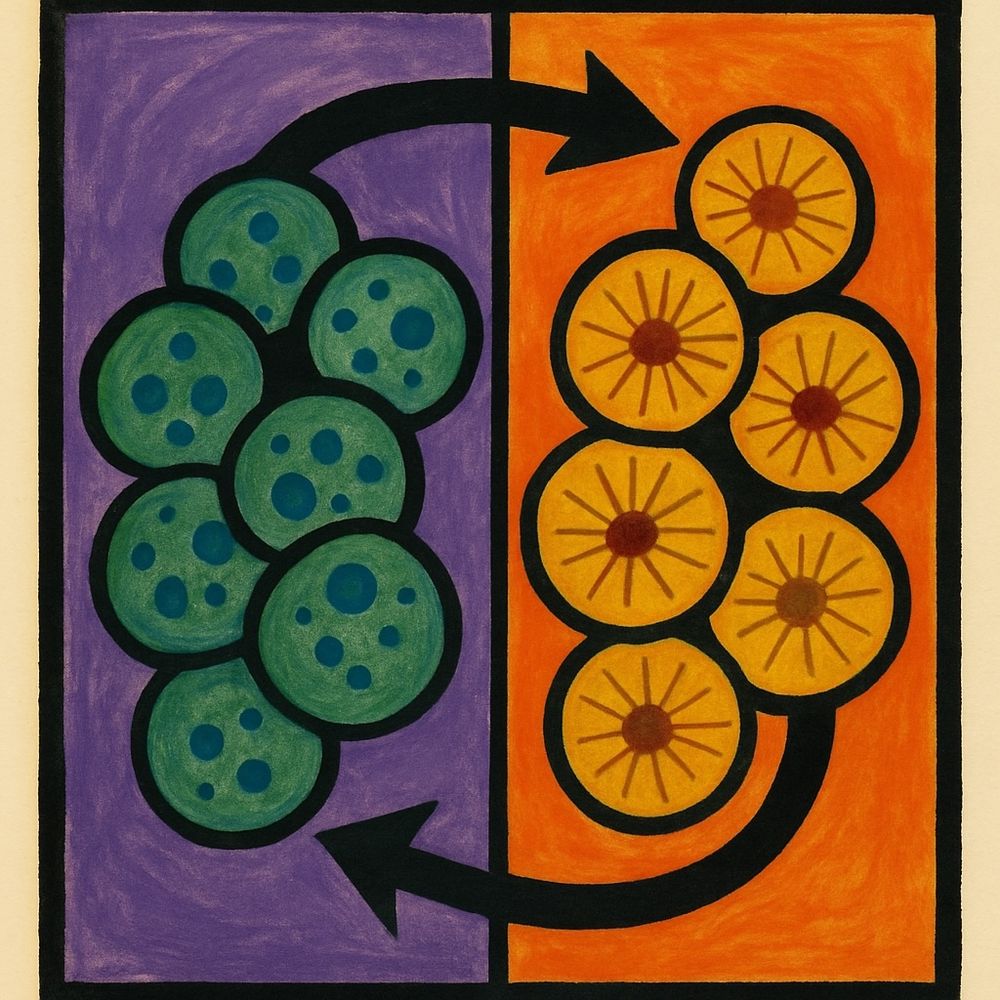
AI-generated image using the paper's title and abstract as input.
New paper: “The clonality window: relatedness and the group covariance effect in the evolution of division of labour”, with @kztwyman.bsky.social #OpenAccess
doi.org/10.1093/evol...
@journal-evo.bsky.social #Image: #ChatGPT #Evolution #OA
07.05.2025 18:59
👍 23
🔁 17
💬 0
📌 0
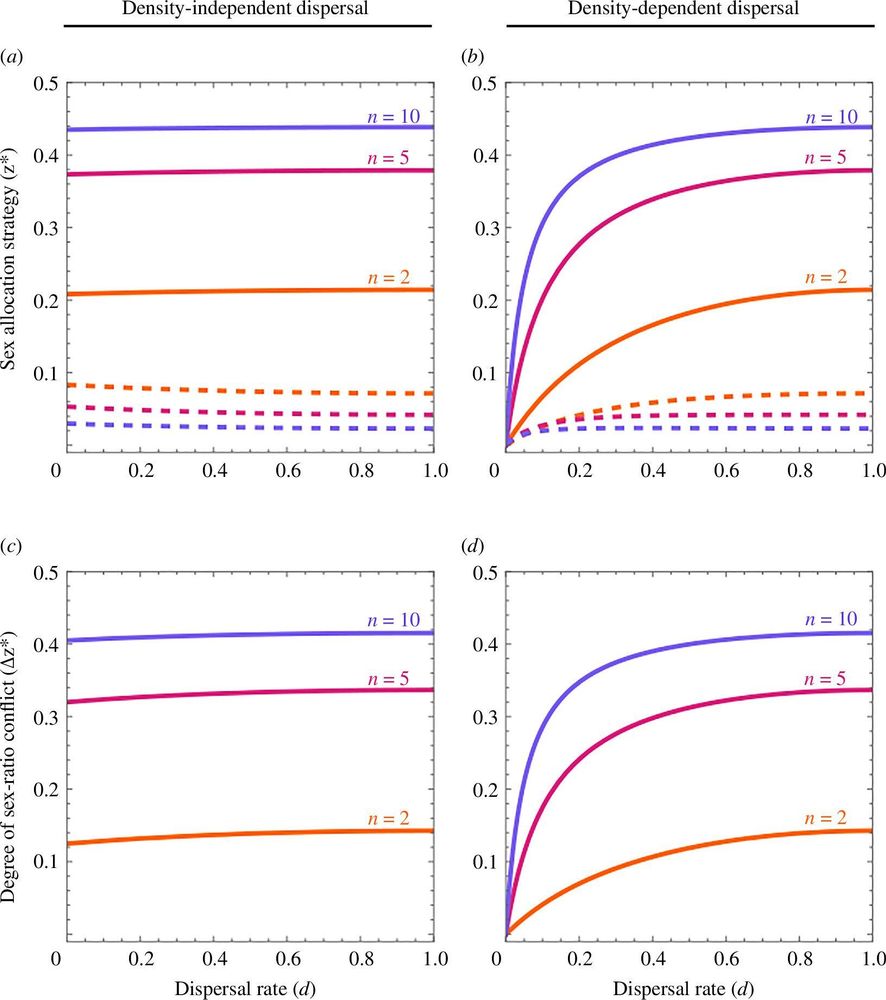
Sex-ratio optima for haplodiploid parents converge in viscous populations when dispersal is density-dependent. Read 'Density-dependent dispersal reduces conflict over the sex ratio': royalsocietypublishing.org/doi/10.1098/... #BiologyLetters #evolution
04.05.2025 11:01
👍 4
🔁 2
💬 1
📌 1
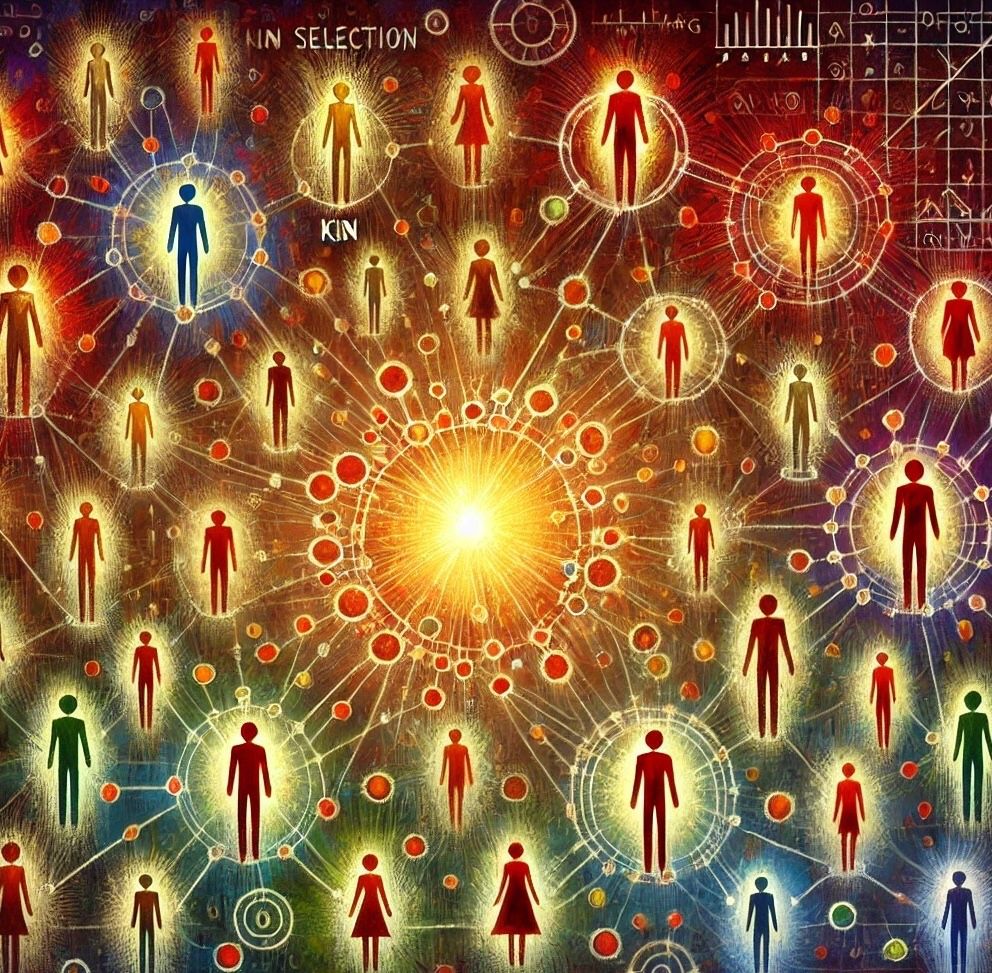
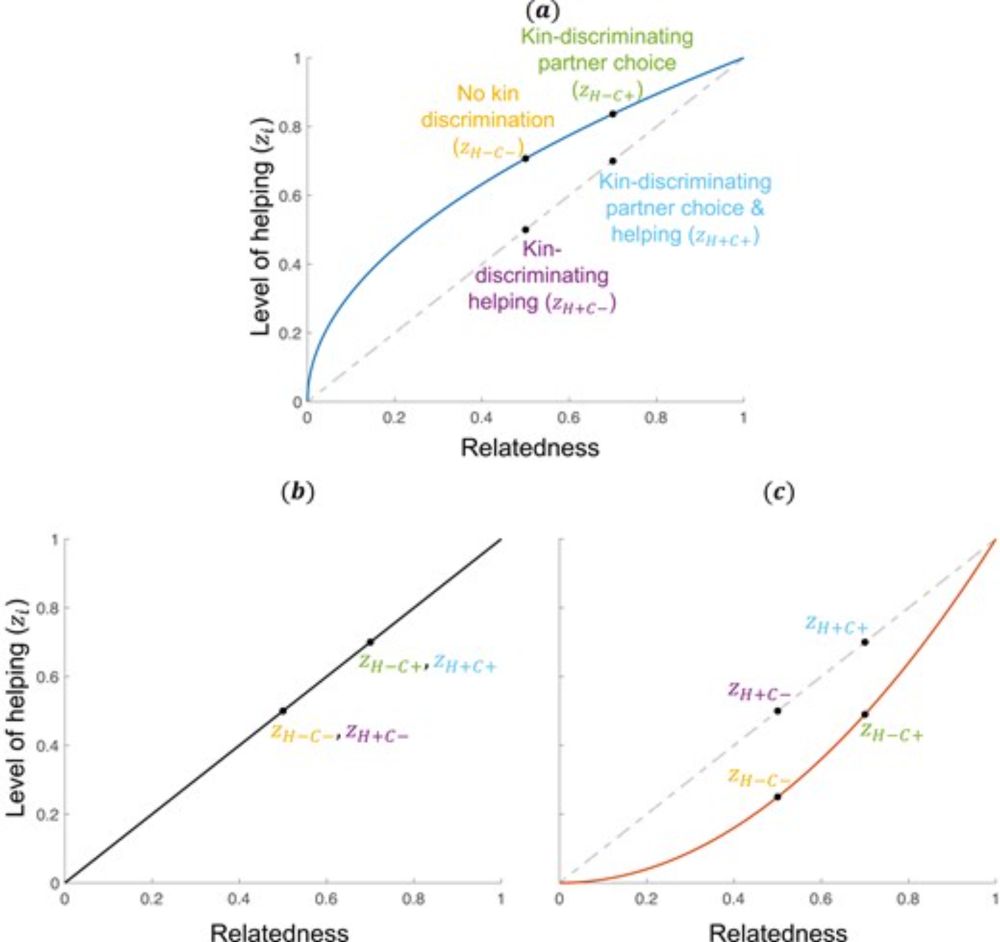
New paper: "Kin-discriminating partner choice promotes the evolution of helping"
with Tom Scott (@tomwscott.bsky.social) & Geoff Wild (@geoffwild.bsky.social) #OpenAccess
doi.org/10.1093/evol...
@journal-evo.bsky.social #Image: #ChatGPT #Evolution #OA
17.02.2025 09:45
👍 22
🔁 11
💬 0
📌 0
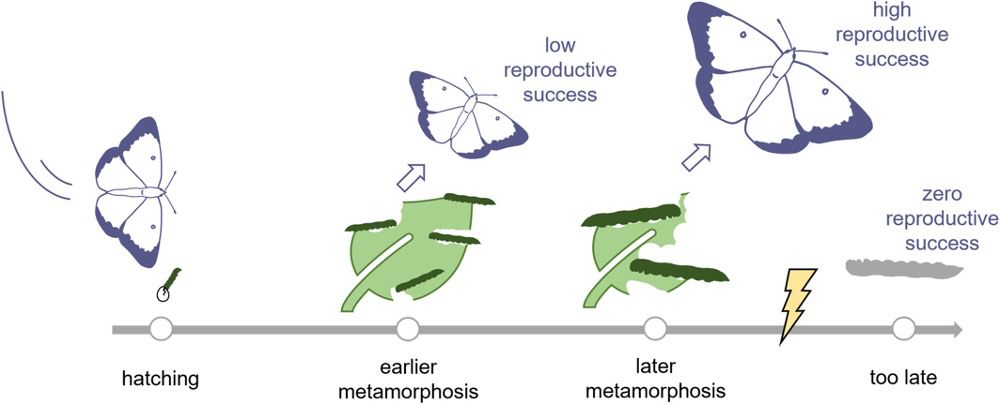
New paper: "Kin competition drives the evolution of earlier metamorphosis", with @bingdongevo.bsky.social.
doi.org/10.1002/ece3...
15.01.2025 08:05
👍 12
🔁 5
💬 0
📌 0
Hello - how nice to be off twitter!
I'm a PhD student at the University of St Andrews studying evolutionary theory (my research profile: tinyurl.com/kztwyman).
Would love to connect with anyone working in evolution, theory, social behaviour etc.!
29.11.2024 14:34
👍 29
🔁 3
💬 1
📌 0
Join us for our satellite event on selfish genetic elements!
08.11.2024 13:48
👍 2
🔁 1
💬 0
📌 0
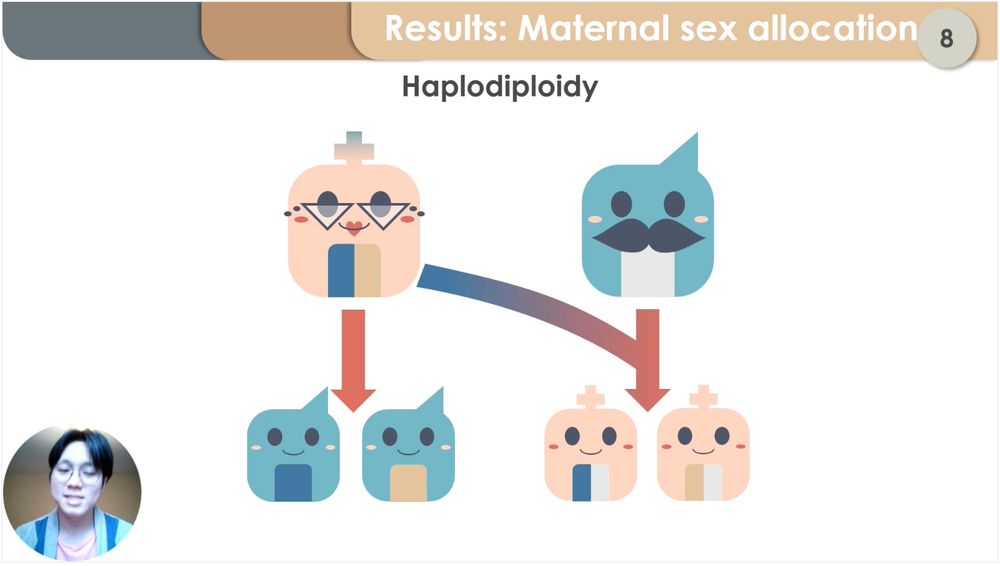
A slide from Tim's talk, featuring a schematic showing how haplodiploid inheritance works, with mothers contributing genes to sons and daughters, and fathers contributing genes only to daughters.
Chedhawat (Tim) has given an online seminar about this sex-ratio work, here:
cassyni.com/events/K7vsZ...
07.11.2024 14:38
👍 1
🔁 0
💬 0
📌 0
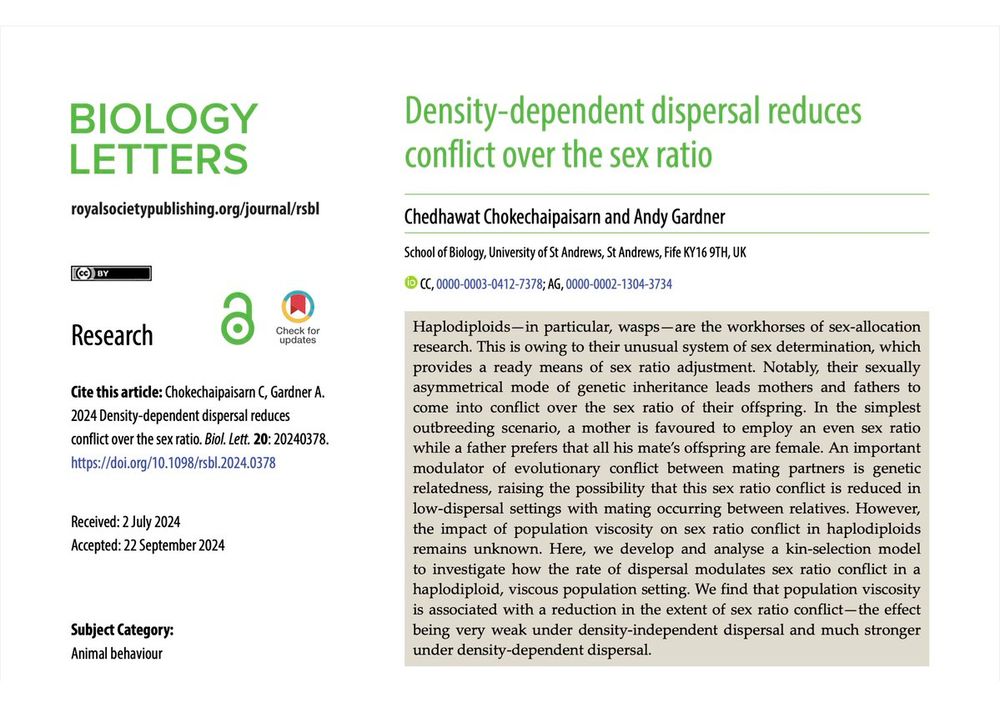
A portion of the title page of the paper. The Abstract reads:
Haplodiploids—in particular, wasps—are the workhorses of sex-allocation research. This is owing to their unusual system of sex determination, which provides a ready means of sex ratio adjustment. Notably, their sexually asymmetrical mode of genetic inheritance leads mothers and fathers to come into conflict over the sex ratio of their offspring. In the simplest outbreeding scenario, a mother is favoured to employ an even sex ratio while a father prefers that all his mate’s offspring are female. An important modulator of evolutionary conflict between mating partners is genetic relatedness, raising the possibility that this sex ratio conflict is reduced in low-dispersal settings with mating occurring between relatives. However, the impact of population viscosity on sex ratio conflict in haplodiploids remains unknown. Here, we develop and analyse a kin-selection model to investigate how the rate of dispersal modulates sex ratio conflict in a haplodiploid, viscous population setting. We find that population viscosity is associated with a reduction in the extent of sex ratio conflict—the effect being very weak under density-independent dispersal and much stronger under density-dependent dispersal.
New paper: "Density-dependent dispersal reduces conflict over the sex ratio" (OpenAccess), w/ Chedhawat Chokechaipaisarn.
doi.org/10.1098/rsbl...
Sex-ratio optima for haplodiploid parents converge in viscous populations when dispersal is density-dependent.
30.10.2024 09:33
👍 7
🔁 2
💬 1
📌 0
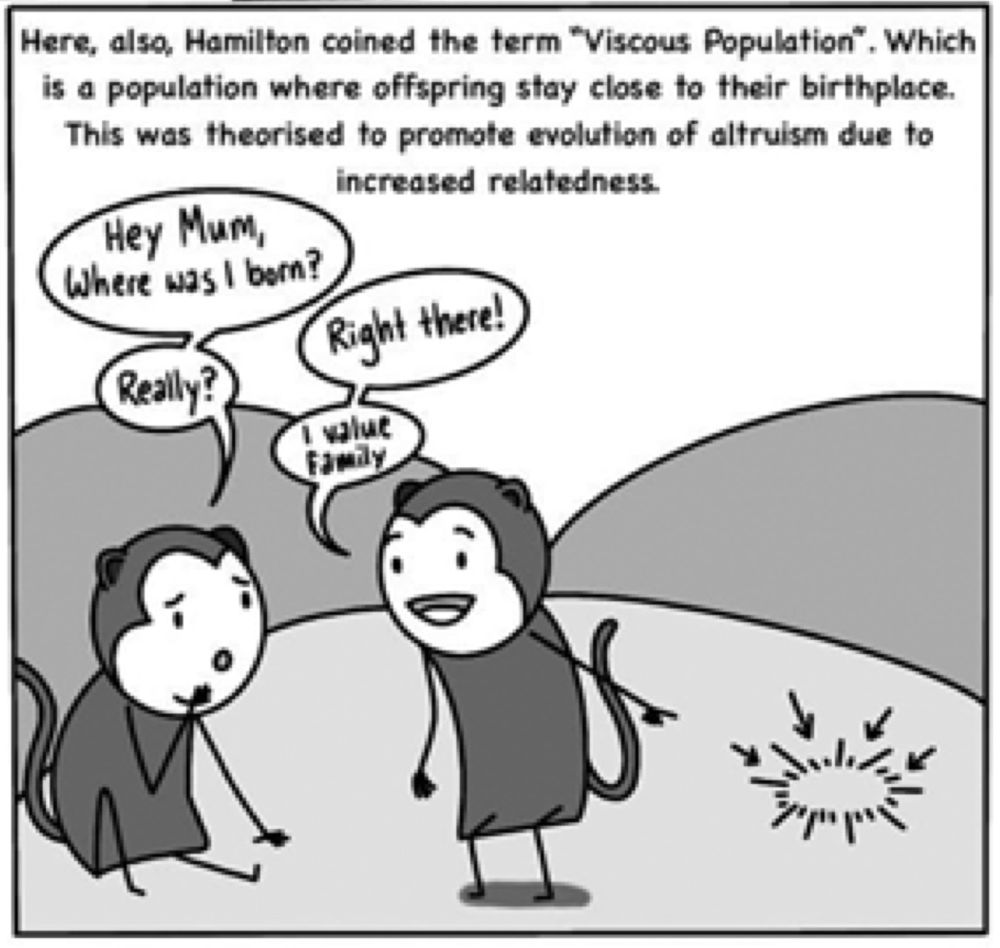
One of my undergraduate students, Callum Ferrando, has just published a comic in Journal of Evolutionary Biology. You can find "Taylor's famous result" here:
doi.org/10.1093/jeb/...
@jevbio.bsky.social @uniofstandrews.bsky.social
01.10.2024 17:54
👍 11
🔁 5
💬 0
📌 0
One of my undergraduate students, Callum Ferrando, has just published a comic in Journal of Evolutionary Biology. You can find "Taylor's famous result" here:
doi.org/10.1093/jeb/...
@jevbio.bsky.social @uniofstandrews.bsky.social
01.10.2024 17:54
👍 11
🔁 5
💬 0
📌 0
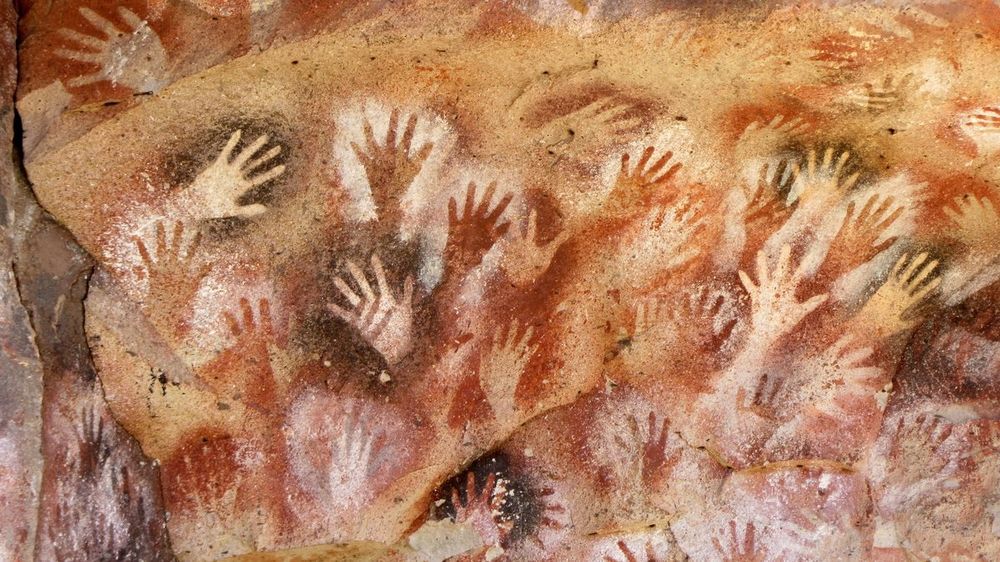
Rock art at Cueva de las Manos, Santa Cruz Province. From Wikipedia: "Cueva de las Manos (Spanish for Cave of the Hands or Cave of Hands) is a cave and complex of rock art sites in the province of Santa Cruz, Argentina, 163 km (101 mi) south of the town of Perito Moreno. It is named for the hundreds of paintings of hands stenciled, in multiple collages, on the rock walls."
New paper: "Kin selection as a modulator of human handedness: sex-specific, parental & parent-of-origin effects" (#OpenAccess), with Bing Dong & Silvia Paracchini (@silparacchini.bsky.social):
doi.org/10.1017/ehs....
#OA #Image commons.wikimedia.org/wiki/File:Cu...
27.08.2024 13:58
👍 3
🔁 2
💬 0
📌 0
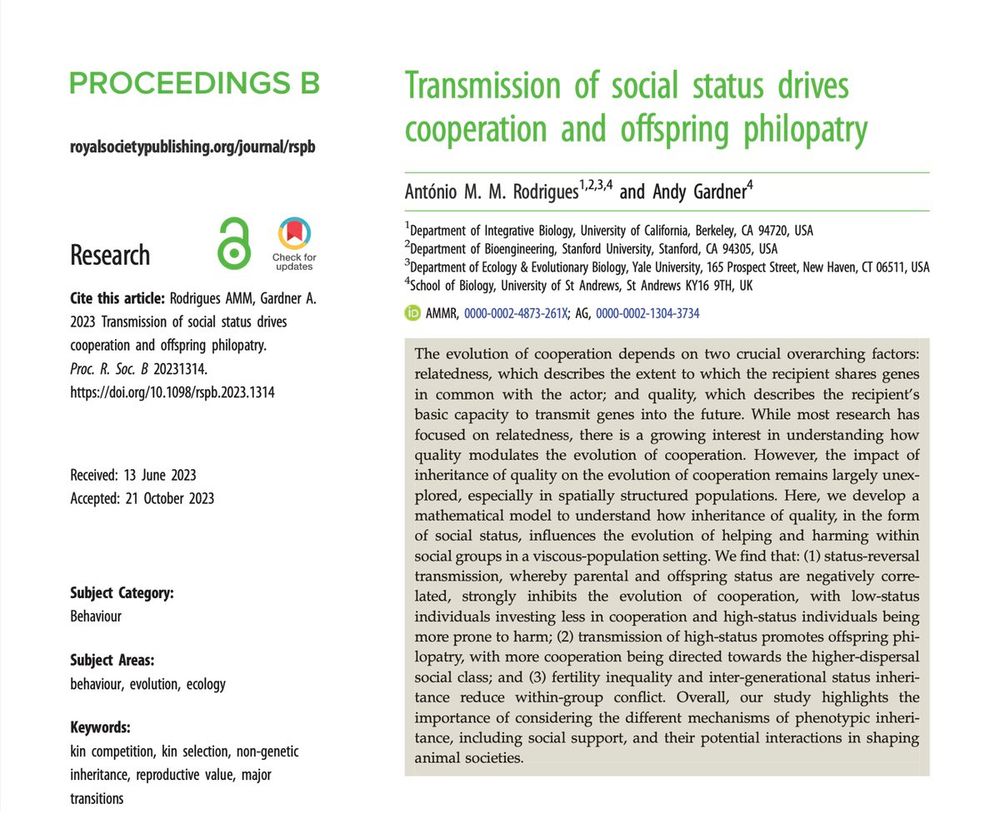
New paper: "Transmission of social status drives cooperation and offspring philopatry", with Antonio Rodrigues (Open Access)
doi.org/10.1098/rspb...
29.11.2023 10:34
👍 1
🔁 0
💬 0
📌 0