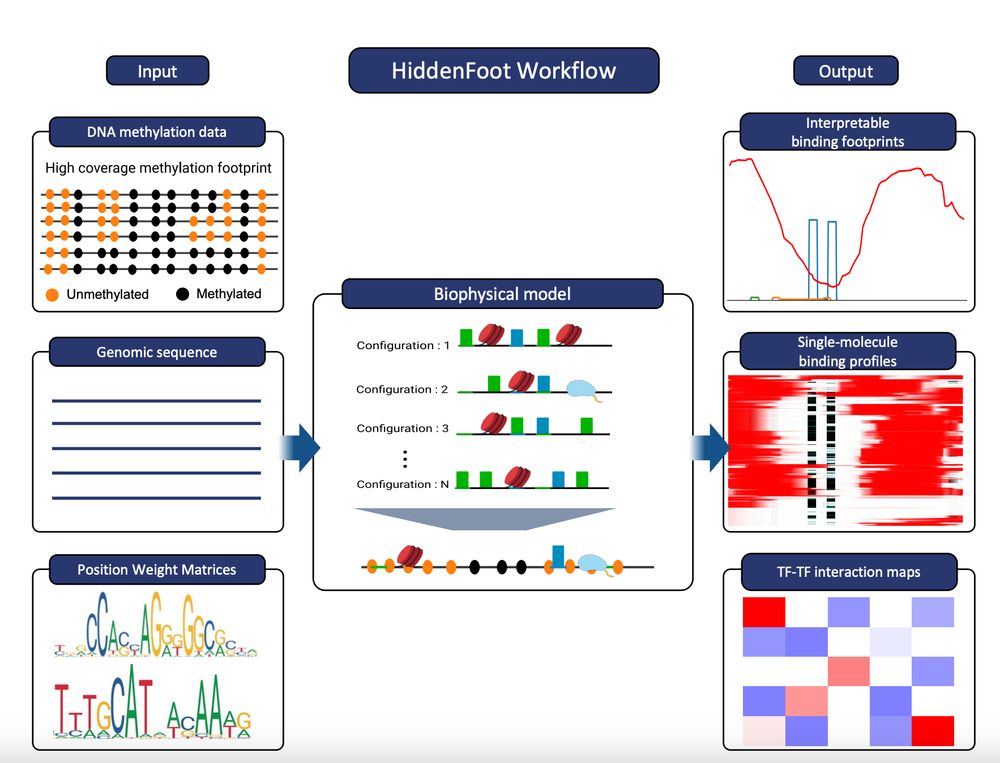
Time for a short thread! We developed HiddenFoot, a biophysics-inspired approach to decode single-molecule footprinting data and infer TF, nucleosome, and RNA Pol II binding profiles on individual DNA molecules. One molecule at a time! www.biorxiv.org/content/10.1...
1/6
19.05.2025 18:55
👍 54
🔁 18
💬 2
📌 2

Senior Research Officer at University of Essex
Searching for an academic job? Explore this Senior Research Officer opening on jobs.ac.uk! Click to view more details and browse other academic jobs.
We have a postdoctoral opening for a researcher with experience in bioinformatics of DNA sequencing and machine learning to work on the development of new methods for cancer diagnostics related to nucleosomes, chromatin and beyond www.jobs.ac.uk/job/DMK060/s.... Application deadline: 21st April 2025
27.03.2025 09:15
👍 9
🔁 20
💬 0
📌 0

I'm anxious, overwhelmed and have a
bad headache
Have you tried consuming nothing but coffee and terrifying news updates?
#vanitas #memes
25.03.2025 20:04
👍 177
🔁 29
💬 9
📌 3
Thank you so much to everyone who contributed to this work which resulted in a fascinating insight into #RepeatExpansions
12.12.2024 14:31
👍 0
🔁 0
💬 0
📌 0
These results indicate that THAP11 expansions are rare in the British population and that sequence structures predisposed to expansions may be more common in non-British ancestries.
12.12.2024 14:31
👍 0
🔁 0
💬 0
📌 0

We showed a linear relationship between the number of CAA interruptions and overall repeat length. Furthermore, we showed that the prevalence of alleles with three CAA interruptions (characteristic of the disease-causing alleles) is most common in African and South Asian genetic ancestries.
12.12.2024 14:31
👍 0
🔁 0
💬 0
📌 0

We identified expanded repeats in four individuals with learning difficulties without ataxia and in three individuals in UK Biobank, one with hereditary ataxia (also highlighted by Fearnley et al. (2024)), one with hereditary neuropathy, and one with neurodegenerative disease. See an exemplary case:
12.12.2024 14:31
👍 1
🔁 0
💬 0
📌 0

We explored the repeat size and structure by interrogating data from from Genomics England, the UCL Queen Square Institute of Neurology in-house database (UCL IoN), and the UK Biobank.
12.12.2024 14:31
👍 0
🔁 0
💬 0
📌 0
Tan et al. (2023) found a CAG repeat expansion in THAP11 was recently found to be associated with spinocerebellar ataxia in two Chinese families. Expanded repeats ranged from 45 to 100 units, with CAA sequence interruptions in the 5′ region and an uninterrupted CAG tract in the 3′ tail.
12.12.2024 14:31
👍 0
🔁 0
💬 0
📌 0
The lab of (amazing!) Arianna Tucci and I are delighted to share our published work on the repeat expansion locus in THAP11:
12.12.2024 14:31
👍 0
🔁 1
💬 7
📌 0
My fav starter packs so far, a thread:
stats: go.bsky.app/Ki7PjpS
stats: go.bsky.app/7TBN5rX
causal inference: go.bsky.app/FdemGAZ
package devs: go.bsky.app/N1569Qh
data peeps: go.bsky.app/8TdEfdK
medical stats: go.bsky.app/ArqEz36
bioinformatics: go.bsky.app/Ha64Gmv
r-ladies: go.bsky.app/Vgxwa2F
26.10.2024 19:23
👍 278
🔁 132
💬 18
📌 30
congrats Emma!
21.11.2024 19:01
👍 0
🔁 0
💬 0
📌 0