Our working model for this form of adult cortical plasticity is that repeated, varied visual experience causes a rebalancing of dendrite-targeting inhibition, leading to increased SST interneuron output to excitatory neurons, enhanced surround suppression, and sharpened tuning.
17.02.2026 21:30
👍 2
🔁 0
💬 0
📌 0

Imaging revealed that SST visual responses increased with visual experience, but VIP interneuron responses were suppressed over the same time period. In turn, excitatory pyramidal neurons showed more surround suppression and increased selectivity for small stimuli.
17.02.2026 21:30
👍 1
🔁 0
💬 1
📌 0

Individual beta events get much stronger with visual experience, and they organize cortical spiking more strongly. Why is beta interesting? This activity pattern relies on activation of GABAergic interneurons, particularly somatostatin-expressing (SST) cells.
17.02.2026 21:30
👍 2
🔁 0
💬 1
📌 0

Turns out that exposure to varied, but not single, stimuli over days causes a huge increase in activity in the beta (15-30Hz) range. We see beta plasticity in response to gratings and natural stimuli and it generalizes to stimuli that aren't shown during training.
17.02.2026 21:29
👍 2
🔁 0
💬 1
📌 0
New preprint from the lab! Stefan Sun and @q-perrenoud.bsky.social collaborated to look at how sensory experience affects the adult cortex. Using ephys and 2-photon imaging, they found that varied visual experience reorganizes dendrite-targeting inhibitory circuits in V1.
17.02.2026 21:28
👍 23
🔁 7
💬 1
📌 0
Organization, Neuronal Composition, and Dynamics of Neuronal Ensembles in the Songbird Auditory Forebrain
Auditory learning is a key component of vocal learning and communication. Neurons involved in auditory learning are typically examined as single encoders, but there is increasing evidence that the coincident activity of groups of neurons, or ensembles, is important for the processing and transmission of sensory information. In songbirds, a forebrain region analogous to mammalian secondary auditory cortex, the caudomedial nidopallium (NCM), is crucial for representing and learning auditory signals. In the awake state, NCM neurons exhibit stimulus-specific adaptation in response to repeated presentation of song stimuli, considered a form of auditory working memory. Yet, how complex stimuli like song are encoded by networks of excitatory and inhibitory neurons is essentially unknown. Using in-vivo single-unit electrophysiology, we systematically unveiled neuronal ensembles that operate at high temporal precision (< 10 ms) across the NCM of awake zebra finches (Taeniopygia guttata). Our data show that multiple ensembles are concurrently activated by song with high temporal precision, and that their neuronal composition is heterogeneous, topographically proximate, and biased towards excitatory members. NCM ensembles adapt to song playback and, notably, become more stimulus selective over tens of minutes, accompanied by fast remodeling (membership gain and/or loss) during adaptation. Altogether, our results suggest that song representations in the forebrain can be conveyed by multiple, dynamic network ensembles in parallel. These findings advance our knowledge of the composition, dynamics, and neuronal network reorganization of ensembles as complex sensory stimuli become increasingly familiar. ### Competing Interest Statement The authors have declared no competing interest. National Institute of Neurological Disorders and Stroke, https://ror.org/01s5ya894, R01NS082179
Auditory neurons form ensembles in the songbird NCM, showing synchronized activity within ~6ms! And the ensemble show stimulus-specific adaptation. Remarkable dissertation work from Felipe Cini, who has just started his postdoc with @jess-cardin.bsky.social .
www.biorxiv.org/content/10.6...
22.01.2026 15:47
👍 16
🔁 6
💬 0
📌 0
Brain circuits, bioturbation, and a new physics doc
Yale researchers study a mass extinction from the distant past, uncover hidden brain networks, and share expertise at an international meeting on enhanced weathering.
In a new @natbiotech.nature.com study, a team led by @yaleneuro.bsky.social’s @kuanawanda.bsky.social & Joerg Bewersdorf used pan-expansion microscopy to achieve a nanoscale view of the structure + molecular composition of brain circuits 🧠🔬
More 👇
news.yale.edu/2025/12/08/b...
10.01.2026 13:36
👍 5
🔁 1
💬 0
📌 0
Overall, visually-evoked ACh release in V1 reconfigures local GABAergic circuits to boost sensory responses and support conditioned behavior. Rather than being a simple gate for learning, cholinergic plasticity is actually the mechanism for expression of conditioned behavior! 5/5
14.11.2025 03:17
👍 1
🔁 1
💬 0
📌 0

Widefield imaging of cholinergic signaling revealed selective, visually evoked ACh release after visual fear conditioning. Local blockade of ACh muscarinic receptors in V1 disrupted both enhanced visual responses and conditioned behavior. ACh is required for neural and behavior plasticity! 3/5
14.11.2025 03:12
👍 1
🔁 1
💬 1
📌 0

In head-fixed mice, associating a visual cue with mild foot-shock resulted in conditioned cessation of licking (~freezing). Behavior required V1 activity, and wide field+2p calcium imaging showed learning-dependent increases in visual responses for V1 pyramidal neurons.
14.11.2025 03:09
👍 0
🔁 1
💬 1
📌 0

Learning-dependent cholinergic plasticity reconfigures cortical circuit dynamics
Neuromodulation by acetylcholine (ACh) plays a critical role in reshaping neural dynamics in the neocortex as a function of development, behavioral state, and learning [1][1]–[6][2]. Prior work sugges...
See our latest - collab with @jess-cardin.bsky.social, led by @andrewmoberly.bsky.social. We combined mesoscopic and 2p imaging to show that learning-dependent plasticity of ACh release in visual cortex drives enhanced visual representations and conditioned behavior. 1/5 tinyurl.com/3cfea6df
14.11.2025 03:02
👍 19
🔁 5
💬 1
📌 0
A bad thing is unfolding at NIH this week: It looks like the Trump administration is trying to replace key civil servant scientific leaders, the Institute Directors, with political hires. These directors control the NIH budget, tens of billions.
A bit of a video explainer here: 1/ 🧪
13.11.2025 22:31
👍 692
🔁 446
💬 16
📌 35
Thrilled to see this out! It was such a rewarding collaboration with Alex Wang, @jess-cardin.bsky.social, and an amazing team. We show that V1 SST interneurons integrate on a delayed developmental timeline, shaping how visual cortex processes and normalizes sensory input.
31.10.2025 15:00
👍 2
🔁 1
💬 0
📌 0
For those interested in methods for analyzing a specific frequency of neural activity as a series of discrete events, the CBASS code is posted here with an excellent wiki by @q-perrenoud.bsky.social: github.com/cardin-higle...
10.10.2025 13:59
👍 6
🔁 2
💬 1
📌 0

Flexible perceptual encoding by discrete gamma events - Nature
Using a new analytical method for tracking gamma band events in mouse visual cortex, flexible encoding of visual information according to behavioural context is shown.
New @nature.com article from the @jess-cardin.bsky.social lab: the team, led by @q-perrenoud.bsky.social, identified where gamma activity emerges and how it relates to behavior. "This could lead to an early biomarker for Alzheimer’s disease that is easily accessible in humans."
09.10.2025 15:42
👍 7
🔁 3
💬 1
📌 0
I thought we would never work on gamma oscillations again, but I was wrong 🤷♀️ So happy to see this work out in @nature.com! This was a truly epic project spearheaded by @q-perrenoud.bsky.social. Gamma isn't always an oscillation, but it's critical for sensory encoding and perceptual performance 🧠
08.10.2025 17:59
👍 17
🔁 2
💬 0
📌 0
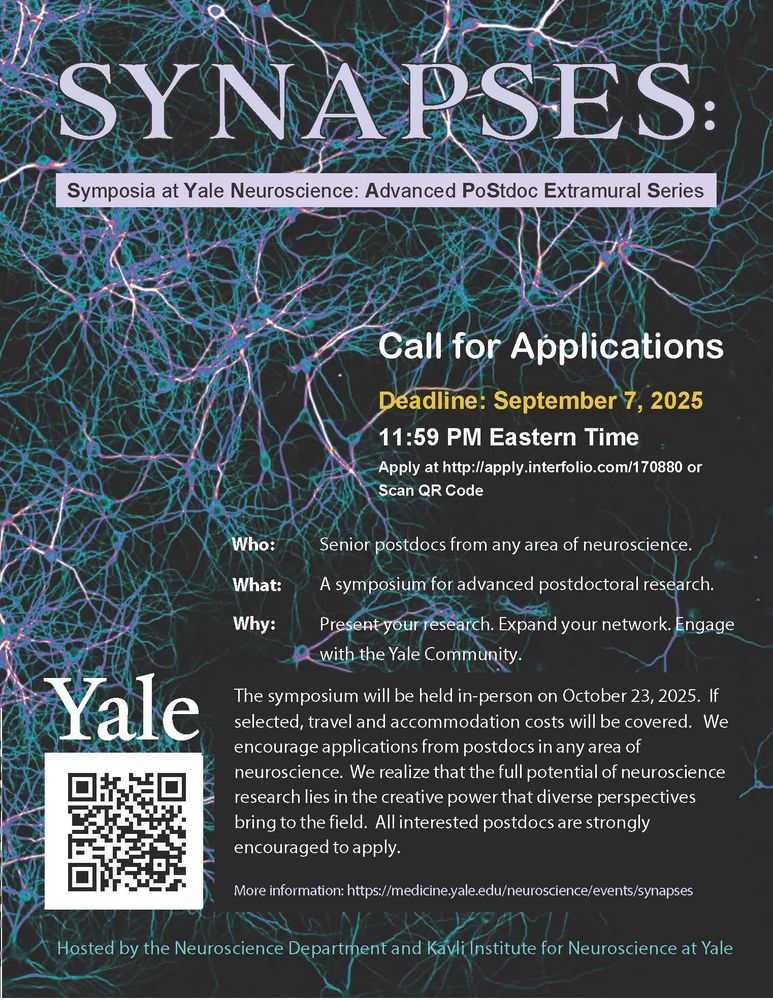
Flyer of the SYNAPSES symposium call for applications.
📢 Calling all senior neuro postdocs: SYNAPSES brings postdocs from around the world to Yale to share their work during an in-person symposium on October 23, 2025. Apply today to present your research, talk with faculty members in 1:1s, & interact with Yale postdocs! 🧠🧪 Deadline Sept 7. #neuroskyence
30.07.2025 13:31
👍 16
🔁 12
💬 0
📌 1

Traditional end-of-cycle lunch today with @mhigley.bsky.social and our fabulous @nsb-mbl.bsky.social students Peniel and Romana, along with heoric TAs Olivier and Hao. Some amazing 🧠 science happened over the past two weeks! Going home happy with more data than we can analyze 😎
11.07.2025 21:37
👍 4
🔁 0
💬 0
📌 0
Congrats!!
02.07.2025 19:57
👍 1
🔁 0
💬 0
📌 0

Stony Beach at sunset
Back in Woods Hole for cycle 3 🐭 @nsb-mbl.bsky.social. This year, we brought new tech developed by @mhigley.bsky.social for freely moving cortical imaging!
29.06.2025 21:20
👍 8
🔁 0
💬 1
📌 0
We're excited to welcome the Levenstein lab to Yale's Neuroscience Department!
23.06.2025 17:55
👍 7
🔁 0
💬 0
📌 0