Overall, I consider the Q4 final GDP report as good as it could be – both relative to the preliminary data and relative to the expectations at the end of 2024.
Alas, we all know that this is quickly becoming old news with the incoming tariffs and boatload of uncertainty…
9/9
10.03.2025 07:50
👍 2
🔁 0
💬 0
📌 0

The problem is that the decline in net exports in last two quarters was much more about decline in exports than increase in imports.
In other words, there is a good reason to expect further declines in net exports.
8/
10.03.2025 07:50
👍 1
🔁 0
💬 1
📌 0

That leaves net exports as the only true negative part of the release.
We know net exports will drag on growth given their bounce in mid-2022 to 2023, which to a large degree was about drop in imports – after all imports were likely to bounce back at least a bit.
7/
10.03.2025 07:50
👍 1
🔁 0
💬 1
📌 0

So what about those inventories, then?
First, we knew they the Q3 boost will not come again, so weakness was expected.
Second, inventories went further away from normal, so they will likely add in future quarters.
x.com/CrisisStuden...
6/
10.03.2025 07:50
👍 1
🔁 0
💬 1
📌 0

Again, looking across countries the same story holds.
We got at least some consumption growth everywhere – and that was on top of strong Q3.
And we got strong growth in fixed investment everywhere but France (alas for investment it is bounce back from previous quarter).
5/
10.03.2025 07:50
👍 1
🔁 0
💬 1
📌 0

And even better, all the components of final domestic demand have expanded, including fixed investment - where we saw expansion for the first time in a long while.
4/
10.03.2025 07:50
👍 1
🔁 0
💬 1
📌 0

Importantly, this story is geographically broad-based:
All the major economies saw solid increases in final domestic demand, including Germany and France (0.23% and 0.22%).
3/
10.03.2025 07:50
👍 1
🔁 0
💬 1
📌 0
Why does this matter?
Well, starting in late September there was a chorus of worries about economic growth in eurozone.
We now know that this was mostly misplaced: in absence of Trump eurozone was on its way to recovery.
2/
10.03.2025 07:50
👍 1
🔁 0
💬 1
📌 0

How bad was the Q4 in euro zone?
Actually, in my opinion it was great. My preferred measure it was the best quarter in two years: Final domestic demand grew at very strong 0.53%.
In other words, the relatively subdued headline growth comes solely from net exports and inventories.
1/
10.03.2025 07:50
👍 6
🔁 1
💬 1
📌 0
So overall, very bad end to disappointing year. Rather than the expected bottoming out of production we got another leg down – and with Trump in White House, this might be a (noisy) beginning of yet another contraction.
6/
13.02.2025 11:04
👍 0
🔁 0
💬 0
📌 0


So why do I say that the overall number is more ugly than reality?
One reason, really: drop in transport production drove a lot of the decline, and this is unlikely more than monthly noise to be reversed next year.
(That said, similar thing in reverse applies to jump in pharma production).
5/
13.02.2025 11:04
👍 0
🔁 0
💬 1
📌 0

Looking at individual industries brought further disappointment. For example, chemicals production seems to be on downward trend again now that gas prices are at 50euro per MWH.
4/
13.02.2025 11:04
👍 0
🔁 0
💬 1
📌 0


It was also not concentrated in one or two industries, with median industry seeing large decline in December and at 2digit detail most industries saw decline.
3/
13.02.2025 11:04
👍 1
🔁 0
💬 1
📌 0

Unlike some previous months, this time around the drop was not about Ireland and Germany.
Indeed, the jump in Ireland mostly offset drop in Germany, so excluding both meant decline of -1.5%
2/
13.02.2025 11:04
👍 0
🔁 0
💬 1
📌 0

Ugly, even if not as ugly as the headline number suggests.
That was the #eurozone industrial production release for December, which showed 1.1% decline on the month.
1/
13.02.2025 11:04
👍 3
🔁 0
💬 2
📌 0

As a result, based on the available data we believe that the final domestic demand had an ok quarter – not as good as Q3, but better than Q1 and Q2.
So in our mind, the recovery is intact – albeit disappointing one.
5/
30.01.2025 16:12
👍 0
🔁 0
💬 0
📌 0

That said, under the hood the numbers were more positive. While consumption probably saw subdued growth, investment likely added to growth for the first time in more than a year.
Instead, it was net exports which likely dragged on growth – with France and Spain showing as much.
4/
30.01.2025 16:12
👍 0
🔁 0
💬 1
📌 0
In other words, if it wasn’t for the strong growth in Spain and stellar in Portugal, we would get a contraction in euro zone GDP. This is not a good picture.
3/
30.01.2025 16:12
👍 0
🔁 0
💬 1
📌 0

Instead of the headline number, it was the geographical composition of growth which was most negative news in the report:
There was little if any growth to be found outside of Iberian Peninsula. Germany and France saw small contractions, Italy, Austria and Belgium stagnation.
2/
30.01.2025 16:12
👍 0
🔁 0
💬 1
📌 0

#Eurozone #GDP numbers brought a negative surprise, but its was not a big one.
On our preferred metric, eurozone excluding Ireland, we got 0.07% increase, small difference from the 0.18% expectation from early January.
1/
30.01.2025 16:12
👍 1
🔁 0
💬 1
📌 0

Overall, I think that Q1 will bring some upside inflation surprises relative to the consensus.
Luckily for doves, this won’t change the outcome of January and March meetings.
But I am increasingly more convinced that April will be a skip.
11/
17.01.2025 12:19
👍 0
🔁 0
💬 0
📌 0

Here we are in for further unpleasant numbers in Q1.
For example, the decline in German gas prices is for now over, which is not a good sign at all.
10/
17.01.2025 12:19
👍 0
🔁 0
💬 1
📌 0
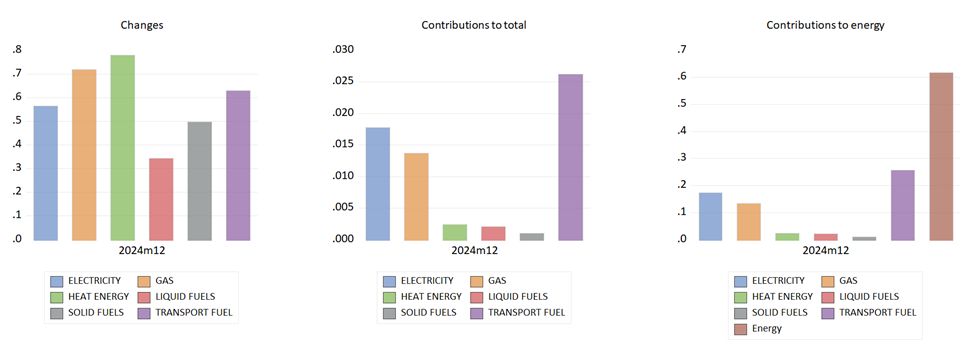
Finally, energy prices confirmed our expectations that the large increase was not only about fuel prices, but reflected higher gas and electricity prices.
9/
17.01.2025 12:19
👍 0
🔁 0
💬 1
📌 0

The worst news in food prices is that the pass-through from higher feed prices into higher animal product prices is still not over.
8/
17.01.2025 12:19
👍 0
🔁 0
💬 1
📌 0


Otherwise, the same cross currents are still present.
There hasn’t been any slowdown in coffee and tea prices yet, and while olive oil prices are dropping quickly, butter is doing its best to compensate.
7/
17.01.2025 12:19
👍 0
🔁 0
💬 1
📌 0

The most interesting news was in food, and it wasn’t positive.
The monthly increase was flattered by large drop in vegetable prices, that subtracted 0.15% from the 0.04% overall increase.
6/
17.01.2025 12:19
👍 0
🔁 0
💬 1
📌 0

Meanwhile, core goods had a good month, which can be seen in the distribution of changes.
There were some one offs, mainly in clothing, but also some goods news, such as renewed decline in household appliances.
5/
17.01.2025 12:19
👍 0
🔁 0
💬 1
📌 0

Overall, the distribution of service prices is slowly moving away from the extreme to more moderate price increases – but the battle is far from concluded, with most categories now in the 2-4% range.
We need more progress next year to keep inflation close to 2%.
4/
17.01.2025 12:19
👍 0
🔁 0
💬 1
📌 0

But it was made worse by jump in airline ticket prices, almost offsetting the drop in packaged holidays.
3/
17.01.2025 12:19
👍 0
🔁 0
💬 1
📌 0

In services there were countervailing forces.
The number was flattered by drop in packaged holidays, which won’t repeat next month, as it reflects changes seasonal patterns.
2/
17.01.2025 12:19
👍 0
🔁 0
💬 1
📌 0