A fascinating discovery from the Pedra de Fogo Formation, Lower Permian in Northeast of Brazil: Tanyka amnicola, a stem-tetrapod that extends the record of a lineage primarily known from the Carboniferous, and shows adaptations to a peculiar niche that exploited a herbivorous or omnivorous diet.
The name "Tanyka" comes from Guarani, local indigenous language, and the word means "jaw"; from Latin, "amnicola" means "that lives in/near the river". The fossils are all of jaws, most of them approximately 17 cm long (one of them being 25% larger), and the animal would have reached ~1 m in length.
Known from 9 jaws, Tanyka had teeth turned outwards, as if its mouth were twisted. What seemed like a deformation due to injury or fossilization proved to be a feature of the species as more and more specimens were found, some very well preserved. The strange shape is probably due to a slight rotation that the jaw makes on its own axis when opening the mouth. The posterior portion of mandible also had a curious triangular flange pointing outwards.
In addition to the main teeth row, next to it there were remarkable pads full of denticles that would have acted like a grinder. With them, Tanyka possibly scraped and crushed algae, plants, and/or hard-shelled invertebrates, being a herbivore or omnivore. This is something super rare among amphibians, extinct or extant, and shows us how these ancient tetrapods explored unusual niches.
Tanyka is not a close relative of contemporary Permian temnospondyl amphibians, but it is part of a group of stem-tetrapods that originated in the Carboniferous, the baphetids. A lost survivor, compared to what the platypus represents for mammals today.
In the scene, Tanyka feeds on algae and conchostracans that hide among them.
What a birthday gift seeing this amazing news out today! A fascinating discovery from the Pedra de Fogo Formation, Lower Permian in Brazil: Tanyka amnicola!
At the invitation of Dr. Juan Cisneros, I had the pleasure of creating the artwork for the media release of the research!
#SciArt #Paleoart
05.03.2026 01:03
👍 57
🔁 12
💬 1
📌 0

Homo floresiensis and Stegodon florensis insularis

Leptoptilos robustus sinisterly observe the hominins, perhaps intending to steal their prey

The hominins repel a Komodo dragon attack with stones and a flaming branch

Tokay geckos dispute territory on a foreground tree
A full-moon night on Flores Island, Indonesia, 50.000 year ago. An isolated habitat with many examples of insular dwarfism and gigantism.
The story explores how some Flores men may have learned the benefits of fire from rare natural events, even if no longer believed to have mastered/produced it.
27.02.2026 00:24
👍 4
🔁 0
💬 0
📌 0

A full-moon night on Flores Island, Indonesia, in the Pleistocene. In isolated habitats such as islands, natural selection often drives large animals to become smaller and small animals to become gigantic - the so-called insular dwarfism and gigantism.
50.000 years ago, before the arrival of Homo sapiens, the island was inhabited by the “Flores man,” Homo floresiensis. An example of insular dwarfism, this hominin stood only 1.1 m tall. In the scene, a group gathers around a "campfire" to prepare a giant rat, Papagomys (45 cm excluding the tail)
It was once believed that H. floresiensis mastered fire due to burnt fossils, but later dating showed the charred remains were left by modern humans, and less than 1% of true Flores men's tools show contact with fire. In this story, it is told that they kept alive a fire sparked by lightning on trees that day, feeding it with branches until building a larger fire at night. It is interesting to think how some populations may have learned the benefits of fire from rare natural occasions, even if not knowing how to produce it
Carrying the skinned rat, they choose an open spot bordered by small trees. Near them are carnivorous plants Drosera and basil, a herb they gather and crush into a paste as seasoning. As night falls, a giant lizard attacks: a 3 m Komodo dragon. Two hominins repel it with stones and flaming branches
In the center background is a herd of dwarf Stegodon (1.3 m tall). Two giant Leptoptilos storks (1.8 m tall) watch the hominins, intending to steal their prey.
Owls of the genus Otus perch on trees behind the fire; Flores crows observe the fight below from a dry tree. On a branch by the right side, a Heleia family rests on its nest, while farther away a Megapodius pair guard their mound nest from a reticulated python passing by
In the foreground, a tree houses tokay geckos and an atlas moth. On the bottom right, a Gasteracantha catches a fly
Flores de Fogo - Pleistocene of Indonesia
Artwork for Tales from the Phanerozoic, by João Macêdo. Check the final chapter, the Pleistocene, with detailed information about its backstory, environment and creatures: sites.google.com/view/talesfr...
Quick description in the Alt
#SciArt #Paleoart
27.02.2026 00:24
👍 13
🔁 5
💬 1
📌 0

Odobenocetops mother and Calf. In the bottom are seen the bibalves Anadara and Chlamys, as well the sea cucumber Isostichopus (some buried in the sand, some outside). A common octopus camouflages on a rock

Thalassocnus ground sloths feed on Zosteraceae sea grasses. Near them, the Luidia starfish attack the sea urchin Loxechinus. Myliobatis rays search the sand for bivalves.

An Acrophyseter group approaches from the open sea, putting the Odobenocetops and Thalassocnus in danger.

Multiple attacks on the Sardinops school: Humboldt penguins and their larger relatives, Spheniscus megarhampus, attack in their groups; The "small" whale Piscobalaena tries to fill its mouth; A mako-shark flees before eating any fish, scared away by an approaching Piscogavialis from below; An Acrophoca catches a Sardinops separated from the school; some Pelagornis fly over and wait to capture any fish that goes too near the surface
These are the warm waters of a shore not too far from the beach in Peru during the Late Miocene. We see many animals feeding, as well trying to not become food. This marine fauna includes not only creatures somewhat strange to our eyes, but also some species that continue to exist today
01.12.2025 17:02
👍 11
🔁 1
💬 0
📌 0

Pico Formation, Peru during the Late Miocene.
A female Odobenocetops and her calf feed on Anadara bivalves on the seafloor. This odd cetacean, related to modern belugas and narwhals, had the shortest snout among whales and backward-facing tusks (males bore a single very long one). Though known only from incomplete skeletons, vertebrae suggest a length of about 3 m. The mother shields her calf as if sensing nearby danger. Their presence also startles swimming Chlamys scallops.
Sharing the bottom, the semiaquatic ground sloths Thalassocnus graze on Zosteraceae seagrass, showing an unusual niche compared to today’s small arboreal sloths. Nearby, Luidia starfish prey on Loxechinus urchins, Myliobatis rays search for buried bivalves, and Isostichopus sea cucumbers partly bury themselves while others cling to rocks beside a camouflaged Octopus. Farther away grow Lessonia algae, and above them drifts a weakened Architeuthis, speculatively depicted in this Period.
Both Odobenocetops and Thalassocnus are in the sight of an Acrophyseter group, ~4.5 m macropredatory sperm whales with powerful teeth adapted to hunt large marine animals.
The main action centers on a dense school of Sardinops. These 40 cm fish rely on safety in numbers but face multiple attacks at once. Two penguin species, the smaller Spheniscus humboldti and the larger, long-beaked Spheniscus megarhampus, attack in their groups. Piscobalaena attempt to filter-feed on the school, though at only 4–5 m long they are "small whales". An Isurus mako shark appears but retreats when a massive Piscogavialis crocodilian approaches from below. A swift Acrophoca snatches an isolated Sardinops, while overhead big Pelagornis birds (6 m wingspan) wait to seize any fish that reaches the surface.
Coastal Feast - Pisco Formation
New art for Tales from the Phanerozoic, a project by João Macêdo. Check the Late Miocene chapter here, with detailed information about its backstory, environment and creatures: sites.google.com/view/talesfr...
Quick description in the -big- Alt
#SciArt #Paleoart
01.12.2025 17:02
👍 49
🔁 20
💬 1
📌 1
Many thanks!
02.11.2025 03:55
👍 1
🔁 0
💬 0
📌 0
Hehehe, valeu Juan! 😄
02.11.2025 03:55
👍 0
🔁 0
💬 0
📌 0

Edmontosaurus annectens sculpture showing a midline crest/frill that starts on the neck, and at the hips starts transitioning to feature scales/spikes that cover the tail.
That transition was nothing too crazy to speculate back then, as the neck frill was reported in the "Trachodon" mummy, and there was an E. annectens tail preserving the feature scales. Yet, these details were rarely, if ever, combined in reconstructions, and it is always nice to see an unusual guess going in the right direction!
Edmontosaurus annectens is in the news, and it made me remember of this oldie (2016) work. Something unusual tried here that got more or less confirmed from the new mummies is how a midline crest starts at the neck, and near the hips starts to transition to spikes that cover the tail!
23.10.2025 20:14
👍 31
🔁 7
💬 0
📌 0
*Middle Miocene chapter, not Eocene. Edit button when, BlueSky? 😜
09.10.2025 23:05
👍 1
🔁 0
💬 0
📌 0

Kelenken

Protypotherium and Peltephilus fight for the burrow. A Patagosmilus approaches from behind. A Theosodon herd feed while being stalked by Kelenken. A Neotamandua mother and its baby climb the tree.

Astrapotherium group bathes in the lake. A Patagosmilus annoys a Neosteiromys.
The Middle Miocene of Patagonia, Argentina. A warm environment with open areas, few trees, and covered by low vegetation.
A land full of exquisite animals, many living under the terror of the large predatory bird Kelenken.
Detail shots:
09.10.2025 21:08
👍 5
🔁 1
💬 0
📌 0

Patagonia, Argentina, during the Middle Miocene. A warm environment with open areas, few trees, and low vegetation.
After the Age of Dinosaurs, the top of the food chain is once again occupied by a large terrestrial theropod: Kelenken, the largest of the "terror birds" (Phorusrhacidae). This nickname is no exaggeration: with a ~70 cm skull, sharp beak, standing over 2 meters tall, powerful claws, and legs suggesting high speed and agility for its size, it truly inspired fear in any potential prey. Two individuals appear, each separately surrounding a group of Theosodon, a macrauquenid that could reach 2 meters in length and ~1 meter at the shoulders. These camel-like mammals likely had a complex nasal structure resembling a trunk, but unable to grasp food (not a true proboscis, but a "prorhiscis", similar to moose, saigas, and sea lions). The herd feeds among Nothofagus trees, using the woods to try to evade the fast predatory birds. On the nearest tree, a mother Neotamandua hangs with her baby clinging to her back.
In the lower right corner, small animals fight over a burrow. Two Protypotherium try to take over the hole dug by a horned armadillo, Peltephilus. It scares off several Panstrongylus bugs living inside, forcing them out. Focused on their dispute, they don’t see a predator creeping from behind: Patagosmilus, a saber-toothed marsupial. The notoungulates will flee in time while the armadillo will be attacked, but will escape after the first bite thanks to its armor. Another Patagosmilus appears on the other side, harassing the giant porcupine Neosteiromys.
In the right corner, a group of Astrapotherium cools off in the water. These large mammals (~4 meters long) stand out with their tusks (larger in males) and a trunk likely used to gather food. Behind them, Podocarpaceae trees grow near the shore.
Patagonian Plains - Collón Curá Formation
New artwork for Tales from the Phanerozoic, a project by João Macêdo. Check out the Eocene chapter here, with the backstory of the scene and detailed information about its environment and creatures: sites.google.com/view/talesfr...
#SciArt #Paleoart
09.10.2025 21:08
👍 17
🔁 8
💬 2
📌 0
Que pintura linda, dá muita vontade de saber mais sobre a história e o universo dela! Definitivamente uma capa que vende o livro!
19.09.2025 22:46
👍 1
🔁 0
💬 1
📌 0

A Tetheopsis, an Uintatherium pair and a Gastornis.

A Sinopa looking up to a tree; a Saniwa drinks and rests on the shore; entering the forest, a Mesonyx follows a Orohippus herd.

2 Notharctus feed on a Sapindaceae tree leaves; on nearby branches of the same tree, a Zygodactylus pair tries to stop Titanomyrma ants to advance towards their nest.

A Patriofelis catches a Chisternon turtle; erosion reveals a Torosaurus skull within the rocks of the lake shore.
A valley in Wyoming, USA, during the Eocene. The scene shows not only creatures known directly from the Bridger Formation, but also some "visitors" based on fossils from other nearby Formations of equivalent age to help visualizing the diverse fauna and flora of this time and place.
Detail shots:
03.08.2025 15:58
👍 8
🔁 0
💬 0
📌 0
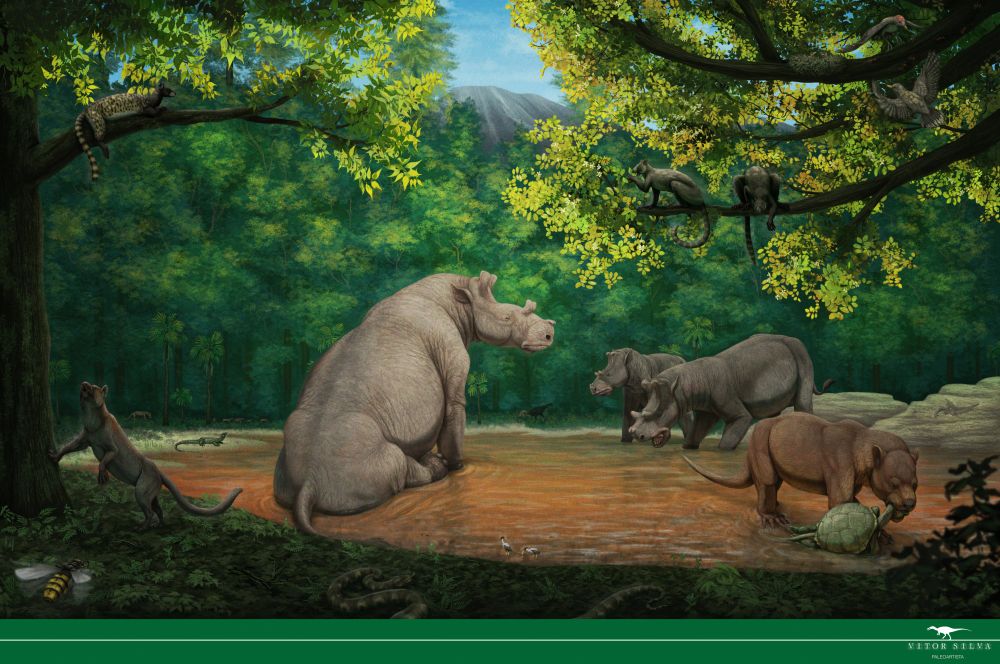
A valley in Wyoming, USA, during the Eocene.
The central figure is a "visitor", a large Tetheopsis, with a 90 cm skull and about 4 m in length. Known from the Washakie Formation, of near place and equivalent age, it may have passed through the Bridger Fm. Nearby, a pair of Uintatherium drink at the lake. These animals are slightly smaller, with 70 cm skulls and similar lengths.
A Patriofelis, over 2.5 m long, comes from the water holding a prey, a Chisternon turtle. Also in the lake, a pair of small Aletornis birds capture mollusks.
On the shore, a Saniwa lizard drinks and warms itself in the sun. In the upper left, a Vulpavus rests on a Lauraceae tree branch, unaware of the hyaenodont Sinopa watching it from below. Two female Notharctus, primates around 40 cm long (not counting the tail), feed on Sapindaceae tree leaves. Nearby in the same tree, a pair of Zygodactylus. birds try to stop Titanomyrma ants (3 cm workers) from reaching their nest.
On the forest ground, a 2 m long Boavus slithers through the dry leaves. Near it, closer to the viewer, a wasp-mimicking bug, a Chimaeroblattina, flies.
In the left corner background, the ungulate predator Mesonyx follows a herd of Orohippus, small equids. Also present is the large bird Gastornis, foraging for plants in the center, behind the lake. Though not directly from the Bridger Fm., its presence is inferred from the nearby Green River Fm., like the Zygodactylus, Titanomyrma, and Chimaeroblattina.
Plants include sequoias, Sabalites palms and ferns on the forest floor, elements known from the rare flora fossils of the Bridger Fm. Again inspired by the Green River Fm., a more diverse angisperm forest is shown for this time and place, with trees like oak, cinnamon, and maple, the other mentioned Sapindaceae and Lauraceae, plus some cucurbits near the ground.
Among the rocks on the lake shore, erosion reveals a glimpse to the past, a Torosaurus skull.
Emerging Beasts - Bridger Formation
New artwork for Tales from the Phanerozoic, a project by João Macêdo. Check out the Eocene chapter here, with the backstory of the scene and detailed information about its environment and creatures: sites.google.com/view/talesfr...
#SciArt #Paleoart
03.08.2025 15:58
👍 42
🔁 12
💬 2
📌 0
The reversed wings might have been tempting to "fix" (I can imagine a version with 2-3 fingers or spikes pointing forward to fake the silhouette), but for a creature full of fantasy and wonder, it was really worth keeping such unusual detail. Their folded shape when the dragon walks is quite cool!
30.07.2025 10:08
👍 3
🔁 0
💬 0
📌 0
To see Prehistoric Planet return, and even with a new theme, is such a joy! I'm eager to know and see the full animal lineup!
30.07.2025 09:55
👍 4
🔁 0
💬 0
📌 0
Extended Data Fig. 4: Geometry of overlapping integumentary appendages in Mirasaura. | Nature
Oh, this made me wonder about it too now, I hadn't thought of that detail! Looks like it is like your B model, this figure has a cross section:
www.nature.com/articles/s41...
25.07.2025 16:38
👍 3
🔁 0
💬 1
📌 0
Oops, forgot to add #SciArt #Paleoart ^^
03.06.2025 12:16
👍 2
🔁 0
💬 0
📌 0

Nanuqsaurus with Pachyrhinosaurus calf prey. Alaskacephale appear behind

Pachyrhinosaurus herd VS young Nanuqsaurus

A preening Alaskan Troodon. A Cimolodon duo is on the branch above

An Ornithomimid herd, a burrowing Thescelosaurid and a wandering Therizinosaurid
Detail shots:
03.06.2025 12:12
👍 6
🔁 0
💬 1
📌 0

Late Cretaceous in what is now Alaska, at the highest paleolatitude ever inhabited by dinosaurs. In a foggy, cold landscape under a prolonged night that lasts for months, the aurora borealis shines over a prehistoric ecosystem facing its harshest season.
During winter, the average temperature could drop to 2 °C or lower, occasionally reaching even -10 °C for short periods. Snow could have been present, and is illustrated still at a relatively light amount and not fully covering the ground. Ferns and horsetails lie dormant underground in their rhizomes, while shrubs like Hollickia persist. The forest is composed of small deciduous conifers including Parataxodium.
At the front, a classic dinosaur clash: an adult Nanuqsaurus and her two offspring attack a herd of Pachyrhinosaurus. The adult grabs a calf while the juveniles distract the herd. The theropods soon retreat, but the small reward from this hunt will belong only to the hungry mother.
Startled by the chaos, the small mammal Unnuakomys flees its hiding place, only to be caught by a Saurornitholestes, who risks approaching the giants driven by its hunger. A Sikuomys stays still and safe at a tree base. On the oposite side, two Cimolodon watch from a branch a large Alaskan Troodon resting beneath them.
More dinosaurs are present: a group of Alaskacephale runs through the center of the scene. A nearby Thescelosaurid clears out its burrow while looking at a shadowy figure among the trees - a Therizinosaurid, which presence is speculative. In the distance, several Ornithomimids search for food among the remaining conifer leaves. At the far left, a herd of Alaskan Edmontosaurus wander also after food. In the background, another speculative addition: a large Azhdarchid pterosaur walks near the hadrosaurs.
Cold Cretaceous - Prince Creek Formation
New artwork for Tales from the Phanerozoic, a project by João Macêdo. Check out the Late Cretaceous chapter for detailed information about the environment and its creatures: sites.google.com/view/talesfr...
Click the Alt text for a looong image description.
03.06.2025 12:12
👍 26
🔁 5
💬 1
📌 0
No worries, it is fine hehe
29.11.2024 10:20
👍 1
🔁 0
💬 0
📌 0

Daspletosaurus checking the nest temperature.

Crato Formation. Tupandactylus feeding on Welwitschiostrobus, Lacusovagus flying afar.

Santa Maria Formation: a Staurikosaurus pair, one of them has catched a Clevosaurus; a Dynamosuchus feeding on an Aetosauroides, and a Rauisuchus looking to steal the prey; groups of Exaeretodon, Hyperodapedon, Hyperodapedon and Ixalerpeton; a Saturnalia and a Trucidocynodon; flora is composed mostly of Dicroidium (long, palm-like trees), as well Ginkgoites trees, Podozamites (conifers), Cladophlebis (ferns), Neocalamites (large horsetails) and Taeniopteris (bramble-like plants far away).

Parasaurolophus 1/30 scale sculpture.
Hello! A Pinned post to introduce myself!
I am Vitor Silva, a paleoartist from Brazil. I work mainly with digital paintings and traditional sculptures, and will focus mostly on paleoart in this profile (with something different once in a while 😄)
My ArtStation gallery: vitor_silva.artstation.com
21.10.2024 20:03
👍 125
🔁 23
💬 2
📌 0


Carboniferous swamps: Arthropleura and Balanerpeton are over a fallen a log; On a tree, a Pulmonoscorpius catches a Westlothiana; A Crassigyrinus head and the Tristychius' fins are seen over the water surface; far away, a Hibbertopterus crawls out of the water; the forest is composed of the large trees Lepidodendron, Sigillaria, Calamites and Cordaites; smaller plants are the "seed fern" Medullosa and the horsetail Sphenophyllum.
So, a 100+ years paleontology mystery has been solved, and we now know the head of Arthropleura!
Here's an updated version of a previous illustration of the Carboniferous swamps of Scotland.
#SciArt #Paleoart
16.10.2024 21:09
👍 63
🔁 11
💬 0
📌 1
Same, I would love one of these flying muppets at home! And thank you! ^^
08.10.2024 17:43
👍 0
🔁 0
💬 1
📌 0