
four people happy in the forest with trillium flowers everywhere


Exciting new undergraduate research opportunities here at Carnegie Museum in Botany! Applications due March 1. drive.google.com/file/d/1jNNy...
06.02.2026 18:17
👍 24
🔁 15
💬 0
📌 3
"The soil in our part of the neighborhood was even sandy and acidic...A lot of trees don’t like the sandy soil because it drains too much, but we love it...We started playing together pretty seriously in high school, and released our first album right before graduation." 😂
10.12.2025 12:07
👍 7
🔁 0
💬 1
📌 0
me: You can be creative in your final essays!
my student: This is an interview with Margaret and Bianca, two members of hit pop rock band Arnold the Ill. The band is made up of four Eastern White Pine siblings from southwest Vermont.
my student: also I designed a vintage band poster.
09.12.2025 13:18
👍 6
🔁 0
💬 0
📌 1
Hosted our final speakers for the EAB on campus pop-up last night. We were so privileged to hear from our own folks in biology and buildings and grounds, an Abenaki basket maker, a county forester, state forest health folks, academic researchers, social scientists, and a USFS forest entomologist!
05.12.2025 14:43
👍 2
🔁 0
💬 0
📌 0
Thank you! We'd love to have you visit!
26.11.2025 17:44
👍 2
🔁 0
💬 0
📌 0
oh cool! thank you!
26.11.2025 17:43
👍 1
🔁 0
💬 0
📌 0
would love your thoughts @kheyduk.bsky.social & @martinebotany.bsky.social!
26.11.2025 15:06
👍 0
🔁 0
💬 1
📌 0
looking forward to reading this
25.11.2025 13:03
👍 2
🔁 0
💬 0
📌 0

stickers with illustrations of plants & puns written underneath: "good chives only", "i'm kind of a big dill", "its about damn time", "lookin' sharp", and "mint to be"
Collecting some prizes for the #plantsgiving participants on campus
25.11.2025 12:57
👍 4
🔁 1
💬 0
📌 0

A college science building hallway with a large poster titled "Plantsgiving" and a blank histogram with an x-axis with Plant Families listed on the bottom. There are photos of corn (Poaceae), coffee (Rubiaceae) and Brassica oleracea (the species that gives us cabbage, brussels sprouts, kohrabi, kale, broccoli, and cauliflower — Brassicaceae). The poster is waiting for students to add their Plantsgiving data.
We're ready to collect some #Plantsgiving data at Bennington. How about you, @martinebotany.bsky.social?
21.11.2025 15:29
👍 6
🔁 1
💬 2
📌 0

How the Story of the American Revolution Is Misunderstood
Ken Burns’s new documentary unpacks the Revolutionary War—and explains why history doesn’t repeat, even if human nature never changes
"The analogy that I use a lot is that I live in New Hampshire and have for the last 46 years. We make maple syrup there. It takes 40 gallons of sap to make one gallon of syrup." Ken Burns
(I'll be teaching mostly arts students to make maple syrup this spring)
www.theringer.com/2025/11/20/n...
20.11.2025 19:34
👍 1
🔁 0
💬 0
📌 0

One Art
By Elizabeth Bishop
The art of losing isn’t hard to master;
so many things seem filled with the intent
to be lost that their loss is no disaster.
Lose something every day. Accept the fluster
of lost door keys, the hour badly spent.
The art of losing isn’t hard to master.
Then practice losing farther, losing faster:
places, and names, and where it was you meant
to travel. None of these will bring disaster.
I lost my mother’s watch. And look! my last, or
next-to-last, of three loved houses went.
The art of losing isn’t hard to master.
I lost two cities, lovely ones. And, vaster,
some realms I owned, two rivers, a continent.
I miss them, but it wasn’t a disaster.
—Even losing you (the joking voice, a gesture
I love) I shan’t have lied. It’s evident
the art of losing’s not too hard to master
though it may look like (Write it!) like disaster.
HOLD THE PHONE —
The lover that Elizabeth Bishop lost in 'One Art' CAME BACK TO HER after the poem was published.
I always assumed that the 'you' in the last stanza died, but she was just going to marry a man. WOW.
www.newyorker.com/books/page-t...
26.07.2025 11:48
👍 1
🔁 0
💬 0
📌 0
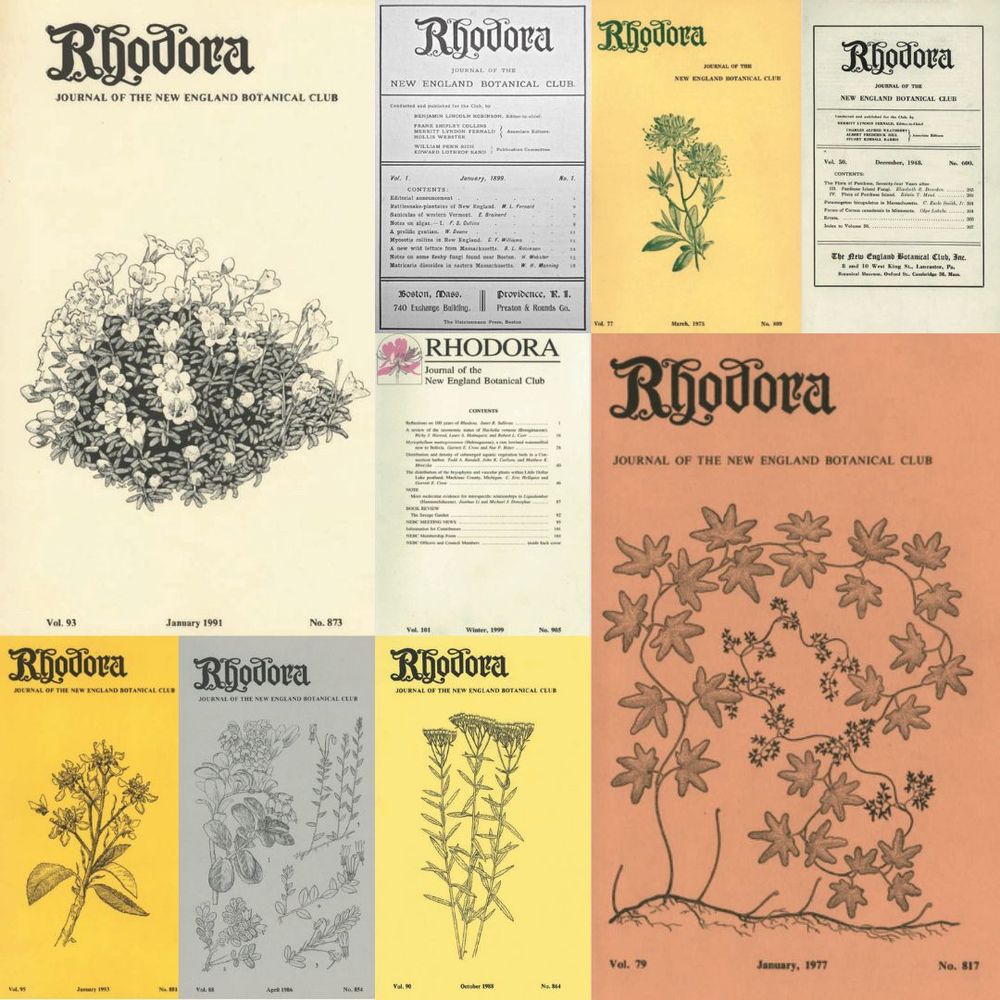
Our celebratory issue of Rhodora is available! NEBS members have access through their membership AND we've made most of this issue open-access. We've been publishing since 1899, so there's a lot to celebrate and we want everyone to join in! bioone.org/journals/rho...
11.06.2025 16:00
👍 3
🔁 1
💬 1
📌 0

Outlooks: Josephine Halvorson
This is "Outlooks: Josephine Halvorson" by Storm King Art Center on Vimeo, the home for high quality videos and the people who love them.
To be fair to that incredible sculpture park, I was obsessed with this uncanny tree sculpture and I started teaching forest ecology methods with Josephine Halvorson's Measure (Tree) and that piece really seems to resonate with students.
vimeo.com/166578932
08.07.2025 13:45
👍 1
🔁 0
💬 0
📌 0
Reading the new alpine snowbank refugia paper at coffee shop while my kid attends a morning sewing camp reminds me of the years when her sister attended day camp at a sculpture park and I wrote manuscripts in a courtyard adjacent to a giant xylophone that kids whaled on with sticks.
08.07.2025 13:39
👍 2
🔁 0
💬 1
📌 0

a comic that comprises three rows and three columns of mock-scientific papers where only the titles are legible. The title of the whole comic is: "Types of scientific paper we read in advanced forest ecology & conservation (with lab)".
The titles of the first row of papers are:
"We made a computer model and called it a day"; "It was the past and ecology was easier back then"; "If you ignore the other variables, this finding is shocking!"
The titles of the middle row of papers are: "I hope you like graphs…"; "I found these old documents so now I can do research for free*"; "FIA did the field work so we don’t have to"
The titles of the bottom row of papers are: "Mars Attacks: Forests Invaded by Evil Alien (plants)"; "Oh, god, that’s right, there’s fauna out there"; "Some good news, actually"

a comic that comprises three rows and three columns of mock-scientific papers where only the titles are legible. The title of the whole comic is: "Types of scientific paper we read in advanced forest ecology & conservation (with lab)".
The titles of the first row of papers are:
"I think I’m obsessed with FIA data"; "I’ve been writing for the last ten years and I refuse to part with a single letter I wrote"; "I just found out about species interactions. Did you know about them?"
The titles of the middle row of papers are: "Crap, we’re screwed."; "I've only talked with academics the last 10 years What do you mean you don't know ___"; "I’ve been studying acid rain for a whole lifetime and the government still won’t listen to me"
The titles of the bottom row of papers are: "I hate that Canham cited me."; "You need 40 pages of history to begin to understand my brilliance"; "I enjoy making my students read my papers"
My students' take on the xkcd 'types of scientific papers'. A very cool, interesting moment of reflection on the semester together.
This exercise was inspired by Cindy Kohtala's blog about the meme www.cindykohtala.fi/2021/10/14/f...
28.05.2025 18:40
👍 3
🔁 1
💬 0
📌 0
We recently found Emerald Ash Borer on campus.
I'm putting together a Fall 2025 pop-up course/seminar series to celebrate ash trees, mourn the arrival of EAB, and explore the ash's human and non-human relationships in the northern forest.
Please share recommendations for speakers!
24.05.2025 12:01
👍 3
🔁 0
💬 2
📌 1
Spent the day in a DIY workshop with co-PIs from an NSF grant that was archived the day we were set to resubmit. Here’s the thing about scientists in a tiny state who work with small natural history collections: we get the science/teaching/conservation/outreach done. Our ROI is off the charts.
12.05.2025 23:14
👍 4
🔁 0
💬 0
📌 0

Graphic promoting "Botany on a Budget," a casual discussion on May 8, 2025, at 2 p.m. EST. The background shows green and blue tube racks filled with labeled microcentrifuge tubes. Text invites participants to join a conversation about strategies for conducting research on a limited budget. The image includes a QR code to register and logos for the Botanical Society of America (BSA) and Botany360. Sponsored by the BSA Diversity, Equity, and Inclusion Committee.
🌿 Stretching your research dollars? You’re not alone!
Join us for the #Botany360 free virtual event, Botany on a Budget — a casual discussion with BSA members who have experience making research happen with limited resources.
Thursday, May 8, 2025, 2–3 p.m. EST
Register here: tinyurl.com/bot360
28.04.2025 16:45
👍 20
🔁 18
💬 0
📌 2

This image shows a hand holding a leaf that is half green and half burning and brown. The AJB logo is seen in the top left corner. Text: AJB Special Issue Call for Papers: Plant Resilience and Conservation for a Changing Cliimate. Proposal deadline: May 30, 2025.
🌱 SPECIAL ISSUE CALL FOR PAPERS 🌱
The #AJB announces a call for papers for a special issue, “Plant Resilience and Conservation for a Changing Climate,” led by guest editors J. Rentsch, E. Stacy, C. Mackenzie, J. Boyd & V. Negron-Ortiz.
Deadline for proposals: May 30, 2025.
bit.ly/3GcyMUG
17.04.2025 18:13
👍 25
🔁 14
💬 1
📌 0

a scientist sits on the summit of a mountain in Acadia National Park, Maine. She is wearing a purple jacket and blue baseball cap, writing in an orange notebook. Behind her, the view stretches out across Mount Desert Island forests into the Gulf of Maine and distant islands.
#WithoutNSF my PhD research on the impacts of climate change on plant communities in Acadia National Park would not have been possible. Managers use our work to protect resources. Park educators & interpretive staff use our work to create signage and talk to the public.
We need to fund NPS and NSF.
06.05.2025 18:11
👍 9
🔁 3
💬 0
📌 0

Thread with an email being sent to @asn-amnat.bsky.social @sse-evolution.bsky.social @systbiol.bsky.social members today calling for a Tri-society week of action for NSF:
Dear members:
The tri-societies (ASN, SSE,SSB) are running a ‘Week of Action for NSF’. Your engagement is crucial.
05.05.2025 11:59
👍 182
🔁 159
💬 4
📌 12
Reminder that I'm looking for grad students. Canada just decided for sanity in government, Fredericton elected a musician MP, and UNB is a great place to be. Come join me! Position is fully funded.
30.04.2025 10:22
👍 6
🔁 5
💬 0
📌 0
She was an incredible science writer. Her prose is beautiful. I taught The Edge of the Sea to freshmen in a "welcome to college, take a required writing course" class.
Also she asked E.B. White at the New Yorker to write about pesticides and he demurred. Carson: guess I'll roll up my sleeves...
28.04.2025 12:08
👍 2
🔁 0
💬 1
📌 0


