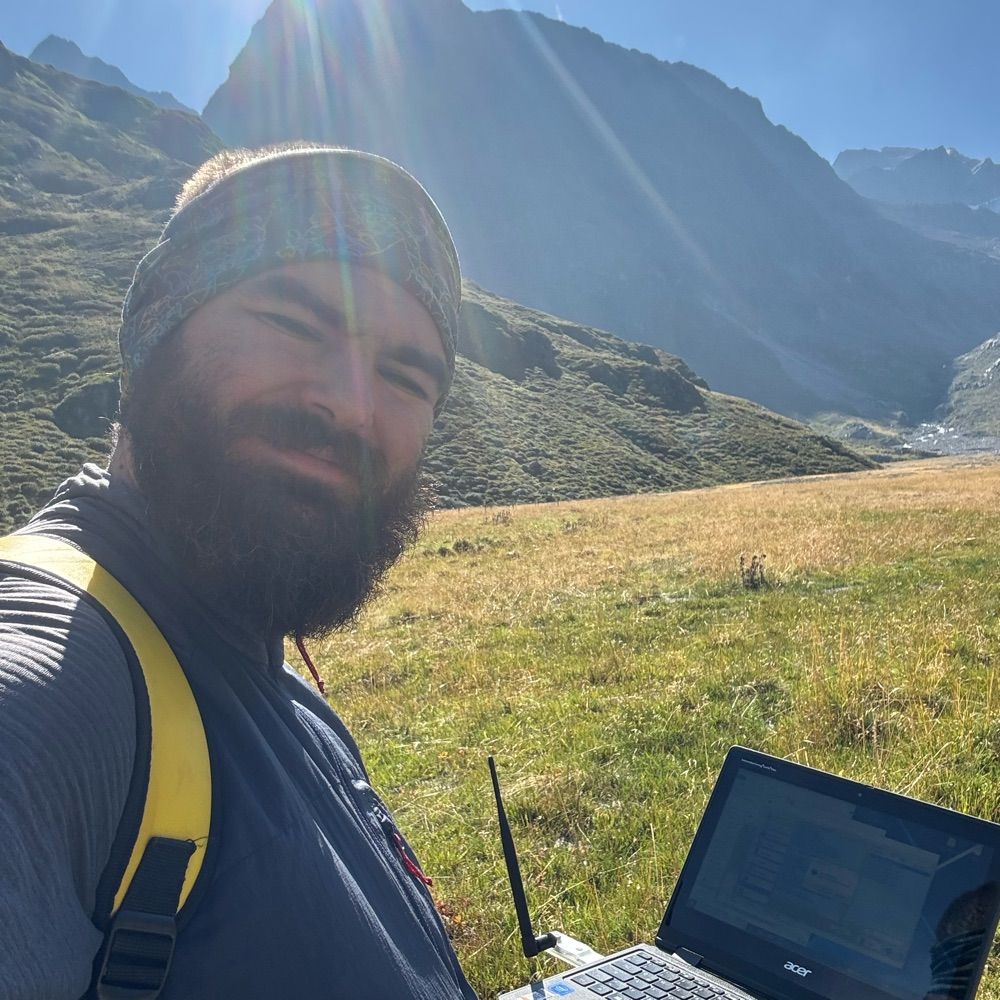
Thank you, Karen! :)
21.01.2026 13:51
👍 0
🔁 0
💬 0
📌 1
Thank you, Karen! :)
I saw you there! Thanks for joining, Patrick.
Thanks Tommaso! It’s gonna be some kind of post processing of the dynamic simulation models. Really curious about that.
Thanks, Jonathan! :)
Thanks, Billur :)
Thanks! The job is not yet done and not even my funding, only the PhD 😁. We are now running the final simulations on the Schrankogel and hopefully in the coming months, we will make some really cool papers.
Thanks a lot for those nice words. It was a fun and enlightening discussion indeed. I really enjoyed that you and Bente brought different perspectives to it.
Thank you, Markus!
Thanks Julia :-)

Anyway, I hang the thesis up on Research gate, so if you are interested in microtopography and alpine plants, go ahead: www.researchgate.net/publication/...

But we made it through, and the lessons learnt were indeed valuable, often changing our perception and views. For instance, the direct role of microclimate temperature on plants is often overestimated; rather than a physiological constraint, it is a trigger to other, much more complex processes.

To our big surprise, fine-scale species distributions turned out to be much more elusive to capture.
Nearly all the data analysis trials we did, we found something unexpected, often pointing to factors that we didn’t measure. This made things quite complicated and papers difficult to publish.


I opted for this all, because I was fascinated by topography. I worked with topography in grasslands before, and scaling to microtopography and microclimate was an attractive challenge.
So the plan was clear: use these fine-scale environmental data to explore how they explain where palnts grow.

We were two PhD students to handle this data, and it clearly became a way of living. For the next 5 years, I have spent around 2 summer months between 2000 and 3500 m a.s.l. having no idea about the date or time. Constantly exploring how bad the weather needs to be to make work impossible.

The idea was so ambitious that it was unclear from the beginning if it was even feasible: to obtain as much fine-scale environmental and vegetation data as possible from one single mountain, permanently fix ~4k plant individuals across the mountain, and transplant another ~4k individuals and more.

Yesterday, I defended my PhD thesis at @univie.ac.at. Thanks @vvandvik.bsky.social and Bente Graae for reviewing it and Stefan Dullinger for supervising.
I tasted quite a bit of science during my Master's by leading 5 papers and doing lots of field research. But this was different. Extraordinary.
Thanks, Rebecca! :-)
Anyway, after seven(!) desc rejections, which is by far my record, we made it through in @oikosjournal.bsky.social. Thanks, Oikos, for appreciating the resolution over extent! ❤️
nsojournals.onlinelibrary.wiley.com/doi/epdf/10....
The strength of our data is, however, not supposed to be its spatial extent, but its spatial resolution and related sampling density of 900 sites covering a lot of the fine-scale variation of this mountain. Which is a very rare thing. But apparently not easily sold to journals.
Up to now, it wasn't very difficult. But now, the process of getting this published has started. From basically every journal, we got quite nice and often positive constructive feedback, but concerns about the size of the study area, which is only one mountain.

Second, we tried to narrow this diversity down, keeping on mind all to colinearity in these data. It's dificult to put it in 250 words, so just check our paper. ;-)
Eventually we foud out that only 6 variables are enough to model even a quite large number of species. Out of 250!

First, we looked at how they correlate with species distributions, comparing them with Bioclim variables most commonly used for this purpose.
And, a first surprise, they were not doing well at all. That's not a criticism of Bioclim, but for microclimate-based models, they are probably not the best.

Even though we only used soil temperature from our Schrankogel loggers, we reached approximately 250 temperature variables.

The story started sometime in 2023 when I wanted to test if microclimate temperatures are indeed multifaceted as Christian Körner and Erika Hiltbrunner emphasized in their 90 ways to describe plant temperature. doi.org/10.1016/j.pp...

This paper was the most frustrating journey I've ever gone through...
Nevertheless, after nearly two years, the paper is finally published.
Thanks @jlembrechts.bsky.social for this blog post about our new Oikos paper! Love your blog. :-)

How to not be swamped by your microclimate data?
The rise of microclimate data may have opened Pandora’s box. Gone are the days of simple bioclimatic variables — now heads spin trying to summarize these timeseries.
A much-needed paper by @krystofchytry.bsky.social:
🔗 the3dlab.org/2025/11/11/h...


This year we’re, in addition to the regular business, using our fine-scale temperature maps to explore isolated cold spots in lower elevations to see if nival species survive there. Quite dangerous sites these cold spots…

Calf in the middle of alpine road. Foggy mountains behind.
Fieldwork in the Alps. 5th year on the same mountain. Even this calf wonders why are we still doing that.

John Rodwell became an Honorary Member of the European Vegetation Survey. John is one of the most prominent vegetation ecologists in Europe.