
What a marvellous hord you have! Glad you’re enjoying Wordhord in your book nook.
17.02.2026 20:25
👍 1
🔁 0
💬 1
📌 0
What a marvellous hord you have! Glad you’re enjoying Wordhord in your book nook.
Just wanted to say, I have an aversion to going onto social media these days but when I do finally get around to it and read kind and generous comments it really makes my day. Thank you and apologies if I do miss your post or respond 3 weeks later.
Wordhords are meant to be unlocked and shared. That’s lovely to hear.
Thank you, it means a lot to me to hear that from readers.

A word cloud of Old English words; the largest word is neorxnawang, and the other words are ān-genga, hrīmig, giccig, eorþ-nafela, wīd-gangol, mixen-duncge, eorcnan-stān, steor-wigle, mere-swīn, lār-þegn, gnorn-scyndende, ears-endu, lācniendlic, lǣce-getawu, clypnys, glædnes, twelf, milte-wærc, friþu, lufu, bēag-gyfa, ge-cūþlǣcan, heofon-hwealf, wæl-cēasiga, sund-hwæt, bed, hlīsa, fēðe-mund, collen-ferhþ, tungol, and hran-rād.
Ic ēow þancung, everyone who shared their favourite Old English word(s) for Old English Wordhord’s 12th birthday. May your hoards of words grow ever more wondrous. For my personal favourites, see the "hord highlights" category on oldenglishwordhord.com or on the Old English Wordhord App.

A commemorative wooden plaque with a tweet from @OEWordhord from 11 November 2013; it says hashtag Old English Word of the Day, hashtag word-hord, n, a word hoard, a store of words.
twelf, n/numeral/adj: twelve (12). (TWELF / ˈtwɛlf)
Today marks 12 years of the Old English Wordhord! What’s your favourite Old English word?
#OldEnglish #WOTD
I’m glad to hear it! 🐍 🐆 🐘 🦔
"The Deorhord" is as entertaining as it is informative. @hanavideen.bsky.social brings life to the stories behind the words in a way that is a true delight to read. I very much recommend it to all philologists, etymologists, "word nerds," and of course, natural history enthusiasts. #Booksky
@bookshop.org are you ever coming to Canada because I would love to do this…

Screenshot of a Princeton University Press ad for Hana Videen’s THE DEORHORD: AN OLD ENGLISH BESTIARY with an AI suggested follow-up question below: ‘Why were toucans called egg-suckers?’
No idea why this is the first AI follow-up question that comes up for this post. My book contains no toucans. If you want to read THE DEORHORD (which does discuss other ornithological wonders like phoenixes and flaming chickens), you can find it here: oldenglishwordhord.com/deorhord-book/

A stack of THE DEORHORD: AN OLD ENGLISH BESTIARY, including two paperbacks and two hardcovers. The books are on a wooden staircase and beside them is a brown and white cat sniffing at a treat.
dēoren, adj: of or like a wild animal. (DAY-o-ren / ˈdeːɔ-rɛn)
It’s #WorldAnimalDay (Dēores Dæg…sounds better in Old English). Learn about medieval animals in THE DEORHORD: AN OLD ENGLISH BESTIARY: buff.ly/l4Lbsip
#OldEnglish #WOTD #TheDeorhord @profilebooks.bsky.social
@princetonupress.bsky.social

Also now available for 70% off from @princetonupress.bsky.social are @hanavideen.bsky.social's books Word Hord and Deor Hord

A white book cover with green medieval-style beasts on it and a green border. The book is called Deor Hord: An Old English Bestiary and the author is Hana Videen
New book arrived!! @hanavideen.bsky.social @oewordhord.bsky.social
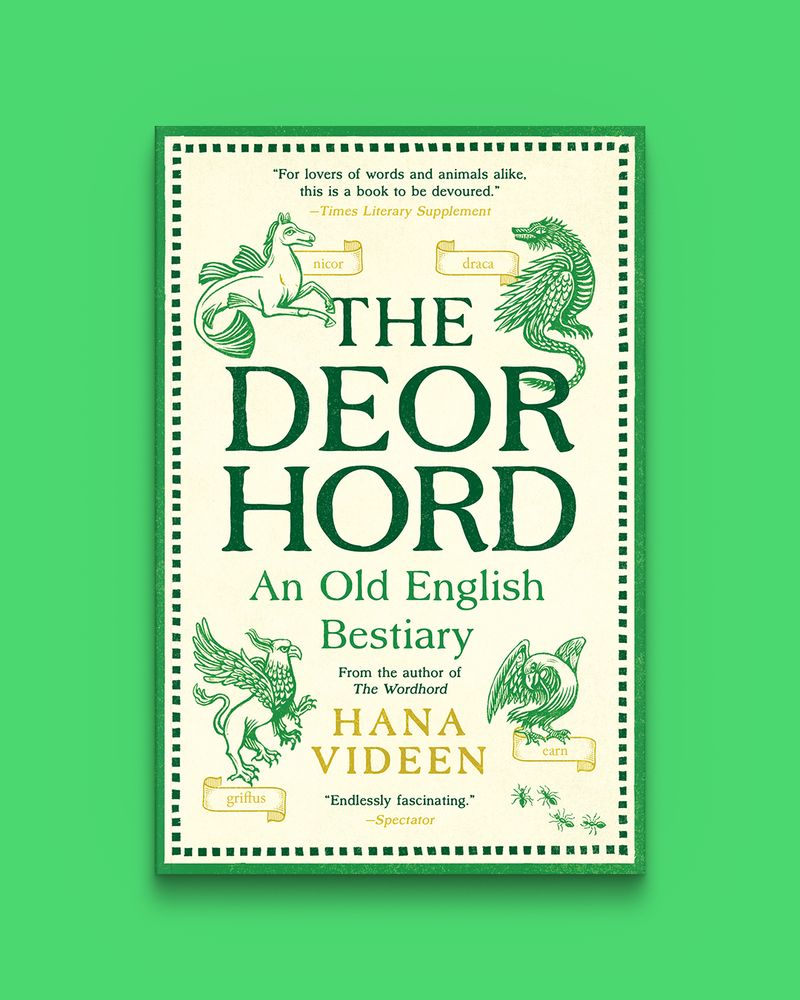
Paperback cover of The Deorhord: An Old English Bestiary by Hana Videen
An entertaining tour of Old English words for animals, from the author of The Wordhord: Daily Life in Old English.
@hanavideen.bsky.social's The Deorhord is now available in #paperback in the United States and Canada! Learn more: press.princeton.edu/books/paperb...
#English #OldEnglish #Language

A row of copies of the paperback book THE DEORHORD by Hana Videen, with one in the centre facing out so the front cover is visible, with images of a horse-like sea creature, a dragon, a griffin, an eagle and some ants.
lēof-spell, n.n: a pleasant message. (LAY-off-SPELL / ˈleːɔf-ˌspɛl)
The US/Canada paperback DEORHORD is out today! (The UK edition is already out in the rest of the world.) See where to get it here: buff.ly/l4Lbsip
#OldEnglish #WOTD #TheDeorhord @princetonupress.bsky.social

A review of Little Kingdoms by Alex Harvey, written by Hana Videen: ‘Dispels the myth that Early Medieval Britain was a heptarchy, the home of a people easily categorised by ethnicity or nationality. Instead, Harvey breathes life into a sweeping miscellany of little kingdoms. Some familiar and prominent in our early medieval histories, others mysterious and elusive.’
Thank you to @hanavideen.bsky.social of ‘The Deor Hord’ and @oewordhord.bsky.social fame for reviewing my next book, LITTLE KINGDOMS (releasing 30/11/25)
‘Dispels the myth of [easy] ethnicity or nationality [terms]. Instead, Harvey breathes life into a sweeping miscellany of little kingdoms.‘

A paperback copy of ‘The Deorhord: An Old English Bestiary’ by Hana Videen propped up on top of a hardcover copy of the same book lying on its side; beside them is an orange card that says ‘Princeton University Press’.
Very excited to have an advance copy of @princetonupress.bsky.social's paperback THE DEORHORD: AN OLD ENGLISH BESTIARY on my shelf! Available September 16: preorder the US/Canada publication from PUP: buff.ly/OJUqlpB
#TheDeorhord #OldEnglish #MedievalBeasties
Whoever came up with the word podiatrist really missed a trick by not going with doctopus.

And I would be a fool to not mention @hanavideen.bsky.social’s ‘The Deor Hord’ (+ ‘The Word Hord’).
A different subject to mine, sure, but the structure and playful attitude taught me much on how to approach complex subjects for the general reader - visually, the art of this book was a huge inspo
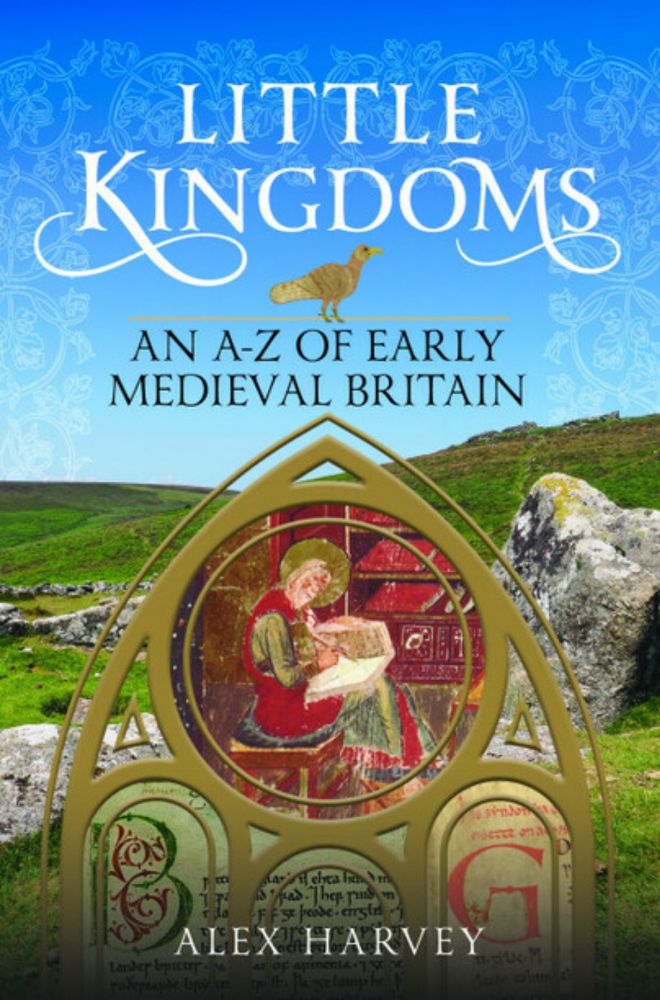
www.pen-and-sword.co.uk/Little-Kingd...
LITTLE KINGDOMS: AN A-Z OF EARLY MEDIEVAL BRITAIN, my next book, releases on the 30th of November 2025
As of today it is now available for preorder, at a discounted early price of £20 (RRP £25)
Why should you pick up this book...? 🧵
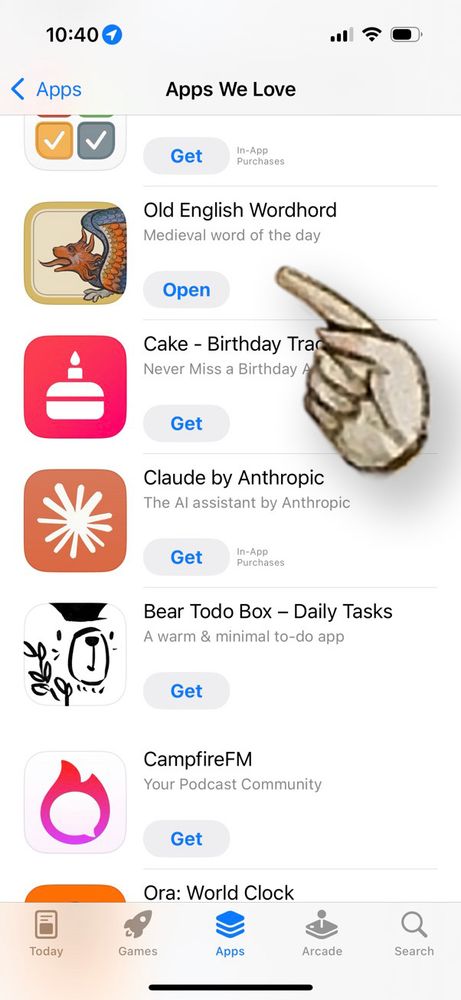
Apps We Love list on the App Store with a medieval manuscript illustration of a hand pointing to the Old English Wordhord app in a list with other apps like Cake - Birthday Tracking, Claude by Anthropic, Bear Todo Box, CampfireFM and Ora: World Clock.
We're in the Apps We Love list on the App Store in Europe this week!
This is the first time Wordhord has been in any list on the App Store. I feel honoured to be alongside other amazing indie apps like @mercuryweather.app and @lookup-app.bsky.social

5 stars. Great Whenever I get sad about the world I remember the lengths nerd will go to to educate people about interesting stuff. 10/10. April 18, 2025. Review_Lord_69
I launched Wordhord v2.0 today and noticed this review while I was in App Store Connect.
If you want an app to cheer you up, check it out (it's free).
Learn an Old English word every day in an app with a unique medieval style.
apps.apple.com/ca/app/old-e...
#iOSDev #OldEnglish #MedievalSky
A black manuscript with gold text in a medieval font that reads Old English Wordhord. A gold outline illustration of a dragon head with long pointy ears and tongue. Version 2.0 is written below in blue text and then a badge that says Download on the App Store again in a medieval font with a red illustration of an apple instead of the Apple logo.
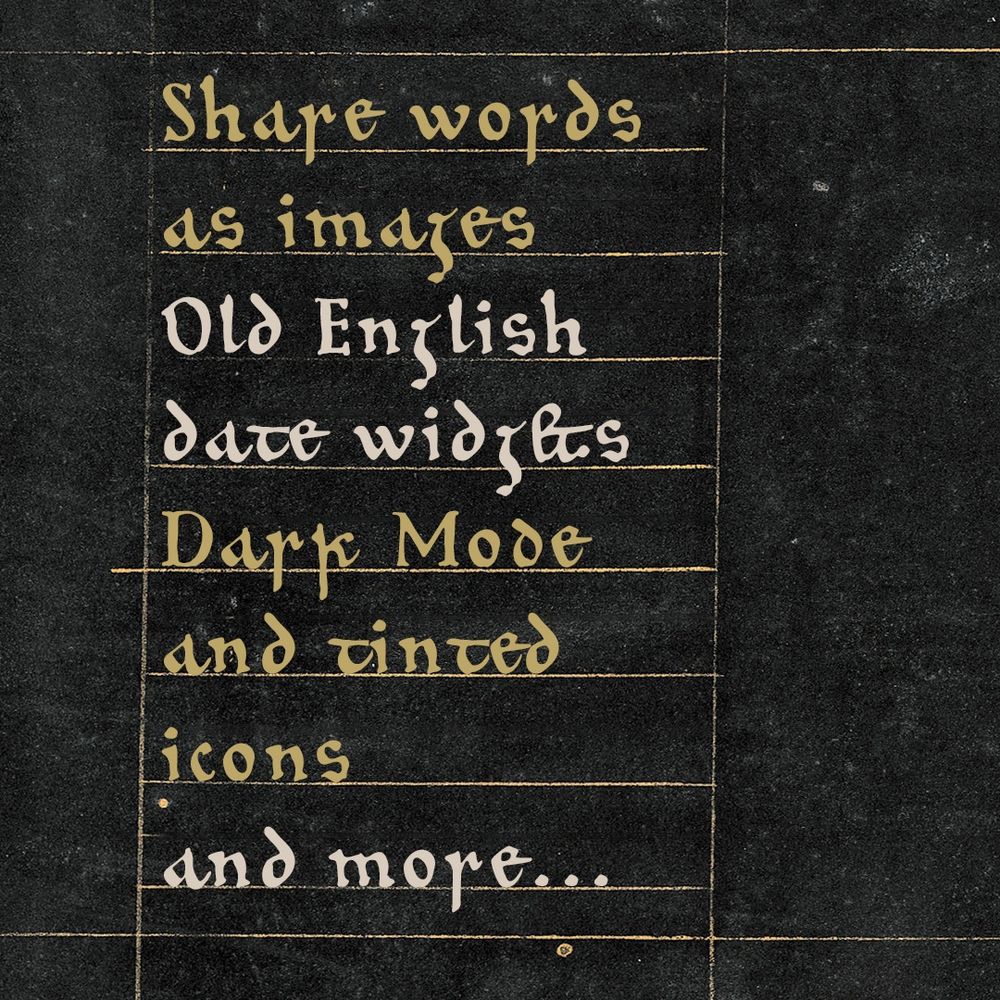
A black page manuscript with gold rule lines and gold and white text that reads: Share words as images. Old English date widgets. Dark Mode and tinted icons and more...
The Old English Wordhord version 2.0 is available today on the App Store!
New features include:
- Share Old English words
- Old English date widgets
- Dark mode icon
As always the app is free so check it out!
apps.apple.com/ca/app/old-e...
#OldEnglish #Medieval #MedievalSky

Medieval manuscript illustration of a whale underwater gulping several fish into its mouth.
dēop, adj: deep, extending downwards; describing the extreme of range (of understanding, thought, doctrine, oaths, etc.), profound, complete. (DAY-op / ˈdeːɔp)
Image: Bestiaire of Guillaume le Clerc; France, late 13th century; @labnf.bsky.social fr. 14964, f. 150v.
#OldEnglish #WOTD

Medieval manuscript illustration of a fire-breathing dragon; it has no neck, a hairy face, and two wings that taper off into two feet.
fȳrene, adj: fiery, flaming with fire, fireproducing. (FUE-reh-nuh / ˈfyː-rɛ-nə)
Image: Livre des propriétés des choses; France (Toulouse), c. 1350; Paris, Bibliothèque Sainte-Geneviève, Ms. 1029, f. 248r.
#OldEnglish #WOTD

Medieval manuscript marginalia depicting a hooded man holding the midsection of a winged dragon while swallowing its head; a bird pecks its breast and a squirrel eats a nut nearby.
for-swelgan, str.v: to swallow (something/someone) entirely, devour (something/someone) utterly. (for-SWELL-gahn / fɔr-ˈswɛl-gan)
Image: Ormesby Psalter; England (East Anglia), 1250-1330; @bodleianlibraries.bsky.social MS. Douce 366, f. 71v.
#OldEnglish #WOTD

Medieval manuscript illustration of a long, spotted cat-like creature.
lox, m.n: lynx. (LOCKS / ˈlɔks)
Image: Lynx in a bestiary; England, c. 1170; @britishlibrary.bsky.social Add MS 11283, f. 3v.
#OldEnglish #WOTD
I am definitely enjoying the joke answers, but yes, I’d love to know what it actually is! Any medieval manuscript zodiac specialists out there? Or maybe @newcollegeoxf.bsky.social can tell us?

Medieval manuscript image of two people holding a large triangle between them, with an orange section on top, then a gold section, and the largest section is white with black spots.
So I'm curious... I know this image from the De Brailes Psalter represents Gemini, but why are the twins holding a pizza? What is that supposed to be? (New College, Oxford, MS 322, f. 3r) #MedievalSky
smēagan, wk.v: to consider, ponder, examine, search, seek an opportunity. (SMAY-ah-gahn / ˈsmeːa-gan)
#OldEnglish #WOTD