

All data generated in this study and all benchmark analysis scripts and source codes for PHACE are available at github.com/CompGenomeLa...
18.07.2025 15:24
👍 3
🔁 1
💬 0
📌 0
All data generated in this study and all benchmark analysis scripts and source codes for PHACE are available at github.com/CompGenomeLa...
Our new algorithm PHACE: Phylogeny-Aware Detection of Molecular Coevolution, by me and Ogün Adebali (@compgenomics.bsky.social), is now published in Molecular Biology and Evolution.
Many thanks to @nehircanozdemir.bsky.social for the beautiful illustration of PHACE!
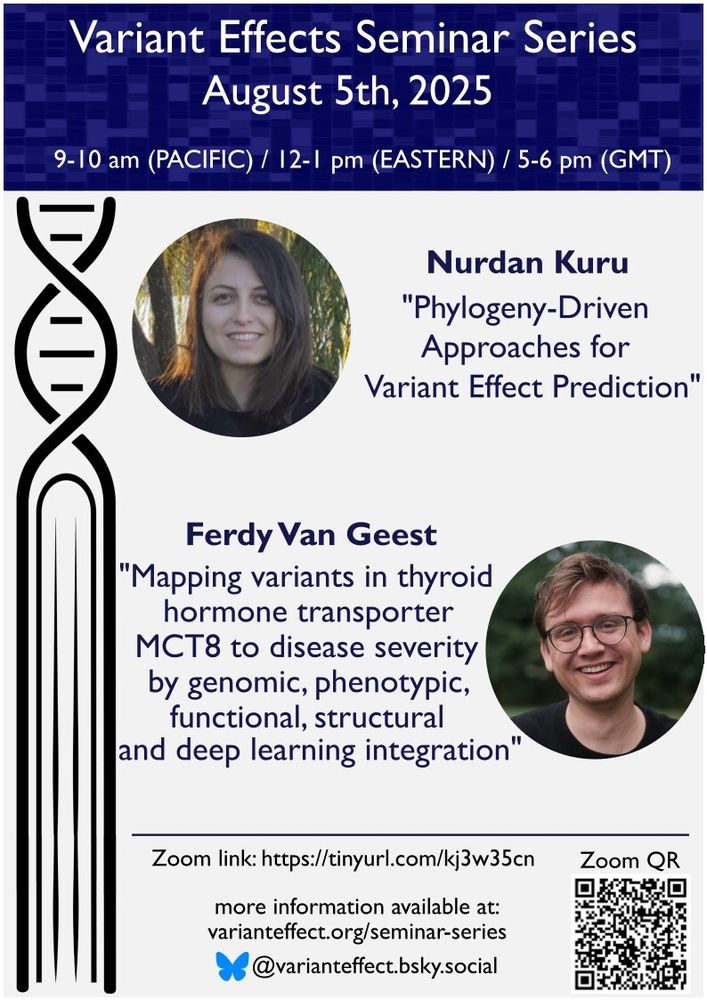
The image is a poster for the "Variant Effects Seminar Series" dated August 5th, 2025. The top section is a blue header with white, bold text indicating the seminar series name and date. Below, the time for different time zones is given: 9-10 am (PACIFIC), 12-1 pm (EASTERN), and 5-6 pm (GMT). On the left side of the poster, a vertical DNA helix graphic in black is visible. To the right, there are two circular photographs of speakers with talk titles.
Coming up on August 5 🗓️
Nurdan Kuru @nurdankuru.bsky.social shares phylogeny-aware methods for variant effect prediction.
Ferdy van Geest dives into MCT8 variants & thyroid disease. Computational meets clinical! #Genetics #RareDisease #MedicalGenetics ℹ️ www.varianteffect.org/seminar-seri...

#BoG25 at home - CSHL

A gene called NOVA1 may be part of the solution to the mystery of how our ancestors evolved language. Here's my story about mice with strange squeaks. [Gift link] nyti.ms/3XuVehN 🧪
NOVA1, a neuron-specific RNA binding protein & splicing factor, likely impacted language function in human evolution. Human NOVA1 is unique (vs mammals, Neanderthals), & it changes vocalization in CRISPR’d mice!
TY @NatureComms @RockefellerUniv team, collaborators @erichjarvis @asiepel labs
🧵👇