🚨Preprint! Happy to share the research from my PhD “Genome delivery of a contractile tailed phage and its superinfection exclusion mechanism”. We use cryoEM to study the genome ejection of the phage T4, revealing how the tape measure protein regulates the process.
www.biorxiv.org/content/10.6...
07.03.2026 11:11
👍 69
🔁 30
💬 3
📌 5
Checkout our latest preprint which is a real lab-wide effort to map antibiotic stress signatures across the pneumococcal pangenome. All findings have also been incorporated in PneumoBrowse 2.0.
www.biorxiv.org/content/10.6...
27.02.2026 13:06
👍 20
🔁 14
💬 1
📌 0
Out today: We discovered new viral proteins that target immune signaling molecules, solely based on their AlphaFold-predicted shapes
www.science.org/doi/10.1126/...
Congrats Nitzan Tal and coauthors! Thank you Kranzusch lab for the fun collaboration!
Linking below previous thread on our findings
05.03.2026 19:28
👍 94
🔁 43
💬 0
📌 5

@nitzantal.bsky.social @romihadary.bsky.social @soreklab.bsky.social use structure prediction and in silico binding site analysis to discover viral immune evasion proteins! Exciting for our lab @reneechang.bsky.social @riveralopz.bsky.social to help with this project.
www.science.org/doi/10.1126/...
05.03.2026 20:23
👍 67
🔁 25
💬 0
📌 0

Tree drawn within the iTOL interface generated by LINtree. The tree is annotated with LIN codes and clonal complexes in different colours.

LINvis displays datasets of LIN codes as a series of hierarchical packed circles.
BIGSdb v1.52.1 has been released. This adds 2 new plugins for LIN code visualisation - LINtree (@giphy-ip.bsky.social) and LINvis. See github.com/kjolley/BIGS... for release notes. BIGSdb powers all the databases at @pubmlst.org and BIGSdb Pasteur.
02.03.2026 13:58
👍 7
🔁 5
💬 1
📌 0

Description
Please note that job descriptions are not exhaustive, and you may be asked to take on additional duties that align with the key responsibilities ment...
Please RT:📢We are hiring a Post-Doc in Structural Biology to join our multidisciplinary team.
Project: study molecular mechanisms of horizontal gene transfer using cryo-EM and integrative structural biology.
Apply: shorturl.at/ecrVL
#StructuralBiology #CryoEM #Postdoc
04.03.2026 16:24
👍 4
🔁 8
💬 0
📌 0

New post-doctoral research position in my phage-host interactions (Phi) laboratory in @otagomicroimmuno.bsky.social at @universityofotago.bsky.social New Zealand. The project is focused on defences against jumbo phages. Please share and if interested apply using the link in the comments.
04.03.2026 00:20
👍 49
🔁 47
💬 5
📌 1

This is the first time we observed bacteria use plasmolysis to defence against phages! biorxiv.org/content/10.6...
Thanks all the authors to discover this together! @fnobrega.bsky.social Zhiying @garushyants.bsky.social Dinshaw and Eugene
04.03.2026 00:03
👍 8
🔁 6
💬 2
📌 0

Epistasis and co-adaptation in bacterial genome evolution
Nature Reviews Genetics - Bacterial genome evolution is shaped by epistasis, which can constrain or promote specific evolutionary paths. The authors review how integrating the effects of epistatic...
I’ve spent a lot of time over the past two years thinking about genome evolution and how recent research revealing complex gene-gene interactions has complicated traditional ‘gene-centric’ genomic approaches to evolution. So here is a review that consolidates these thoughts!
rdcu.be/e6pHY
02.03.2026 15:48
👍 85
🔁 39
💬 4
📌 1

MBE | The role of society journals in protecting the scientific record
MBE Editors-in-Chief Claudia Russo and Brandon Gaut publish a new editorial on the role of society journals in protecting the scientific record.
🔗 doi.org/10.1093/molbev/msag022
#evobio #molbio #societyjournal
@claurusso.bsky.social @bsgaut.bsky.social
03.03.2026 10:18
👍 12
🔁 5
💬 1
📌 1
#microsky #phage #phagesky
03.03.2026 18:22
👍 4
🔁 0
💬 0
📌 0
With whom do they exchange? P4 tend to exchange with other P4 and P2 with other P2. But there are also exchanges with other elements like plasmids and phages. Surprisingly, we couldn't find exchanges between P2 and P4. Hence, these satellites do not exchange anti-phage functions with their helpers.
03.03.2026 17:39
👍 0
🔁 0
💬 0
📌 0
What are the consequences? We observe lots of novel defence systems, especially chimeras, suggesting that recombination hotspots of P2 and P4 constantly generate novel systems (we experimentally confirmed the function of more than a dozen).
03.03.2026 17:39
👍 0
🔁 0
💬 1
📌 0
How do they vary? They seem to vary by recombination. The data suggests that anti-phage systems are swapped by recombination even before being inactivated. The mechanisms driving their rapid genetic mobility remain mysterious (stay tuned).
03.03.2026 17:39
👍 0
🔁 0
💬 1
📌 0
How quickly do anti-phage systems vary? They vary very quickly; P2/P4 strictly identical at the core genes usually have non-homologous systems. Hence, bacterial defences vary because the MGEs carrying them have high chromosomal turnover, and because their anti-phage systems vary even faster.
03.03.2026 17:39
👍 0
🔁 0
💬 1
📌 0
Fantastic collaboration w/ @dbikard.bsky.social @audeber.bsky.social @rayanchikhi.bsky.social labs led by @jmouradesousa.bsky.social : We assessed the rates of variation of anti-phage systems in P4-like satellites and P2 helper phages. Quick conclusion: Huge variation! We focus on 4 key questions/5
03.03.2026 17:39
👍 44
🔁 20
💬 1
📌 1
Join us at UCL @ugiatucl.bsky.social @ucllifesciences.bsky.social 👇🧵
02.03.2026 10:40
👍 3
🔁 2
💬 0
📌 0

Picture J. Zakany
Vendredi prochain 6 mars à 10h, début de mon cours 2026 @college-de-france.fr. Les relations conflictuelles entre les variations de l’ADN et l’évolution des structures🤓 L’ADN; cause proximale ou cause ultime? 🤔 Entrée libre, sortie libre! Amis Parisiens, 🙏RT 🤘
27.02.2026 09:09
👍 11
🔁 7
💬 0
📌 1

In case you missed it: our review titled "Spatial structure: shaping the ecology and evolution of microbial communities" is out! 🚨
Let me hit you with some highlights on why spatial structure matters. (and why you should care!)
Sharing is appreciated 🙏 🧵👇
doi.org/10.1093/fems...
25.02.2026 13:06
👍 137
🔁 82
💬 3
📌 2
🧵 Proud to present a tour de force by postdoc @gregbwhitfield.bsky.social solving the mystery of how bacterial Tad pili can extend and retract with a single motor ATPase. Great collaboration with Lynne Howell, @dr-lori-burrows.bsky.social, @ianyyen.bsky.social www.biorxiv.org/content/10.6...
26.02.2026 15:56
👍 41
🔁 15
💬 1
📌 1

We tested all the other type IV filament system motors and the only other one to adopt both orientations was the archael Epd pilus. This matches the nice work from @epcrocha.bsky.social showing that Tad pili were inherited from Archaea.
26.02.2026 15:56
👍 3
🔁 1
💬 1
📌 0

🔬 New work from the Mazel Lab engineers programmable conjugative plasmids to selectively target MDR bacteria and the resistance plasmid pOXA-48, blocking its spread in complex communities.
✍️ @amazeld.bsky.social & coll. @pasteur.fr
📖 shorturl.at/GZdJu
#MicroSky #AntibioticResistance #Conjugation
27.02.2026 06:14
👍 19
🔁 11
💬 0
📌 0
New preprint out on bioRxiv!
www.biorxiv.org/content/10.6...
Can conjugative plasmids be used to control plasmid and pathogen spread?
Follow me down the rabbit hole that led to this story 🧵
26.02.2026 09:54
👍 48
🔁 31
💬 5
📌 1
Working on a 🧵 Bacterial Tad pili extend
and retract pili using a single motor ATPase with a unidirectional catalytic mechanism. We find that the Tad motor achieves bidirectionality by physical inversion; alternating which face of the ATPase toroid engages the IM platform complex. #microsky
26.02.2026 13:07
👍 4
🔁 3
💬 0
📌 1

Yet another awesome single-phage paper from Ido Golding's lab #phagesky
www.biorxiv.org/content/10.6...
24.02.2026 23:19
👍 33
🔁 13
💬 1
📌 0
Next one in a storm of preprints from our lab's amazing scientists.. Recent-ex-postdoc, #newPI @cathyhernandez.bsky.social studied thermal ecology of marine bacteria isolated near New Haven. Turns out, response of this bacterium to temperatures is shaped by prophages!
#phagesky #microsky
21.02.2026 17:39
👍 47
🔁 16
💬 0
📌 0
New pre-print with @wtmatlock.bsky.social!!!
www.biorxiv.org/content/10.6...
What shapes the distribution of plasmids across bacteria? Our paper shows that conjugative plasmids actually have a very narrow distribution compared to mobilizable plasmids. Conjugative systems restrict plasmid transfer!
20.02.2026 08:41
👍 31
🔁 15
💬 1
📌 0

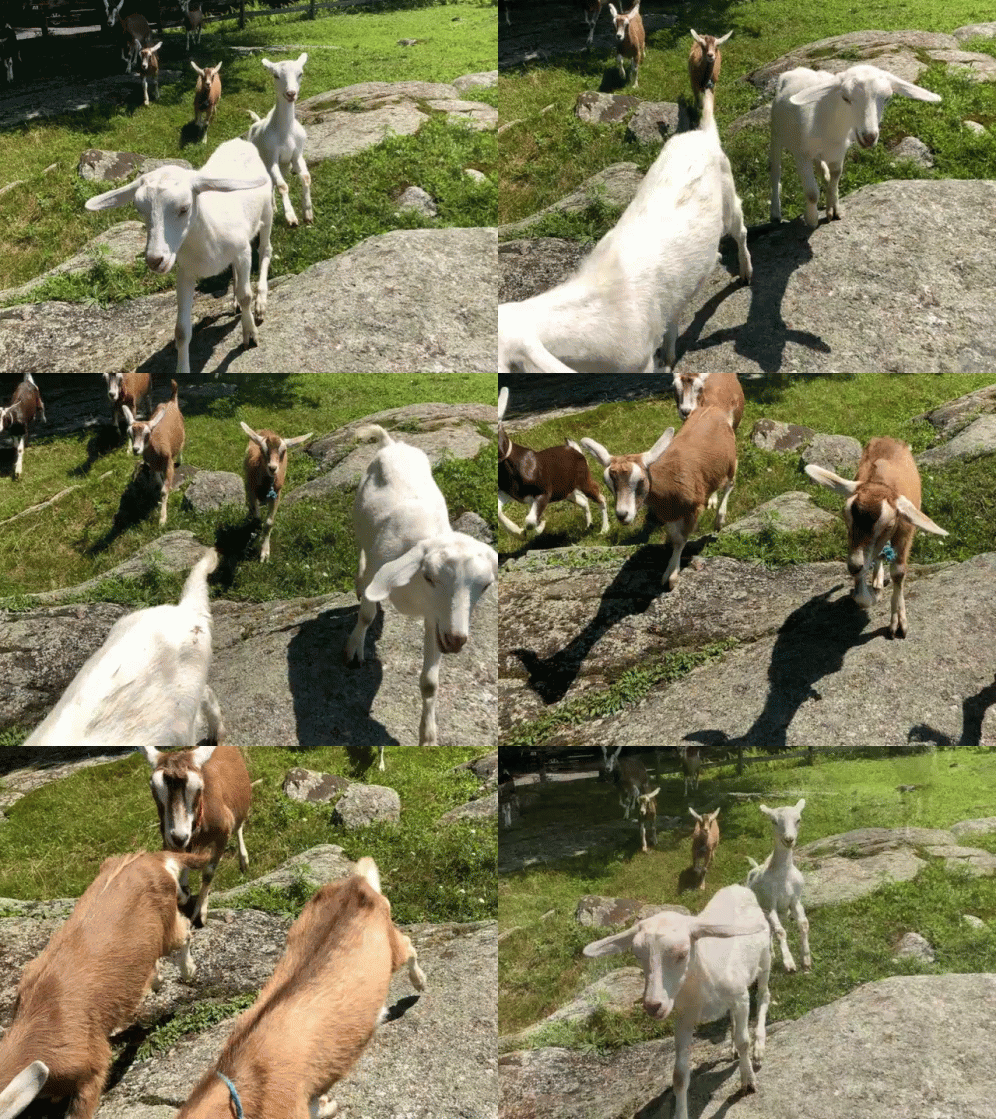
a group of goats standing in a grassy field looking at the camera
Alt: a group of goats running towards the camera
I don't think that the reviewers asking me for higher animal numbers really understand how many 40 goats are. Do you know the CHAOS that comes with dealing with 40 GOATS in an experimental setting!
Mice people cannot comprehend.
3 goats alone ate a tarp, a clock, and 2 expensive accelerometers!
19.02.2026 17:36
👍 144
🔁 20
💬 9
📌 1