If you want more hot takes on China's 15th Five-Year Plan, here you go! I joined my RAND Europe colleague @fraghi.bsky.social on her "Geoeconomic Competition" podcast. open.spotify.com/episode/3zFd...
31.10.2025 18:16
👍 5
🔁 1
💬 0
📌 0

Over the past few years, Beijing has been mirroring the U.S. economic-security toolkit. China is developing its own architecture to manage risk, preserve chokepoints, and respond in kind. It's also learning from the United States.
12.10.2025 17:37
👍 54
🔁 21
💬 3
📌 3
Thank you for cross pollinating. Too many platforms.
Also, it's legitimately funny to me that they have secret but publicly disclosed orders.
10.10.2025 00:20
👍 1
🔁 0
💬 1
📌 0
In my CLM piece, I argue that PRC exporters have found new markets for ~80% of their lost exports to the US and transshipment is low. I updated those figures to include July data. The conclusion is the same. To the extent there is transshipment, it's mostly via SE Asia.
21.09.2025 17:30
👍 6
🔁 0
💬 0
📌 0
China nerds, rejoice! The Relevant Organs is back and on here. Follow them for all the news you need.
@relevantorgans.bsky.social
01.08.2025 20:10
👍 6
🔁 2
💬 0
📌 0
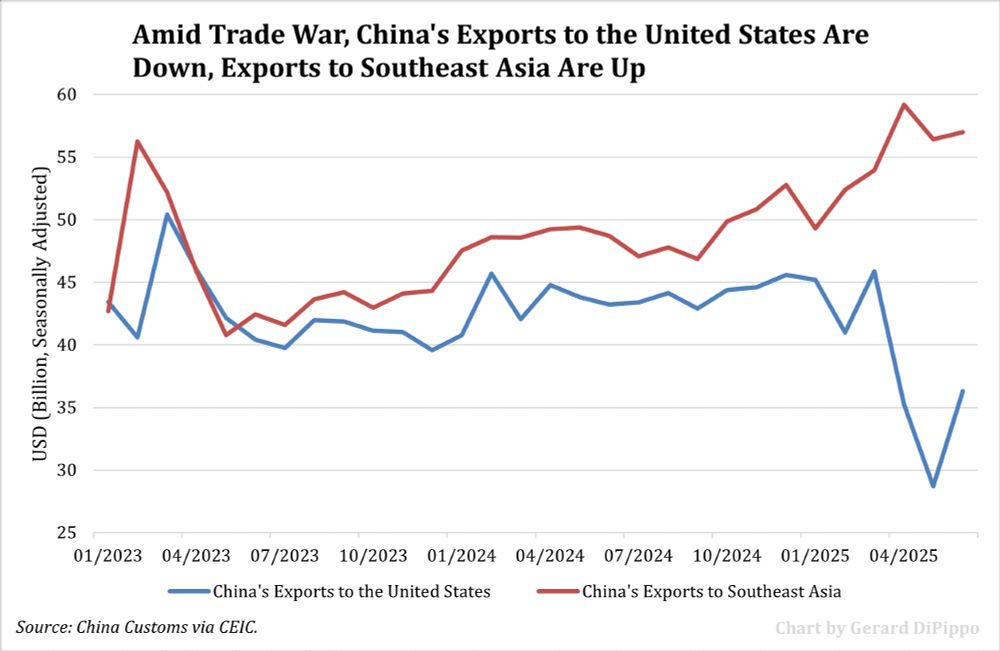
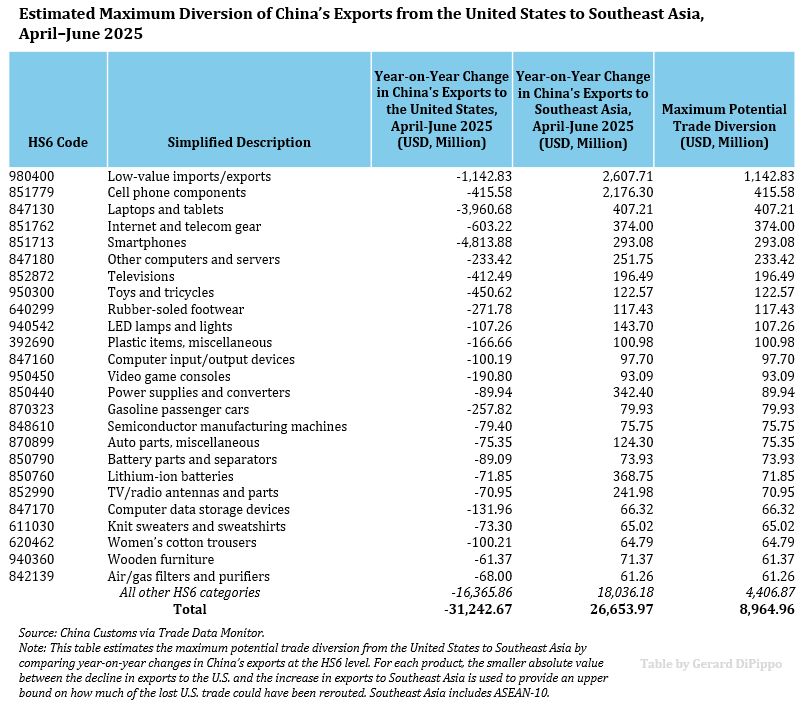
Facing U.S. tariffs, China’s exports to the U.S. are down—while exports to Southeast Asia are up. Is that trade diversion and potential transshipment? My estimate: at most 34% of the increased PRC exports to SE Asia in Q2 could reflect trade diverted from the United States.
20.07.2025 19:15
👍 8
🔁 3
💬 0
📌 2
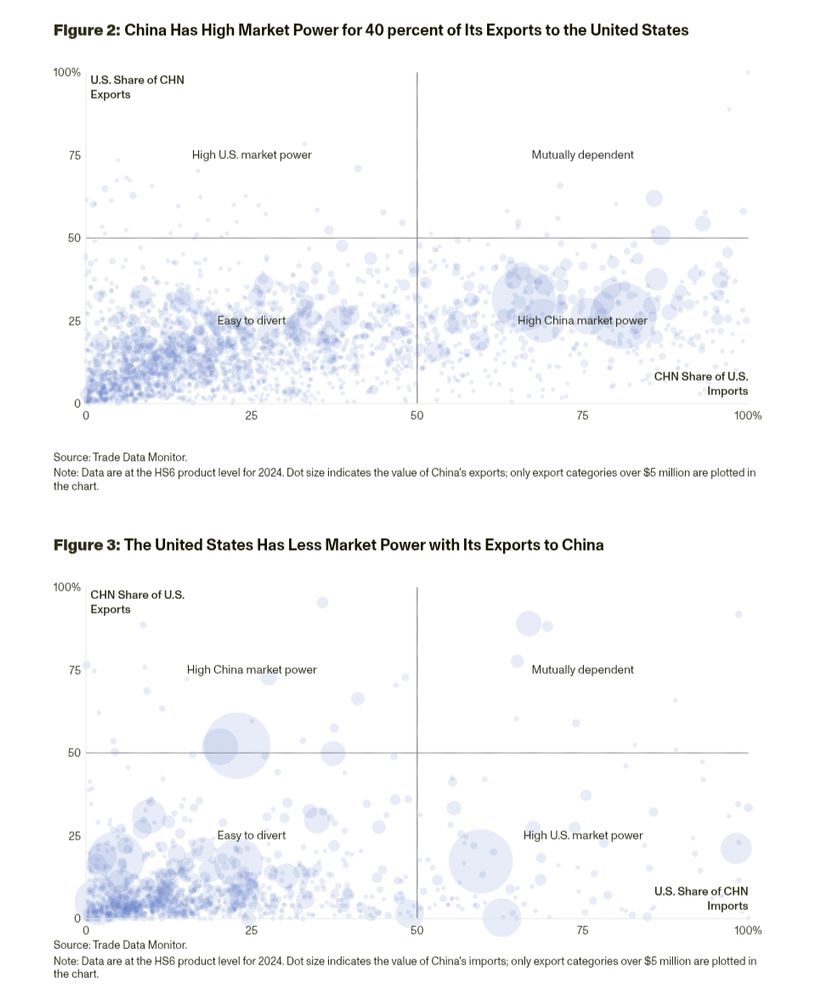
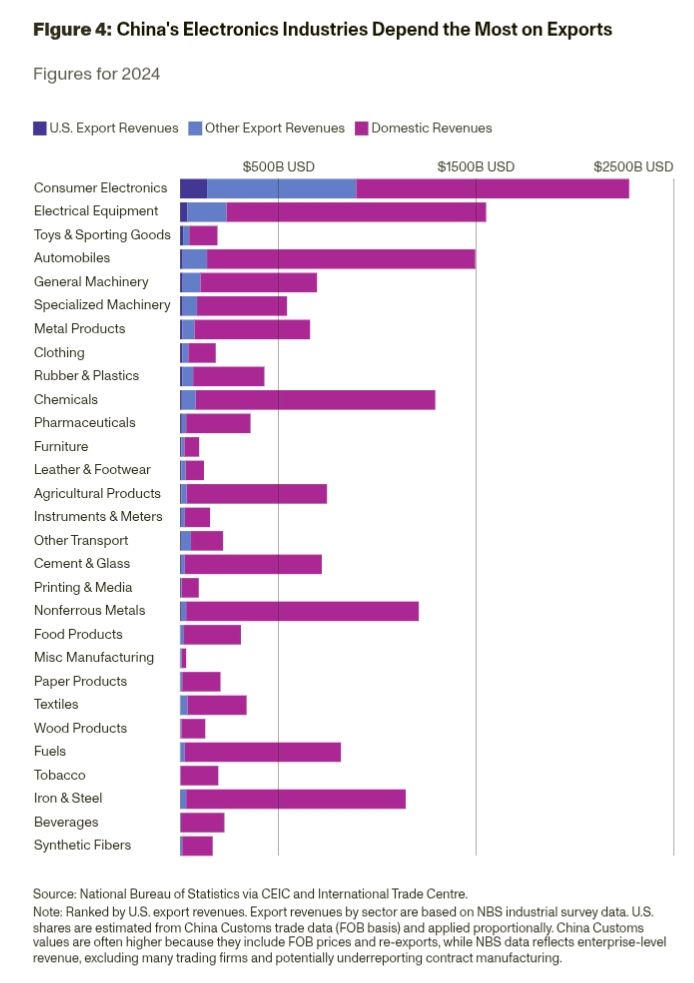
The US and China have a new framework to de-escalate. Whether that'll be durable is unclear. What is clear is that China can and will weaponize its export dominance. We discuss what the trade war teaches us about China's economy in our new RAND Commentary. www.rand.org/pubs/comment...
12.06.2025 11:27
👍 7
🔁 1
💬 1
📌 0

How Resilient Is China’s Economy?
Have decades of economic planning rendered China’s economy more resilient to external shocks? RAND Europe aims to address this critical question by convening leading experts who will delve into the st...
I'll be on a stellar panel this evening discussing the resilience of China's economy. I'll be providing the view from Europe.
With the excellent Jude Blanchette, @fraghi.bsky.social @gdp1985.bsky.social - for fans of imposter syndrome, this is not to be missed!
www.rand.org/randeurope/a...
21.05.2025 11:05
👍 13
🔁 4
💬 0
📌 0


The Trump administration is trying to reindustrialize with tariffs, especially on China. But China has lessons to teach the US about industrial strategy. A new RAND Commentary with @fraghi.bsky.social and Benjamin Lenain. www.rand.org/pubs/comment...
18.04.2025 15:51
👍 7
🔁 1
💬 0
📌 0
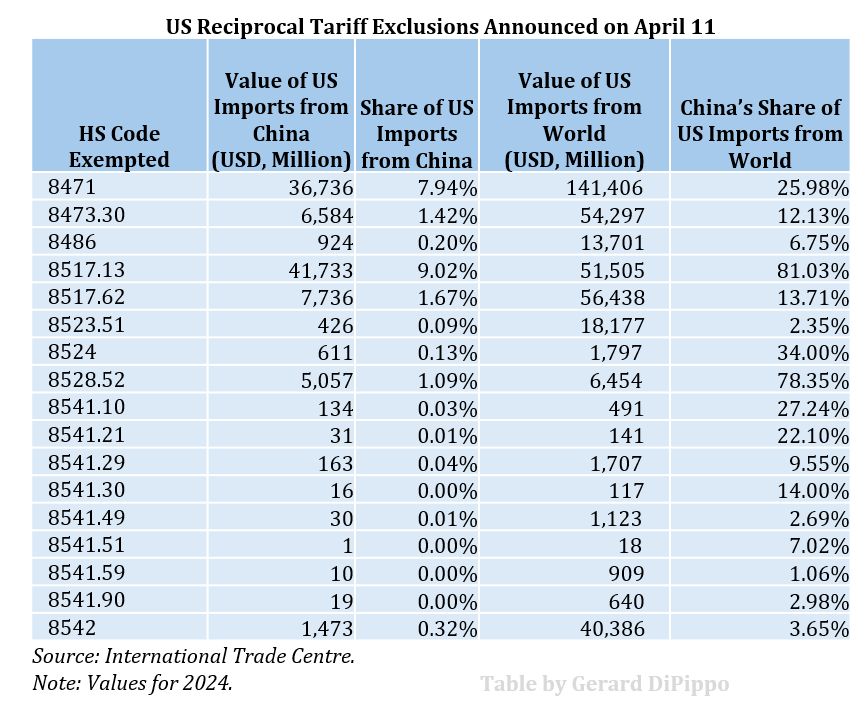
I would interpret the US tariff exemptions primarily as an attempt to mitigate the impact on electronics and consumers more than as a signal of a US-China deal. The exempted categories cover about 22% of US imports from China. content.govdelivery.com/bulletins/gd...
12.04.2025 14:49
👍 17
🔁 10
💬 0
📌 4
So, CA deficit contributing to CA surplus (income) rather than CA deficit contributing to FA surplus. Got it.
08.04.2025 12:51
👍 1
🔁 0
💬 0
📌 0
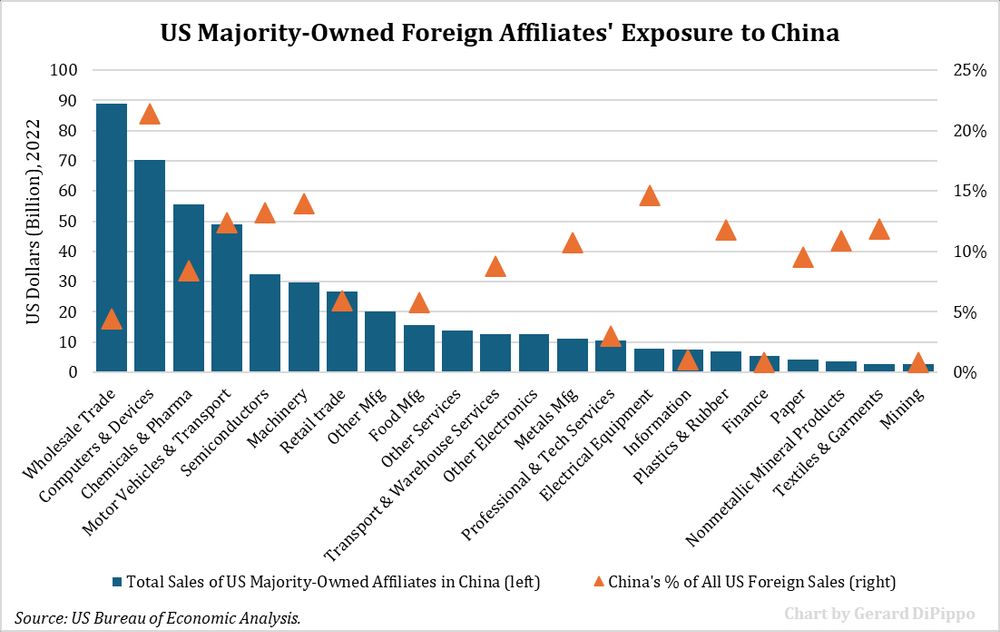
Which US industries are most exposed to the China market? Looking at US majority-owned foreign affiliates, the answer is wholesale trade, computers & electronics, chemicals & pharma, autos, and semiconductors. This could matter for US-China talks and potential PRC retaliation to US tariffs.
30.03.2025 18:07
👍 7
🔁 3
💬 0
📌 0
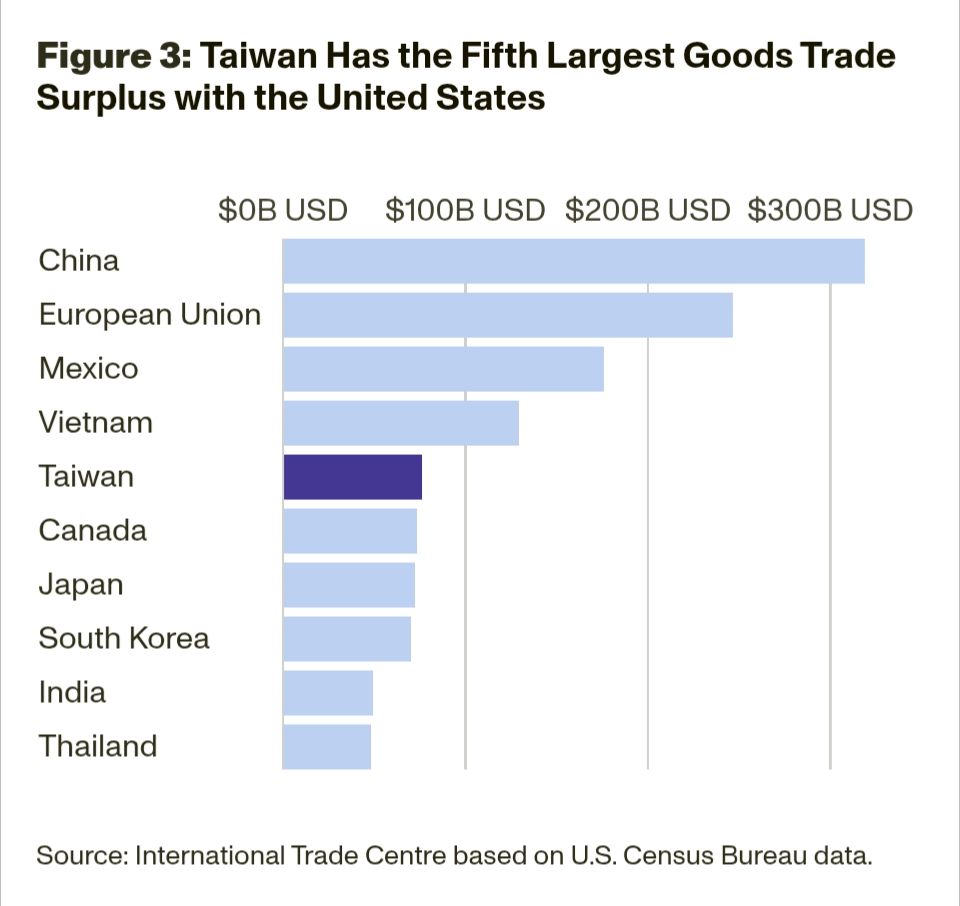
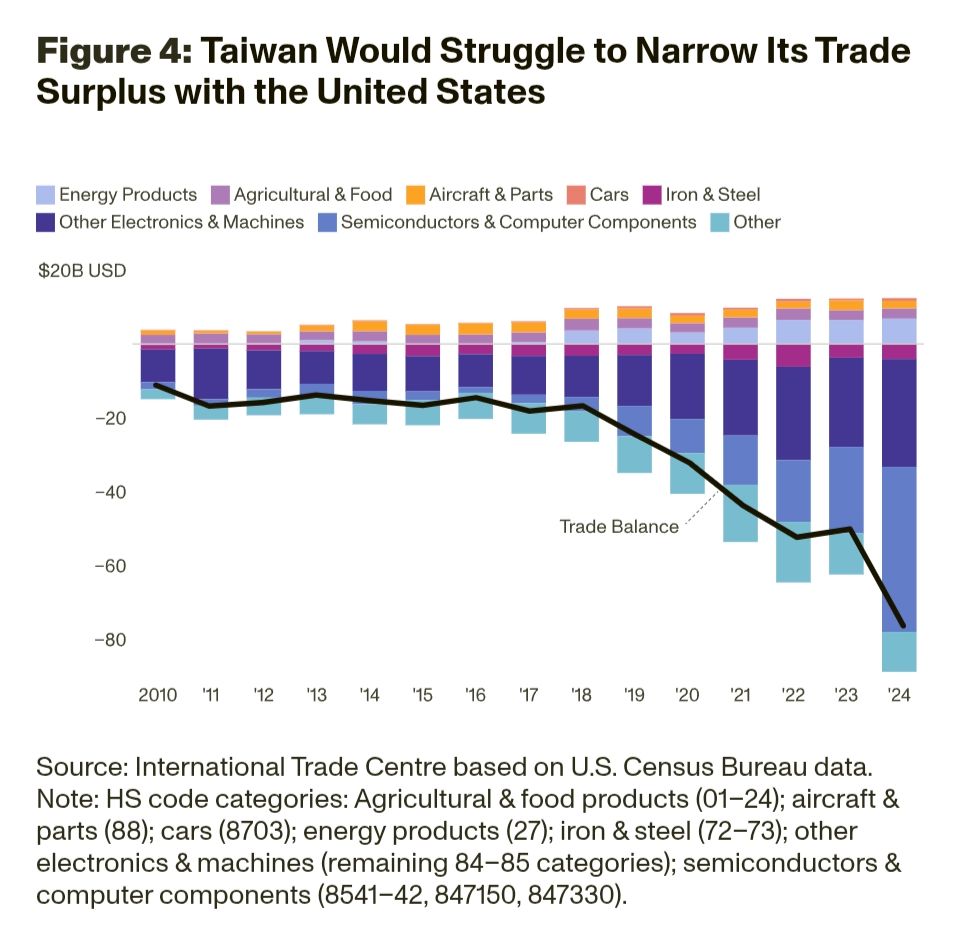
Taiwan is nervous. With good reason. Jude Blanchette and I discuss in our new RAND Commentary. www.rand.org/pubs/comment...
26.03.2025 23:45
👍 13
🔁 4
💬 0
📌 0

China's total fiscal deficit is set to increase by at least 2 percentage points of GDP in 2025. That's maybe not the massive stimulus some wanted, but it's not small either. The question is the composition and effectiveness of the measures.
16.03.2025 16:09
👍 8
🔁 1
💬 0
📌 0
China's retaliation to the new 20% US tariffs:
- 10-15% tariffs on US ag imports
- 10 US firms on Unreliable Entities List
- 15 US firms on export control list (Illumina maybe most affected)
- No product-specific export controls
Less than proportional response.
04.03.2025 12:21
👍 18
🔁 7
💬 0
📌 0
This is a strong possibility.
01.03.2025 12:33
👍 15
🔁 4
💬 1
📌 0


China/BRI nerds, does anyone know if MOFCOM expanded the countries it counts as BRI in its stats? Is there a list by year? Reported BRI projects and investment surged in 2023. Is this due to categorization?
27.02.2025 15:45
👍 4
🔁 0
💬 0
📌 0
China Econ and Trade nerds, apply to this!
24.02.2025 22:32
👍 1
🔁 2
💬 0
📌 0
I meant "slowdown" in terms of GDP growth *rates*. But if you want *absolute* GDP growth for China and the US, here you go! Whether one uses nominal growth at market exchange rates, real growth at fixed exchange rates, or nominal growth at PPP exchange rates makes a difference.
23.02.2025 19:49
👍 3
🔁 0
💬 1
📌 0
Yes. But then I added NEVs (they defined it before NEVs were big) so people wouldn't ask about the very-popular NEVs.
22.02.2025 14:58
👍 2
🔁 0
💬 0
📌 0
Do it anyway
22.02.2025 01:23
👍 2
🔁 0
💬 1
📌 0


Two narratives about China's economy:
- Macro weakness
- Technological and industrial strength
They're both true! How? The "new economy" is a small share of the overall economy. I discuss in a new RAND Commentary.
www.rand.org/pubs/comment...
20.02.2025 01:18
👍 13
🔁 4
💬 1
📌 1

When in Taipei...
Perfect broth. NTD 200 ($6). 😋
17.02.2025 04:17
👍 5
🔁 0
💬 1
📌 0
In that case, the "skills" people were wrong. It *was* an aggregate demand problem. Those people got jobs when the economy improved but with lasting harms. Young Chinese shouldn't similarly blame themselves for macro policy failures. 2/
06.02.2025 11:58
👍 1
🔁 0
💬 0
📌 0

Four stories of Chinese youth breaking through high unemployment
Youth unemployment has emerged as a pressing social issue in China.
Excellent Baiguan piece on 🇨🇳 youth unemployment with data and stories. This reminds me of the "skills mismatch" debate after the US Great Recession. People said the problem was poor or incorrect training or education. Others said it was just a demand problem. 1/ open.substack.com/pub/baiguan/...
06.02.2025 11:57
👍 5
🔁 0
💬 1
📌 0
There's a tension between Trump's emergent desire for a clear US sphere of influence in the Americas and his opposition to those economies being integrated with the US. 🤔
02.02.2025 14:50
👍 4
🔁 0
💬 0
📌 0
Haggis is great
25.01.2025 18:47
👍 3
🔁 0
💬 1
📌 0