
Title bar of "Polarization Diagnostics Applied to Coronal Mass Ejeections and the Background Solar Wind", a newly published paper in the journal Solar Physics
<thud>! Another PUNCH paper dropped today! Congratulations to Sarah Gibson on this omnibus theoretical treatment of polarization in solar wind structures. Given the simplicity of the Thomson scattering mechanism, it's pretty amazing how deep the rabbit hole can go. 🧪☀️⚛️🔭🛰️
bit.ly/4qT9Kvs
23.02.2026 20:17
👍 16
🔁 2
💬 0
📌 0
"60 mm/a (0.075 in/Ms)" is from the wikitext conversion template {{cvt|60|mm/yr}}. The "to units" parameter was left empty, so the template just uses the default conversion for each unit: mm to in and yr to Ms. I do not think that geologists actually use in/Ms.
en.wikipedia.org/wiki/Module:...
26.02.2026 01:44
👍 33
🔁 0
💬 0
📌 0
New development: Wikipedia has deprecated archive.ph/is/today, and will eventually remove hundreds of thousands of existing links. Massive thread here: en.wikipedia.org/wiki/Wikiped... (and FWIW I just verified the malicious code is still active on the captcha page)
20.02.2026 21:35
👍 2
🔁 1
💬 0
📌 0
Yes: Hinode and TRACE. But I do not think SSO is ideal because their orbits regularly pass thru the South Atlantic Anomaly where elevated cosmic ray flux produces noise in the image data. There are also solar imagers in GEO (GOES, SDO), Sun-Earth L1 (SOHO, Aditya-L1), and heliocentric (PSP, STEREO).
19.02.2026 07:54
👍 5
🔁 0
💬 0
📌 0
Yes. Satellites monitor solar activity 24/7. NOAA's GOES series of satellites in particular. There is also a global network of ground-based solar telescopes (GONG).
19.02.2026 05:55
👍 85
🔁 0
💬 2
📌 0
Solar cycle 25 is expected to start winding down, and solar activity is pretty low right now. There were a few large flares at the beginning of the month with the third largest flare of this cycle (~11 years) on Feb 1st iirc.
19.02.2026 05:45
👍 136
🔁 0
💬 2
📌 0
We do not have this problem in solar astronomy
19.02.2026 04:49
👍 300
🔁 3
💬 7
📌 1

The full circle disk image of the sun in hydrogen-alpha light (false color applied) depicts our local star with flame-like prominences at multiple locations around the rim -- the filament/prominence -- filaprom -- feature is at about the fout o'clock position on the disk.
Here's a full-disk view of Sun as it appeared yesterday. We were so excited capturing the filaprom that we let the full disk view go. This really shows off the extraordinary prominence activity that was going on midday, February 16! #sun #astronomy #solarobserving
17.02.2026 21:06
👍 4
🔁 1
💬 0
📌 0
Very clear solar physics bubble next to "Professional Astronomers & Astrophysicists" #heliophysics
09.02.2026 04:50
👍 15
🔁 4
💬 0
📌 0


Farewell to Active Region 4366 -- Giant sunspot complex seen in Sun's northwest. The region continues to issue flares but is showing signs of decay. Soon the sunspot will disappear over the Solar limb. Sky was clear, and winds were light, but seeing was not good. We take what we can get! #sunspots
08.02.2026 23:43
👍 4
🔁 2
💬 0
📌 0

via MollyHaleIsMyFriend
The "I am going to drink ocean water" guy is still active and uploads both.
05.02.2026 07:49
👍 3
🔁 1
💬 0
📌 0
It's good to talk about your love for Wikipedia. It's good to donate. But I firmly believe that it's even better to become an editor. Create an account. Make an edit (don't worry, you can't break things). Visit the Teahouse. Not necessarily in that order.
15.01.2026 15:20
👍 12
🔁 7
💬 0
📌 0

Here is how I have been contributing to Wikipedia in 2025! Edits: 585, Discussions: 74, Thanks: 7, Thanked: 3 #wikipediaYIR
Here is how I have been contributing to Wikipedia in 2025. Happy New Year! #wikipediaYIR
02.01.2026 01:39
👍 3
🔁 0
💬 0
📌 0

The atomic ensemble time scale at the NIST Boulder campus has failed.
20.12.2025 22:53
👍 1557
🔁 563
💬 90
📌 395
The second step (deconvolution) helps further reduce blurring, but subsequent processing appears to be cosmetic. For example, the brightness of the solar disk appears to have been inverted here; brightness should decrease with distance from center disk, and the dark splotches should appear bright.
09.12.2025 03:32
👍 1
🔁 0
💬 0
📌 0
Many of the individual frames will be heavily blurred/distorted due to turbulence in the Earth's atmosphere, so the idea of the first step ("lucky imaging") is to average over the frames that appear the least blurred. This produces a more accurate and better looking image.
09.12.2025 03:32
👍 1
🔁 0
💬 1
📌 0
#heliophysics
02.11.2025 02:09
👍 11
🔁 0
💬 0
📌 0
A sunspot group over about an hour on 2022-09-03. It starts showing the photosphere on the "blue side" (shorter wavelength) of H-alpha, then shifts into H-alpha and finally goes back to the photosphere on the "red side" (longer wavelength).
#sun #sunspots #hydrogenalpha #astronomy
12.10.2025 08:52
👍 3
🔁 2
💬 0
📌 0

SOFTWARE TERMINOLOGY
Then: application, program, operating system, script, shell, batch file, compiler, daemon, service, game, patch, software.
Now: app, app, app, app, app, app, app, app, app, app, app, app.
They existed. This image is from 2012 at the latest
08.10.2025 10:44
👍 3
🔁 0
💬 1
📌 0
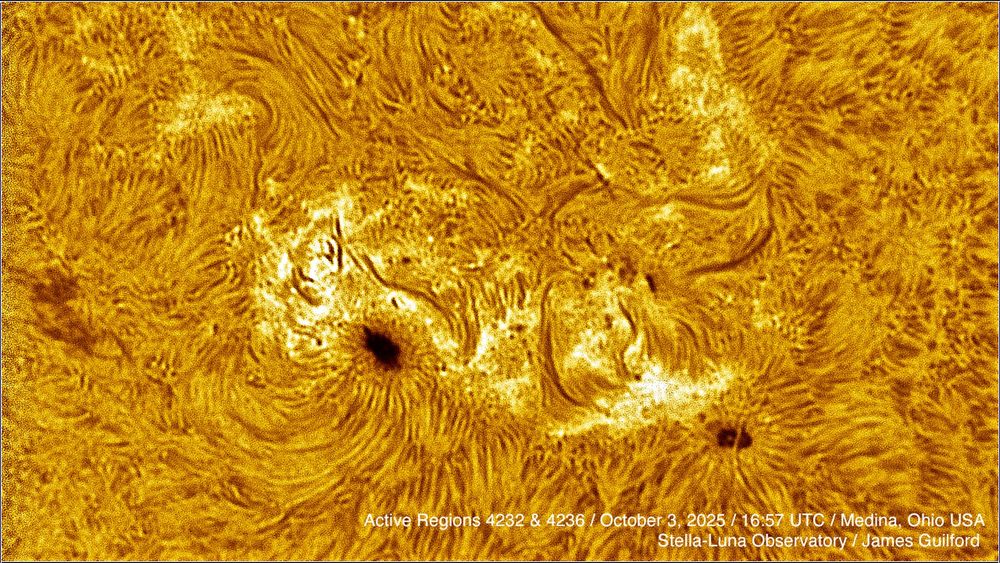
A close-crop of two sunspots viewed in hydrogen-alpha light -- an extensive field of filaments surrounds the spots.

The northeast quadrant of the Sun recorded October 3, 2025 in hydrogen-alpha light. Various features of the chromosphere are visible including several filaments, and prominences.
A few adjustments in data capture parameters was all it took to make a big difference in image processing and results! We're very pleased with Barlow-boosted views though we're still having some issues with achieving even lighting across whole-disk views...
#sunspots
03.10.2025 21:45
👍 2
🔁 1
💬 1
📌 0

Wikipedia is under attack — and how it can survive
The site’s volunteers face threats from Trump, billionaires, and AI.
This long read in The Verge does a remarkable job of describing how Wikipedia's editing community works, the project's strengths and weaknesses, and the threats it faces.
www.theverge.com/cs/features/...
05.09.2025 19:26
👍 865
🔁 326
💬 12
📌 6
Testing this with SDO/AIA imagery of a series of eruptions from 2023 ☀️
29.07.2025 05:25
👍 7
🔁 1
💬 0
📌 0
What might we expect to see during @esa.int Solar Orbiter's upcoming remote-sensing windows; now with an inclined orbit. Here's the PFSS connectivity of Orbiter during the remote-sensing window of spring 2026 (17th Feb to 6th March), using the current coronal magnetic field and in-situ wind speeds.
27.07.2025 14:52
👍 7
🔁 3
💬 2
📌 0

Sunflower head soon to open

Sunflower head and a bee
18.07.2025 22:24
👍 2
🔁 0
💬 0
📌 0

Seven sunflower heads, three of which have bloomed, and one blurred bee
Not the usual Sun I study
18.07.2025 22:24
👍 4
🔁 0
💬 1
📌 0
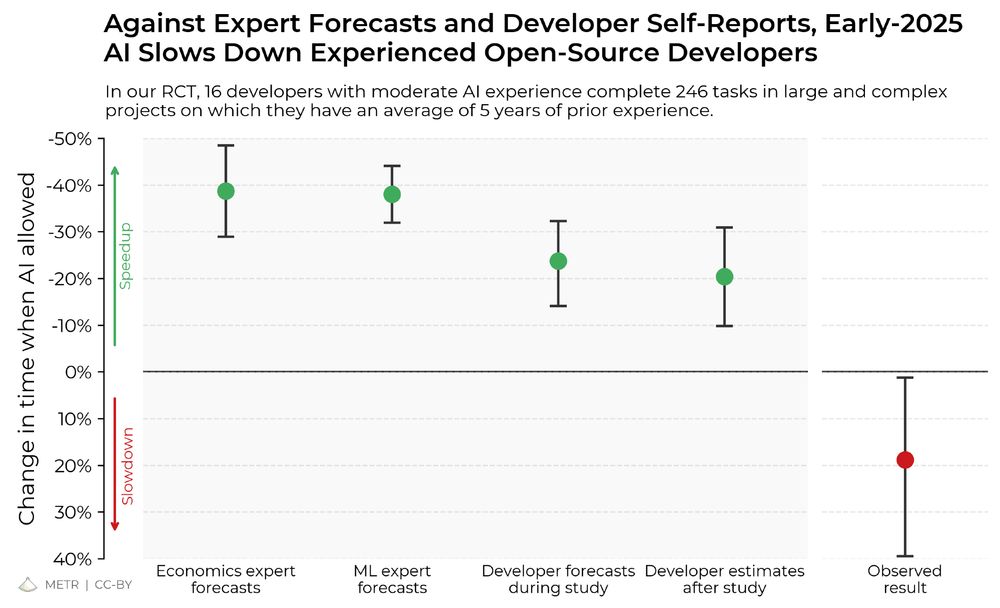
We ran a randomized controlled trial to see how much AI coding tools speed up experienced open-source developers.
The results surprised us: Developers thought they were 20% faster with AI tools, but they were actually 19% slower when they had access to AI than when they didn't.
10.07.2025 19:46
👍 6902
🔁 3016
💬 106
📌 625
Our recent solar flare research was published! We present the first spectral observations of ‘Supra-Arcade Downflows’ (SADs) since 2003. SADs are dark finger-like downflows seen above solar flare loops, but their origins remain elusive! What do we find? 1/6
26.06.2025 15:54
👍 37
🔁 7
💬 2
📌 0


