What happens when elite athletes, world-leading researchers, and cutting-edge technology come together? At Exeter, we’re pushing the boundaries of human performance and translating our discoveries into public-health solutions. (1/2)
23.07.2025 08:02
👍 1
🔁 1
💬 1
📌 0
This Thursday, Exeter academic, Prof Andy Jones, is part of the team that will try and break the women's 4-minute mile. Find out more about the attempt in this great Amazon documentary.
www.amazon.co.uk/gp/...
24.06.2025 07:02
👍 2
🔁 1
💬 1
📌 0


A research team led by Exeter has been awarded a £3.3m grant by the Medical Research Council to study the treatment and potential cure for eczema.
This 5-year study brings together experts from the MRC Centre for Medical Mycology in Exeter and St John’s Institute of Dermatology at KCL.
23.06.2025 15:51
👍 3
🔁 0
💬 2
📌 0

Home - Net Positive Centre
At the Net Positive Centre, we focus on what’s possible — turning the climate challenge into an opportunity to support healthier lives and to improve the environment. Climate change is an urgent healt...
📢 The Net Positive Centre website is live! 🌍Focused on advancing climate-health research & real-world solutions — from urban design to food systems.Funded by @UKRI_News led by a partnership @exeter.ac.uk @ukhsa.bsky.social @nationaltrust.org.uk @forestresearchuk.bsky.social
netpositivecentre.com
17.06.2025 12:08
👍 13
🔁 13
💬 0
📌 2
Watch Shani, a second year medical student talk about our most recent paper in the Journal of Genome Biology and Evolution where we published the genome of the microsporidian parasite, Nucleospora cyclopteri
Full paper: doi.org/10.1093/gbe/...
@genomebiolevol.bsky.social
@exeter.ac.uk
10.06.2025 11:09
👍 1
🔁 2
💬 1
📌 0

Fantastic to welcome @SteveRaceMP to St Luke’s earlier this month! He met Prof Chris Morris & Fleur Boyle to hear about our work on childhood disability – esp. the peer-led Healthy Parent Carers programme promoting parent carer wellbeing, shaped by 10 years of research 💙
🔗 healthyparentcarers.org
09.06.2025 11:29
👍 8
🔁 4
💬 0
📌 0
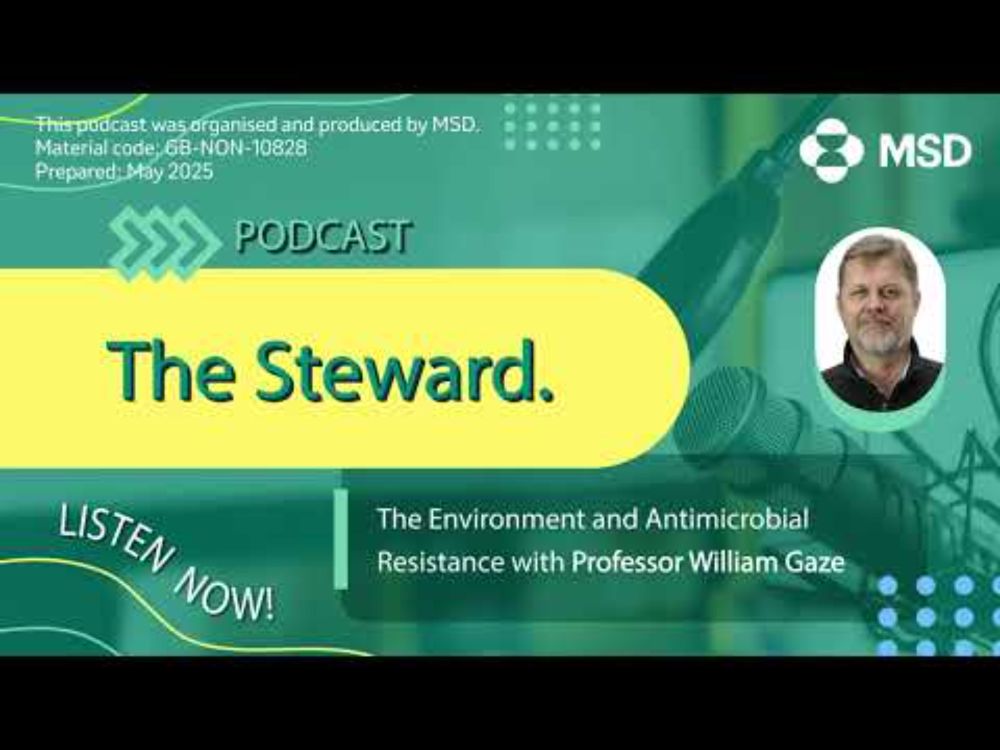
MSD’s podcast ‘The Steward’ – Episode: The Environment and Antimicrobial Resistance
YouTube video by MSD in the UK
How can natural environments contribute to antimicrobial resistance? Listen to the new MSD podcast with Prof Will Gaze to find out.
"Many people don't realise antibiotic resistance is a natural phenomenon that's evoved in environmental bacteria over millions of years."
youtu.be/QI-jJjG3cLg
03.06.2025 12:31
👍 0
🔁 3
💬 0
📌 0
The study will be at the Mireille Gillings Neuroimaging Centre (MGNC) with two flexible visits scheduled around your availability.
If you're interested or know someone who might be? Kindly get in touch with Aliah (aa1414@exeter.ac.uk) or Jon (j.fulford@exeter.ac.uk)
27.05.2025 11:38
👍 0
🔁 0
💬 0
📌 0

Are you aged 40–60 with no history of knee issues (e.g., osteoarthritis, trauma, surgery, or implants)? We’re looking for volunteers to take part in a study on advanced MRI techniques.
27.05.2025 11:38
👍 0
🔁 0
💬 1
📌 0

Big news from our Academy of Nursing!
Our brand-new BSc Adult Nursing degree has just been approved by the NMC
Launching this Sept, it offers a flexible 3-year path to becoming a registered nurse—alongside our 4-year MSci routes!
27.05.2025 10:17
👍 0
🔁 0
💬 1
📌 0

WHO report on nature-based solutions launched | ECEHH
We’ve worked with the World Health Organization to review interventions that can benefit both people and planet.
NOW LIVE: Our new @who.int report on nature-based solutions and health.
From promoting air quality to building liveable cities, learn how to maximise the "roll out of nature-based solutions in tangible, real-world policies."
ecehh.org/news/who-nature-based-solutions
22.05.2025 09:17
👍 2
🔁 3
💬 0
📌 1

Pint of Science is next week!
Grab your tickets now and let your ears are fill with science and your glass fill with beer (or drink of choice).
16.05.2025 13:30
👍 3
🔁 0
💬 0
📌 1
A new @ecehh.org study has found people who live in greener neighbourhoods smoke and drink less on average.
And those who make regular visits to nature tend not to smoke.
The findings are consistent across different countries, household income and educational attainment.
bsky.app/profile/eceh...
14.05.2025 09:26
👍 2
🔁 1
💬 0
📌 0

Breaking Barriers in Academic Medicine!
AIMMS — a national scheme supporting minority women in academic medicine & health sciences — is now active in all UK medical schools
The scheme:
🔹 Supports career progression
🔹 Builds mentor-mentee connections
🔹 Tackles structural barriers in academia
01.05.2025 09:53
👍 0
🔁 0
💬 0
📌 0

Congratulations to Professor Andrew Hattersley who has just won the Claude Bernard Prize, the highest honour in diabetes research, for a career spent improving care for people with diabetes.
Andrew will deliver the opening lecture at the 61st EASD Annual Meeting to over 10,000 participants.
25.04.2025 10:17
👍 1
🔁 0
💬 0
📌 0

Our student Innes FitzGerald has just broken her 2nd European U20 record with a 15:08 in the 5k at Bristol Track Club
Her first, 8:40.05 in the 3000m in Ostrava, smashed a 40-year-old British record
Dubbed the “Greta Thunberg of Sport” she is making headlines for green activism as well as speed.
24.04.2025 09:58
👍 2
🔁 0
💬 0
📌 0

The @exeter.ac.uk team is backing Faith Kipyegon’s bold attempt to become the first woman to run a sub-4-minute mile. Partnering with Nike, leading researchers, will be bringing cutting-edge sport science to Paris on June 26.
24.04.2025 09:51
👍 1
🔁 0
💬 0
📌 0
Steve James will be collecting much of the data himself as he attempts such an inspiring and challenging feat!
16.04.2025 11:54
👍 0
🔁 0
💬 0
📌 0
The researchers are using this challenge to study how extreme endurance exercise affects the body. To do this they will be monitoring: blood, oxygen levels, muscle changes and recovery patterns.
16.04.2025 11:53
👍 0
🔁 0
💬 1
📌 0

Today (April 16), a 65-year-old runner, Steve James, will attempt 200 marathons in 200 days, running the entire coastline of mainland Britain — monitored closely by researchers at the University of Exeter
16.04.2025 11:52
👍 0
🔁 0
💬 1
📌 0
The researchers are calling for routine head injury assessments, alongside return-to-duty protocols.
This is the largest UK study of its kind, and it’s a wake-up call for law enforcement agencies everywhere: protecting those who protect us must include their brain health.
11.04.2025 11:22
👍 0
🔁 0
💬 0
📌 0
A new study from the University of Exeter, based on surveys from over 600 frontline officers across the UK, paints a concerning picture. Nearly 40% had experienced at least one TBI, often on duty. Many had multiple.
11.04.2025 11:20
👍 0
🔁 0
💬 1
📌 0
Police officers are over twice as likely to sustain traumatic brain injuries (TBIs) compared to the general population. And those injuries? They come with a more than doubled risk of complex PTSD.
11.04.2025 11:18
👍 0
🔁 0
💬 1
📌 0
Fungi are essential to life on Earth, from recycling nutrients to producing antibiotics, yet 95% of fungal species remain undescribed.
The papers call for a global "One Health" approach to monitor fungal pathogens and resistance trends across people, plants, animals, and ecosystems
10.04.2025 12:20
👍 3
🔁 0
💬 0
📌 0
Two new review papers published in Nature—co-authored with CIFAR’s Fungal Kingdom members and the fAMR UK consortium—highlight how fungi are evolving in response to climate change and increasing resistance to antifungal treatments.
10.04.2025 12:20
👍 0
🔁 0
💬 1
📌 0

As anticipation builds for season two of The Last of Us, which imagines a world ravaged by brain-infecting fungal zombies, scientists at the University of Exeter are spotlighting a real-world threat: fungi.
10.04.2025 12:19
👍 1
🔁 0
💬 1
📌 0
As high blood pressure continues to affect 1 in 3 adults worldwide, non-pharmacological interventions like these remain an area of growing interest—especially for those seeking to complement medication or address stress-driven health issues.
09.04.2025 09:57
👍 0
🔁 0
💬 0
📌 0
A large-scale review of 182 studies found that relaxation practices can reduce systolic blood pressure by around 6–10 mm Hg in people with hypertension.
Most effective:
Mindfulness: -9.9 mm Hg
Tai Chi/Yoga: -9.6 mm Hg
Progressive muscle relaxation: -7.5 mm Hg
Music: -6.6 mm Hg
09.04.2025 09:56
👍 0
🔁 0
💬 1
📌 0