

Finally recorded the Tuna introduction video www.youtube.com/watch?v=vkm...
24.02.2026 22:30
👍 35
🔁 4
💬 4
📌 1
Finally recorded the Tuna introduction video www.youtube.com/watch?v=vkm...
London #neuroscience people you may like this. We're hosting a series of talks at Imperial & Crick on how to get experiment and theory working together better. Each session will have a talk around this and extended networking / group discussion on the questions raised. Plus, free food!
🤖🧠🧪
👋Hello World
Welcome to my humble digital abode!
In my first post on this newly minted Ghost blog, I aim to articulate my goals and motivations behind this blog, and make some resolutions for myself and some promises to you (my dear reader or future self).
Before delving into my motivations […]

Python for Computational Science Week, 7-15 Feb 2026 Start with what you know, end with what you need. Python Week makes it doable.
We’ve kicked off #Python for #ComputationalScience Week,...but it’s not too late to join!
Come learn, practice, and build momentum!
Catch up on #PythonWeek here:
www.reddit.com/r/neuromatch...
Looking forward to the invite

RL Debates 2: Fritz "learning for the sake of learning" Sommer
Fritz introduced an information-theoretic, first-principles approach to modeling exploration through the maximization of "predicted information gain."
📽️ Watch the full presentation here: www.youtube.com/watch?v=rlF-...
🧠🤖🧠📈


Neuromatch Academy 2026 is coming!
✅ Hands-on projects
✅ Global community
✅ Affordable fees
Applications open Feb 2026.
Learn more: neuromatch.io/courses/
Sign up for updates: neuromatch.io/mailing-list/
#ComputationalNeuroscience #DeepLearning #ClimateScience #NeuroAI #Neuroscience #AI

🚨 @vivianeclay.bsky.social and @cortical-canonical.bsky.social respond to “What's the Most Surprising Capability Monty Gains Through Sensorimotor Learning?”
youtube.com/shorts/lUQkb...
Read the paper: arxiv.org/abs/2507.04494
Read the plain language explainer: thousandbrains.org/thousand-bra...
I’m super excited to finally put my recent work with @behrenstimb.bsky.social on bioRxiv, where we develop a new mechanistic theory of how PFC structures adaptive behaviour using attractor dynamics in space and time!
www.biorxiv.org/content/10.1...

Exciting news! 🎉 Our Computational Neuroscience course has been awarded NIH BRAIN Initiative funding! Students will get hands-on experience w real BRAIN Initiative datasets, helping them build computational skills that are essential for the future of neuroscience.
www.linkedin.com/feed/update/...

“Perception as Inference” is a century-old idea that has inspired all major theories in neuroscience 🧠, including:
✅ Sparse Coding
✅ Predictive Coding
✅ Free Energy Principle
& more!
In my new blog post, I build the intuition behind this idea from ground up 👉[1/6]🧵
🧠🤖🧠📈
Google Glass walked so Meta Ray Ban Glasses could also walk

What drives behavior in living organisms? And how can we design artificial agents that learn interactively?
📢 To address these, the Sensorimotor AI Journal Club is launching the "RL Debate Series"👇
w/ @elisennesh.bsky.social, @noreward4u.bsky.social, @tommasosalvatori.bsky.social
🧵[1/5]
🧠🤖🧠📈

An overview of @logseq DB Task Management youtu.be/ITCcMFNSSmw?... with the new Schema and improved UX #logseq #TaskManagement #pkm #Productivity

It is almost time to welcome you all in Santa Cruz! 🦕
We will start with an exciting and timely keynote by
@guyvdb.bsky.social
on "Symbolic Reasoning in the Age of Large Language Models" 👀
📆 Full conference schedule: 2025.nesyconf.org/schedule/

Diagram of how the "collaborative modelling of the brain" (COMOB) project started. Starting material lead to group research or solo research, coming together in online workshops (monthly) in an iterative cycle, finishing with writing up together. The diagram is illustrated with colourful cartoon blob characters.
Is anarchist science possible? As an experiment, we got together a large group of computational neuroscientists from around the world to work on a single project without top down direction. Read on to find out what happened. 🤖🧠🧪

Comic strip of four colored stick-figure characters. In the first panel, green, pink, orange characters speak into megaphones. In the second panel, the green character looks frustrated while the others are silent as they look at him. In the third panel, the pink and orange characters chat with each other, while the green character says, “Bah, I give up. Not getting any engagement here.” In the last panel, the green character walks away as the pink and orange continue their conversation. Text at the bottom reads “@debbieohi.com.”
Looking for more engagement on Bluesky?
I've compiled tips with t he help of others in the community: publish.obsidian.md/debbieohi/bl...
#BlueSkyTips

Task-Optimized Convolutional Recurrent Networks Align with Tactile Processing in the Rodent Brain
1/ What if we make robots that process touch the way our brains do?
We found that Convolutional Recurrent Neural Networks (ConvRNNs) pass the NeuroAI Turing Test in currently available mouse somatosensory cortex data.
New paper by @Yuchen @Nathan @anayebi.bsky.social and me!

Introducing Bases, a new core plugin that lets you turn any set of notes into a powerful database.
Now available to everyone with Obsidian 1.9!
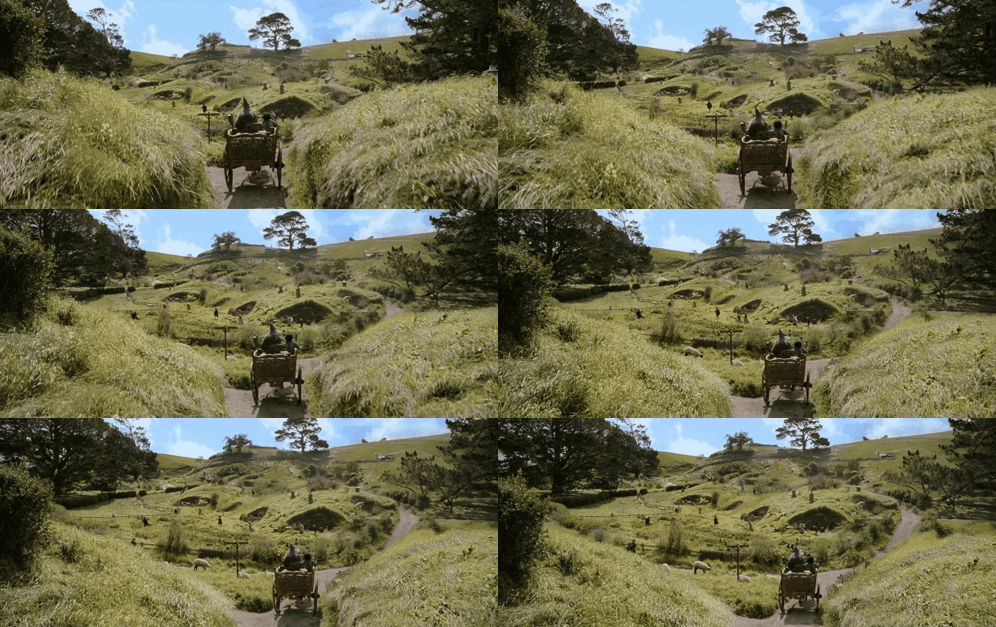
Join us on a (mathematical) journey to a shire - oops, HIGHER - standard and principled evaluation schema for our benchmark datasets. This is the reward of the RINGS framework.
📒 Blog: aidos.group/blog/rings/
📃 Paper: doi.org/10.48550/arX...
👩💻 Code: github.com/aidos-lab/ri...

1/3) This may be a very important paper, it suggests that there are no prediction error encoding neurons in sensory areas of cortex:
www.biorxiv.org/content/10.1...
I personally am a big fan of the idea that cortical regions (allo and neo) are doing sequence prediction.
But...
🧠📈 🧪

1/
🚨Another New Paper Drop! 🚨 “Hierarchy or Heterarchy? A Theory of Long-Range Connections for the Sensorimotor Brain”
👇 Dive into the full thread 🧵
arxiv.org/abs/2507.05888

🔥 Want to understand how the neocortex builds intelligence?
Artem Kirsanov made a great video on the Thousand Brains Theory, the foundation of everything we’re building at here Thousand Brains Project!
🎥 youtu.be/Dykkubb-Qus
#Neuroscience #AI #ThousandBrains #Neocortex
Hello world! This is the RL & Agents Reading Group
We organise regular meetings to discuss recent papers in Reinforcement Learning (RL), Multi-Agent RL and related areas (open-ended learning, LLM agents, robotics, etc).
Meetings take place online and are open to everyone 😊

Announcing the new "Sensorimotor AI" Journal Club — please share/repost!
w/ Kaylene Stocking, Tommaso Salvatori, and @elisennesh.bsky.social
Sign up link: forms.gle/o5DXD4WMdhTg...
More details below 🧵[1/5]
🧠🤖🧠📈
Super excited to share our new paper! We spent the past years building an alternative AI approach, and now we demonstrate a whole range of advantages. Robust object & pose detection, generalization, data and compute efficient training, continual learning, shape bias, intelligent policies, and more!🦾

Together with @repromancer.bsky.social, I have been musing for a while that the exponentiated gradient algorithm we've advocated for comp neuro would work well with low-precision ANNs.
This group got it working!
arxiv.org/abs/2506.17768
May be a great way to reduce AI energy use!!!
#MLSky 🧪
New paper dropped! “Hierarchy or Heterarchy? A Theory of Long-Range Connections for the Sensorimotor Brain” The Thousand Brains Theory explains the cortex’s non-hierarchical connections, and why they matter for building machine intelligence.
Read it now: arxiv.org/abs/2507.05888
1/
This week, we’re releasing two milestone papers: one shows the amazing capabilities of thousand-brains systems and their benefits over deep learning, the other proposes a new theory of long-range connections in the neocortex. Years of work led to this.

