Thanks! So (recognising the comparison would likely complicate things!) we have a low premium compounded by an extra hit to post-tax (or post-payroll) income for those who *did* translate a degree into a higher-paying job.
20.02.2026 13:27
👍 1
🔁 0
💬 1
📌 0
@jburnmurdoch.ft.com is the underlying data based on pre- or post-tax income, and if the latter, would it account for student loan repayments? In other words, is repayment contributing to the reduction in the premium, or does that come on top? It would't change the top line but curious to know.
20.02.2026 13:05
👍 0
🔁 0
💬 1
📌 0

Does AI make you stupid?
Plus why northern trains might be considered value for money now
New YIMBY Pod!
🥴 @mjrobbins.com asks: Does AI make you stupid?
📗 Does the new Green Book make trains value for money now?
🤖 And we speak to @iosad.fyi and @eleniarzoglou.bsky.social on how to rebuild government for the AI era.
Listen/subscribe!
www.abundancepod.com/p/does-ai-ma...
09.02.2026 10:17
👍 1
🔁 2
💬 1
📌 2
Those “invest in Poland or regret it” ads in the late early 2010s turned out to be right on the money…
12.06.2025 12:07
👍 3
🔁 0
💬 0
📌 0
And I am sorry to play to type on this, but the only sensible version of this is one that is consistent across visa categories, and enforceable with as little friction as possible – and the best way to achieve this *is* a digital ID (see, playing to type).
11.05.2025 11:01
👍 1
🔁 0
💬 0
📌 0
As far as I can tell, the only announcement on student visas from the HO so far has been on tightening controls on overstayers. Which could be sensible! (eg we don’t even know how many there are) – if done well; or could just end up an extra admin burden on HEIs not equipped to deal with it.
11.05.2025 11:01
👍 1
🔁 0
💬 1
📌 0
CityAM apparently covered the paper as a government announcement, so clearly lots of attribution struggles going on here.
25.02.2025 18:01
👍 1
🔁 0
💬 0
📌 0
Think of the job losses!
25.02.2025 17:59
👍 0
🔁 0
💬 0
📌 0
One of our hypotheses is that a more coordinated and consistently embedded support structure would improve the use of existing assets in the short term, helping build momentum for broader change.
25.02.2025 08:54
👍 1
🔁 0
💬 1
📌 0
And to accompany the publication of our NDL paper, something of a bucket list item for me with a guest post for @jamesomalley.co.uk. You also have the opportunity to ask burning questions/hurl questionable fruit at me tonight at our long-planned in-conversation about AI in govt – info in the post.
25.02.2025 08:39
👍 5
🔁 2
💬 1
📌 0
I also want to recognise that the NDL has been a collective interest of so many, including @stianwestlake.bsky.social, @wellcometrust.bsky.social, @connectedbydata.org, @odihq.bsky.social & even @jamesomalley.co.uk. A swell of enthusiasm that shows the NDL’s promise & why it’s key to get right 9/9
25.02.2025 08:36
👍 3
🔁 0
💬 0
📌 0
I’m really happy that these ideas are endorsed by some of the sharpest people with experience in government, research & industry, including three former ministers. The NDL is a chance for the UK to become the first nation to get AI-era data right. We should take it! 8/
25.02.2025 08:36
👍 1
🔁 0
💬 1
📌 0
In all, we have 40+ recommendations all mapped out to each phase. Some personal favourites:
👩🏫 A network of National Data Librarians in every department
🪪 A Reader Pass system with a data offenders register to share risks between controllers & users
🧫 Data Biomes for joined-up work on novel ideas 7/
25.02.2025 08:36
👍 0
🔁 0
💬 1
📌 0
To reach its full potential and not get bogged down, the NDL should be built in phases:
1. Governance & support to use existing infrastructure like the ONS IDS better and faster
2. A secure and scalable access mechanism & sustainable model
3. Full statutory footing and integration of novel data 6/
25.02.2025 08:36
👍 1
🔁 0
💬 1
📌 0
The NDL is vital enabling infrastructure for better:
• Policy: helping connect the dots across departments quickly
• Research: running more clinical trials with faster results
• Growth: spawning new AI-led industries
• Services: spotting people at risk & reaching them quickly 5/
25.02.2025 08:36
👍 0
🔁 0
💬 1
📌 0
The NDL is uniquely placed to do a few very important things well:
🚀 Accelerate and simplify how we link and use data
👍 Streamline data-sharing bureaucracy
🔋 Help government bodies to share data responsibly
💥 Deliver real-world impact for citizens, researchers and industry 4/
25.02.2025 08:36
👍 0
🔁 0
💬 1
📌 0
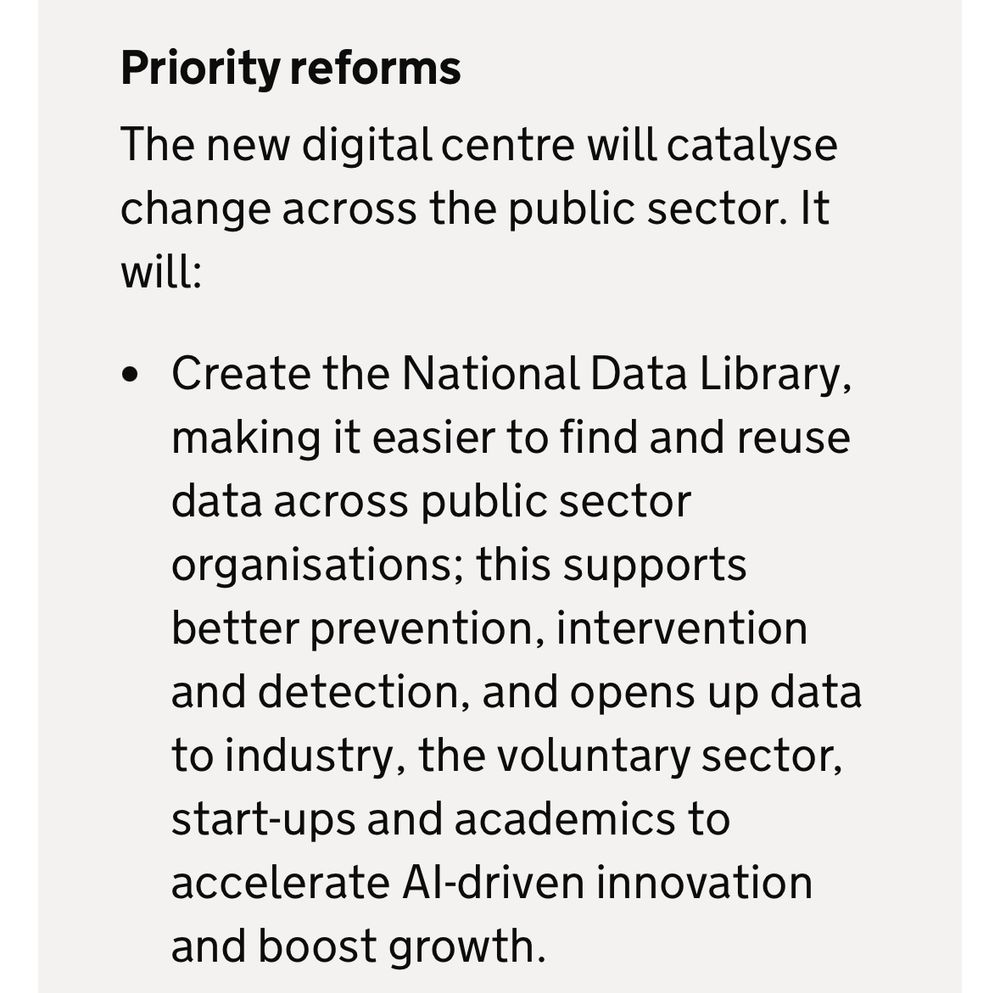
Priority reforms
The new digital centre will catalyse change across the public sector. It will:
• Create the National Data Library, making it easier to find and reuse data across public sector organisations; this supports better prevention, intervention and detection, and opens up data to industry, the voluntary sector, start-ups and academics to accelerate Al-driven innovation and boost growth.
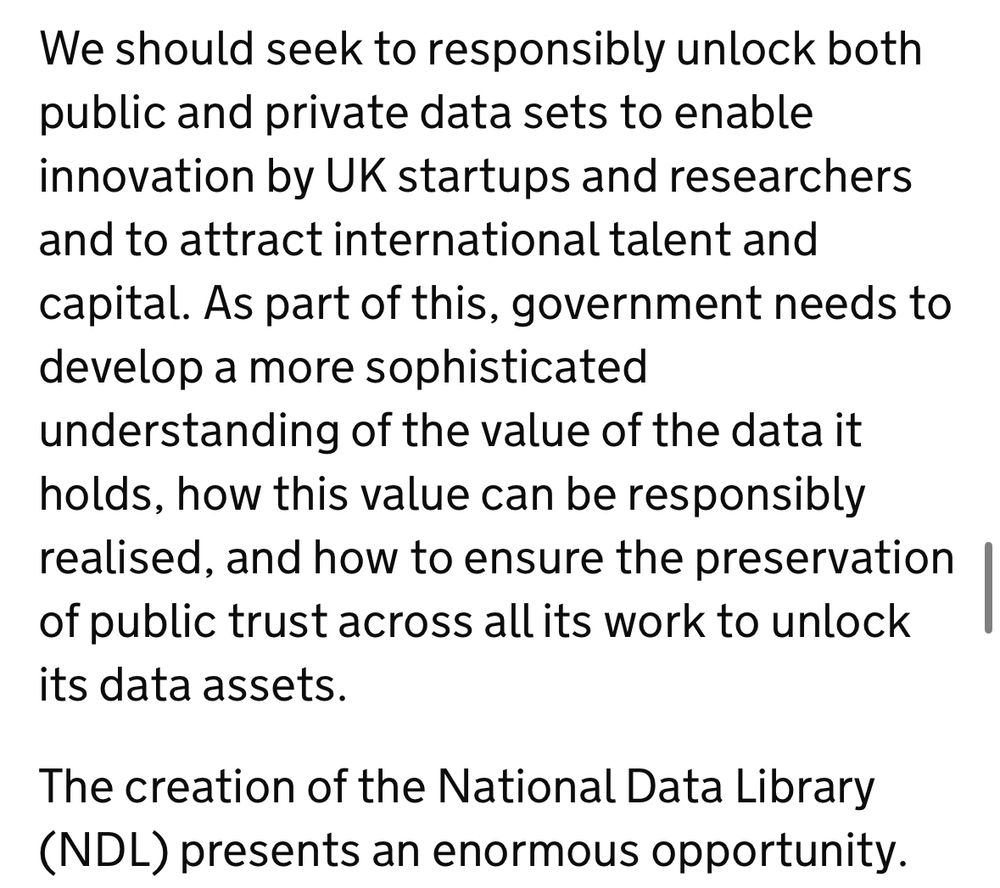
We should seek to responsibly unlock both public and private data sets to enable innovation by UK startups and researchers and to attract international talent and capital. As part of this, government needs to develop a more sophisticated
understanding of the value of the data it holds, how this value can be responsibly realised, and how to ensure the preservation of public trust across all its work to unlock its data assets.
The creation of the National Data Library
(NDL) presents an enormous opportunity.
The NDL is a manifesto commitment and has become something of a shorthand for data-related things in government – with 29 mentions in Parliament,* not to mention at least five references policy papers including the AI Action Plan and the Digital Blueprint 3/
* could be more – they keep coming!
25.02.2025 08:36
👍 0
🔁 0
💬 1
📌 0
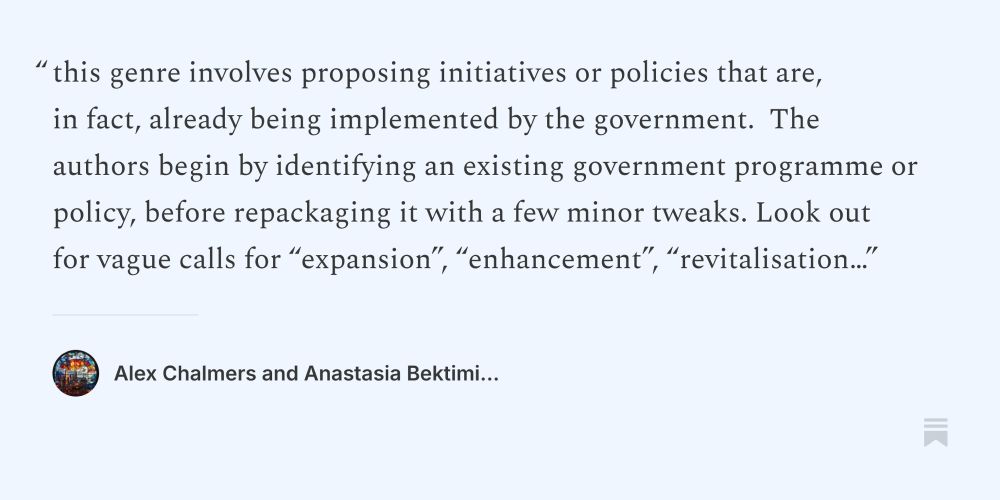
Death by a thousand roundtables
Most policy work is pointless. It doesn’t need to be.
To avoid committing one of those cardinal policy sins of saying “Govt is doing this… and we agree”, we had to get into the detail of what the NDL could most usefully do and what it would take to get there.
This meant taking an approach that was vision-led, not technology-led – ends over means 2/
25.02.2025 08:36
👍 0
🔁 0
💬 1
📌 0

Governing in the Age of AI: Building Britain’s National Data Library
Governing in the Age of AI: Building Britain’s National Data Library
Joining forces today with @anastasiabekt.bsky.social at The Entrepreneurs Network and TBI colleagues to map out the road to the National Data Library. Instead of pointing to a gap in policy and saying “do this”, we share our take on how to help an exciting govt initiative succeed: bit.ly/3XgHjLQ 1/
25.02.2025 08:36
👍 7
🔁 2
💬 2
📌 2
One of (many) key insights for me from this was how important Treasury buy-in was for most transformations – not even funding but the whole “does this give us new ways to embed our POV across government” story is fascinating. Plus: computers in making their way into government use in 1920s already!
25.02.2025 08:30
👍 2
🔁 0
💬 1
📌 0
It just so happens that funding and time are the two scarcest resources in government. AI is not free but for many (not all) things, per task it is *much, much* cheaper than any alternative and as good or better quality-wise.
13.01.2025 13:15
👍 5
🔁 0
💬 1
📌 0
Gave it a shot. Think we might need to have that conversation with @jamesomalley.co.uk after all. And you’re all invited to join in!
13.01.2025 09:57
👍 9
🔁 2
💬 1
📌 0
We mean a lot more than ChatGPT!
13.01.2025 09:54
👍 7
🔁 0
💬 2
📌 0
I would say it matters massively, for exactly the reason you put in the first post: government is about trade-offs, and without a coherent strategy (a small set of commonly understood & clearly articulated priorities) those decisions won’t be made quickly, or well, or at all.
02.01.2025 11:35
👍 2
🔁 0
💬 0
📌 0
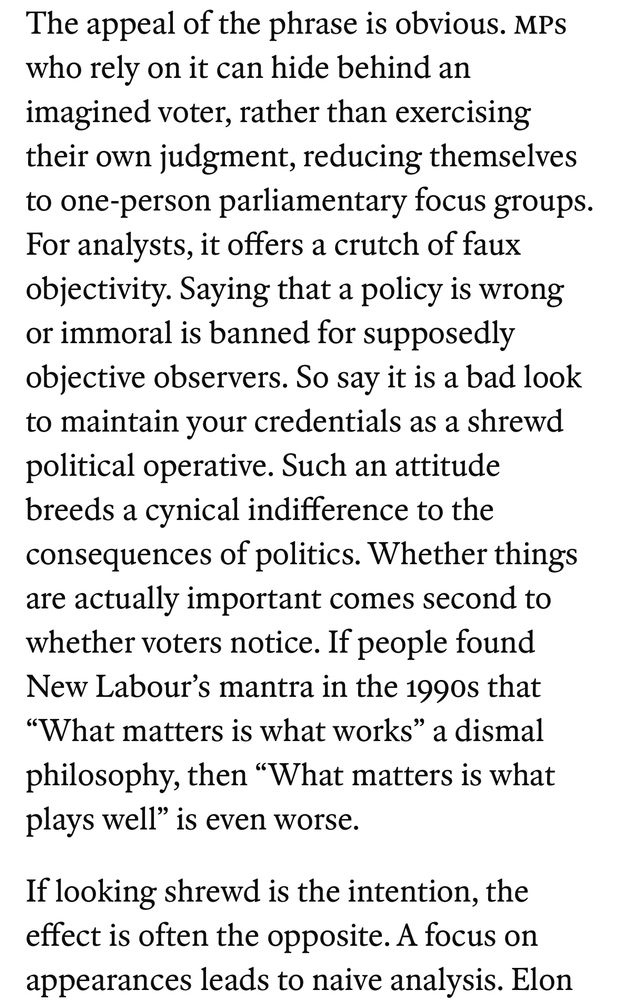
The appeal of the phrase is obvious. MPs who rely on it can hide behind an imagined voter, rather than exercising their own judgment, reducing themselves to one-person parliamentary focus groups.
For analysts, it offers a crutch of faux objectivity. Saying that a policy is wrong or immoral is banned for supposedly objective observers. So say it is a bad look to maintain your credentials as a shrewd political operative. Such an attitude breeds a cynical indifference to the consequences of politics. Whether things are actually important comes second to whether voters notice. If people found New Labour's mantra in the 1990s that
"What matters is what works" a dismal philosophy, then "What matters is what plays well" is even worse.
If looking shrewd is the intention, the effect is often the opposite. A focus on appearances leads to naive analysis.
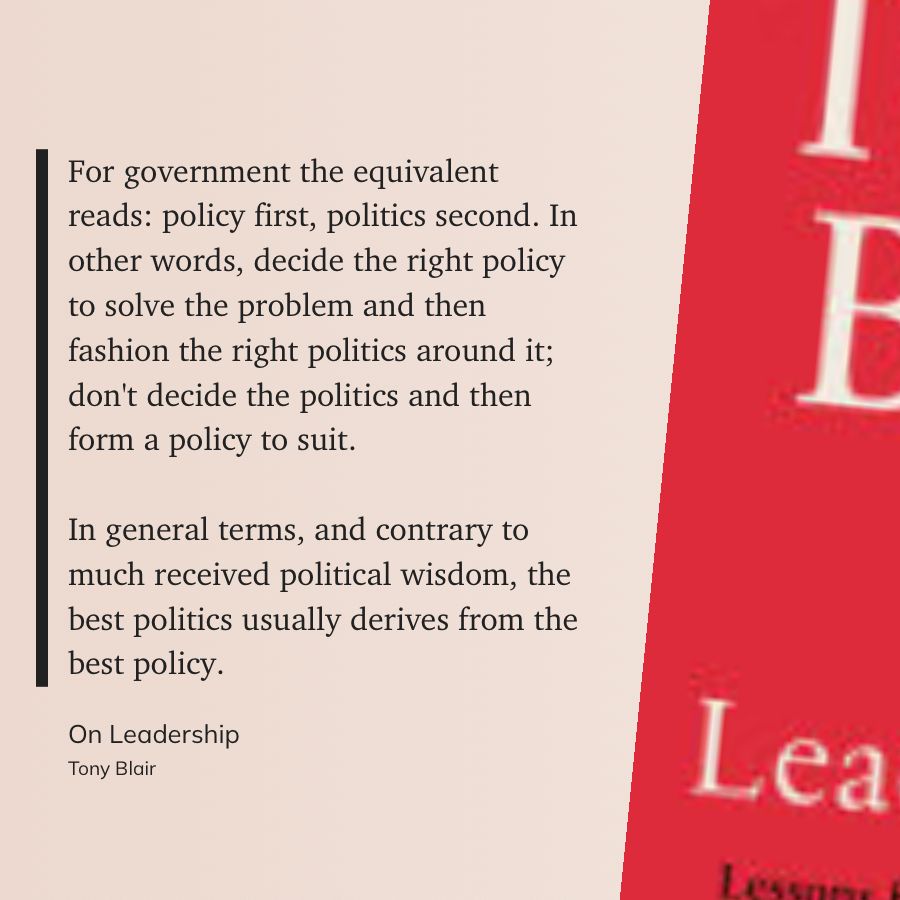
“For government the equivalent reads: policy first, politics second. In other words, decide the right policy to solve the problem and then fashion the right politics around it; don't decide the politics and then form a policy to suit.
In general terms, and contrary to much received political wisdom, the best politics usually derives from the best policy.”
From *On Leadership*, by Tony Blair
In fact, “not a good look” is just another facet of “consultation nation”, except without even a semblance of due process. As @duncanrobinson.bsky.social writes, it leads to bad policy. And bad policy *is* bad politics.
02.01.2025 11:27
👍 2
🔁 0
💬 0
📌 0
An excellent piece if you’ve not read it yet.
It’s a British dysfunction, but I’m sure arguments from optics alone are increasingly common elsewhere, too; & it’s not a left-right issue either. It’s also bad politics; voters care about substance more than looks, except when there’s no substance.
02.01.2025 11:10
👍 9
🔁 1
💬 1
📌 1
I am very much in the camp of “people overworry about screens” (in fact I’m sure humanity in every country and at every age reads much, much more than ever, even if not on paper any more). But enjoyment of reading does matter & being too focused on reading for tests can (imo) be a factor here!
31.12.2024 12:14
👍 1
🔁 1
💬 0
📌 0
One time in Moscow, heading home at 9am on Jan 1 after celebrating NY at a friend’s, I spent 20 minutes inside a locked trolleybus – the badly hungover driver nipped out to the corner shop for a hair of the dog & didn’t realise I was still on board. (But no transport on Christmas Day is still odd).
26.12.2024 11:44
👍 1
🔁 0
💬 0
📌 0
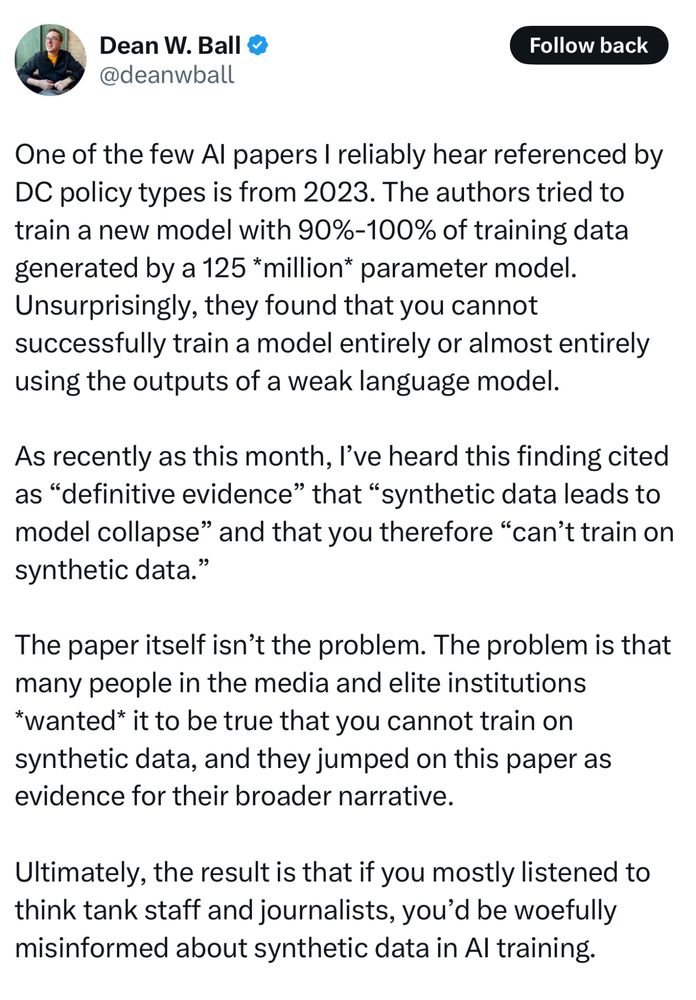
Not going to call out names of people on this app, but I see what @deanwb.bsky.social is seeing a lot in policy circles.
24.12.2024 07:22
👍 11
🔁 1
💬 1
📌 0