

Finished Moon of the Crusted Snow, really great book on how a small native community deals with the colapse of society 5/5 www.goodreads.com/book/show/39...
05.03.2026 03:37
👍 1
🔁 0
💬 0
📌 0
Finished Moon of the Crusted Snow, really great book on how a small native community deals with the colapse of society 5/5 www.goodreads.com/book/show/39...

Finished A Visit to the Husband Archive, interesting narrative about time and memories but I feel like this would probably be better off as a full novel instead of a short story, 3/5 www.goodreads.com/book/show/24...
Finished my second book this year, The Sooner You Forget.

Finished Mythos by Stephen Fry (Audio). Really fun book, despite how much greek myth they taught in schools it was still fun to revisit a lot of the crazy stories. 5/5 www.goodreads.com/book/show/35...
We also went big on planets this episode. @payeldas.bsky.social discussed this paper about detecting the signs of planets that have been eaten by their stars 🤩☄️🧪🔭

@minakimes.bsky.social thoughts?

Shoutout to all my fellow Y2K survivors

fixed it
In Memoriam:
Cheney Haunted By People He Didn't Manage To Kill In Iraq War
Black Homeowners Receive Higher Appraisal After Displaying Pictures Of Klan Members
Just wait

Nation’s Indigenous People Confirm They Don’t Need Special Holiday, Just Large Swaths Of Land Returned Immediately
Nation’s Indigenous People Confirm They Don’t Need Special Holiday, Just Large Swaths Of Land Returned Immediately https://theonion.com/nation-s-indigenous-people-confirm-they-don-t-need-spec-1839033177/
Oh I'll look into it, I've already taken Calc 1, 2 and 3 I'm just looking for a good review/reference book. Thanks!
thanks for the suggestion! I'm looking for something a little more advanced though.
Can anyone recommend a good book for ordinary differential equation and partial derivatives? #math #physics

Here we go #finsup #phinsup
The dashboard I made while at @caltech.edu for @ligo.org is working perfectly, it automatically updated with the newest catalog releases and shows all the correct data 🥳 gwtc-dash.streamlit.app
The wandering hippies of the universe

I am officially co-authored 🥳 #science #ligo #astrophysics journals.aps.org/prd/abstract...
that was me yesterday, I didn't do anything after the meeting either lol


First Exoplanet I found with #ExoplanetWatch 👀
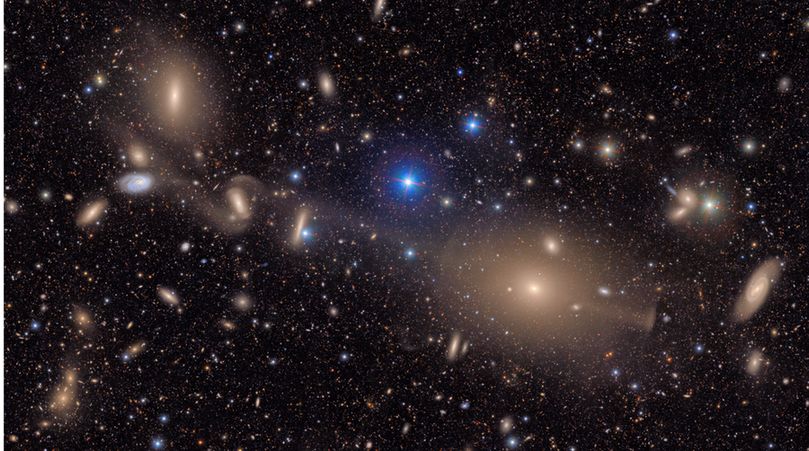
A sprawling, textured field of galaxies scattered across the deep black of space. It is filled with the delicate smudges and glowing cores of galaxies of many shapes, sizes and colors, as well as the bright multi-colored points of stars. The image focuses on a collection of interacting galaxies connected by delicate streams of stars. At top center lies a large elliptical galaxy that is dense and smooth, like a polished stone glowing with golden light. Like delicate spider silk or stretched taffy, these stellar bridges link the large elliptical to the few larger galaxies beneath, evidence of past collisions. All throughout the image, thousands of galaxies gather in clusters or are spread throughout, like glittering gems strewn on a table. Some are sharp-edged and spiral, like coiled ribbons; others round and diffuse, like polished pebbles. Still others are just smudges of various colors against the black of space. The background is peppered with pinpoint stars in reds, yellows, and blues, crisp against the velvet black.
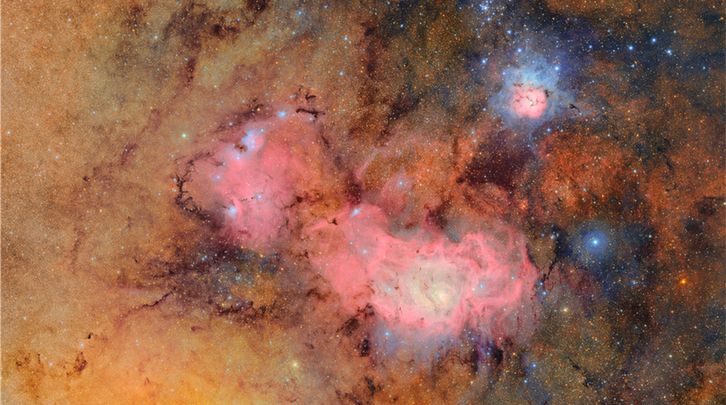
A cosmic tapestry of glowing tan and pink gas clouds with dark dust lanes. In the upper right, the Trifid Nebula resembles a small flower in space. Its soft, pinkish gas petals are surrounded by blue gas, and streaked with dark, finger-like veins of dust that divide it into three parts. It radiates a gentle, misty glow, diffuse and soft like the warmth of breath on a cold hand. To the lower left, the much larger Lagoon Nebula stretches wide like a churning sea of magenta gas, with bright blue, knotted clumps sprinkled throughout where new stars are born. Both nebulae are embedded in a soft tan backdrop of gas that is brighter on the left than on the right, etched with dark tendrils of dust and sprinkled with the pinpricks of millions of stars.
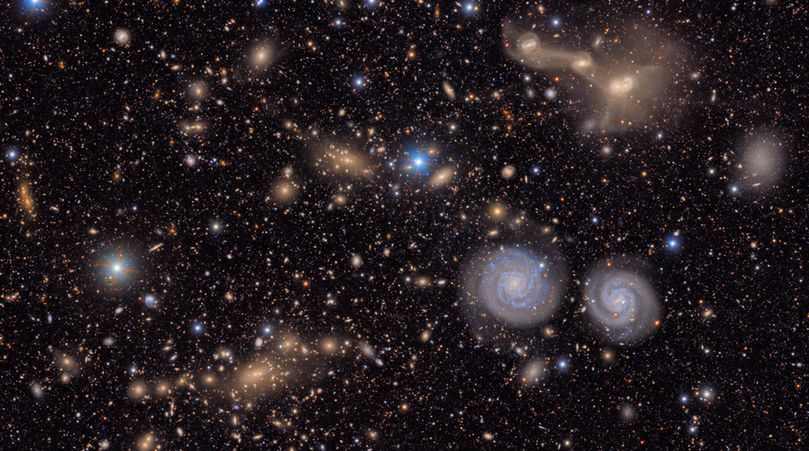
A sprawling, textured field of galaxies scattered across the deep black of space. It is filled with the delicate smudges and glowing cores of galaxies of many shapes, sizes and colors, as well as the bright multi-colored points of stars. To the lower left is a region filled with the hundreds of golden glittering gems of a distant galaxy cluster. In the foreground, below and right of center, two blue spiral galaxies look like eyes beneath the entangled mass of a triple galaxy merger in the upper right. A few bright blue points of foreground stars pierce the glittering tapestry. All throughout the image, thousands of galaxies gather in clusters or are spread throughout, like glittering gems strewn on a table. Some are sharp-edged and spiral, like coiled ribbons; others round and diffuse, like polished pebbles. Still others are just smudges of various colors against the black of space. The background is peppered with pinpoint stars in reds, yellows, and blues, crisp against the velvet black.
Introducing...your sneak peek at the cosmos captured by NSF–DOE Vera C. Rubin Observatory!
Can you guess these regions of sky?
This is just a small peek...join us at 11am US EDT for your full First Look at how Rubin will #CaptureTheCosmos! 🔭🧪
#RubinFirstLook
ls.st/rubin-first-look-livestream
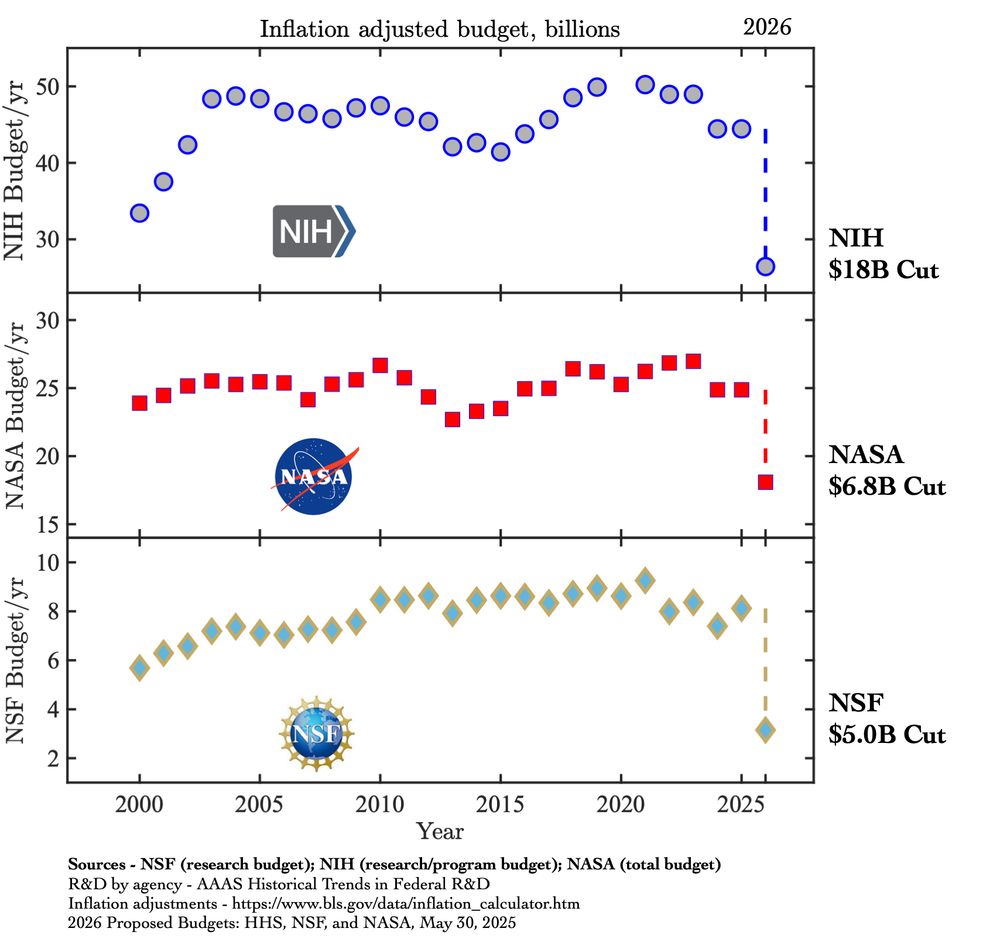
NSF, NASA and NIH budgets per year, inflation adjusted from 2000-2025 along with the proposed cuts. NSF includes research component only. Massive cuts across all sectors, well below support spanning 25 years.
How bad will it be? Catastrophic.
Proposed cuts to #NSF, #NIH, and #NASA will set the US R&D landscape back 25 yrs+, cause economic and job loss now, and undermine innovations to come.
But, this is the WH's *proposed* budget.
Speak up now before it is too late.
(inflation adjusted $-s below)

NSF Physics was cut by 85%, basically wiping out most of its capacity for supporting research.
NSF Astronomy was cut by 53%
Undergrad education was cut by 71% and research on learning by 79%
Graduate education was cut by 100% to ZERO.
#GiftLink ⚛️🔭
www.nytimes.com/interactive/...
Also there is literally nothing else to report on lol
It's dire out there
Grad school admissions in physics and astro are severely contracted rn because of funding uncertainty. Departments that should know better are using undergrad publications to narrow down the applicant pool. This is grossly unfair and has more to do with avoiding hard work than assessing applicants.
Sure enough just got last rejection letter 🥲
Getting into grad school now feels impossible
This would essentially be the end of American astronomy; like at this point (especially if Roman/other missions get killed) I either find a new job or find a new country.

