🤖✨ New report with @partnershipai.bsky.social!
AI agents pose new risks. Monitoring is essential to ensure effective oversight and intervention when needed. Our paper presents a framework for real-time failure detection that takes into account stakes, reversibility and affordances of agent actions.
11.09.2025 16:35
👍 1
🔁 1
💬 1
📌 0
Yesterday's new AI Action Plan has a lot worth discussing!
One interesting aspect is its statement that the federal government should withhold AI-related funding from states with "burdensome AI regulations."
This could be cause for concern.
24.07.2025 18:55
👍 6
🔁 3
💬 1
📌 0

⚖️ New Explainer!
Effectively evaluating AI models is more crucial than ever. But how do AI evaluations actually work?
In their new explainer,
@jessicaji.bsky.social, @vikramvenkatram.bsky.social &
@stephbatalis.bsky.social break down the different fundamental types of AI safety evaluations.
28.05.2025 14:02
👍 4
🔁 2
💬 1
📌 2
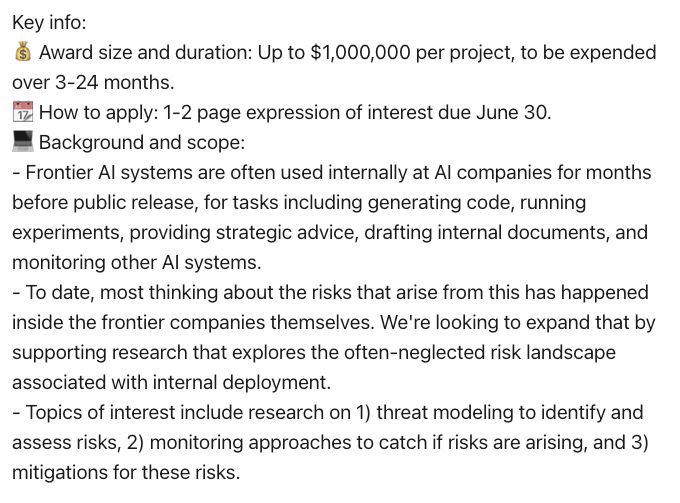
💡Funding opportunity—share with your AI research networks💡
Internal deployments of frontier AI models are an underexplored source of risk. My program at @csetgeorgetown.bsky.social just opened a call for research ideas—EOIs due Jun 30.
Full details ➡️ cset.georgetown.edu/wp-content/u...
Summary ⬇️
19.05.2025 16:59
👍 9
🔁 5
💬 1
📌 1
Finally, and critically: central data collection and dissemination of lessons learned means that harms only have to occur once for everyone to mitigate their risk. This prevents recurrence and builds user and consumer confidence, which is essential for widespread AI adoption.
17.03.2025 14:30
👍 0
🔁 0
💬 1
📌 0
Incident tracking also reveals new, unexpected AI failure modes that we aren’t yet mitigating against. Over time, systematic data collection can help detect emerging risks and new types of harms, a critical benefit given the fast pace of AI innovation and deployment.
17.03.2025 14:30
👍 0
🔁 0
💬 1
📌 0
Over time, incident data can be used to evaluate the effectiveness of new safety policies and regulation through before and after comparisons. This helps refine governance policies through a direct feedback loop.
17.03.2025 14:30
👍 0
🔁 0
💬 1
📌 0
Using real-world data on what works and what doesn’t to guide AI safety research will help us innovate quicker and build reliable systems that are safe to deploy faster. In this way, incident reporting can help prioritize and direct AI safety research to where it is most effective.
17.03.2025 14:30
👍 0
🔁 0
💬 1
📌 0
AI incidents also shed light on the effectiveness of existing safety efforts. We might learn where current technical standards or risk management processes are insufficient to protect people from harm, revealing critical gaps that can be addressed by AI safety research.
17.03.2025 14:30
👍 1
🔁 0
💬 1
📌 0
For instance, we can learn about *how* the use of AI results in harm, e.g. through misuse, user error or AI failure. This information helps channel resources to the right kinds of safety efforts, since preventing misuse requires different measures than addressing operator error.
17.03.2025 14:30
👍 1
🔁 0
💬 1
📌 0
Why should the government do this?
What makes AI risk management so tricky is predicting how deploying an AI system can go wrong. AI incidents are a rich source of information about AI harms, harm mechanisms, AI failure modes and more. Leveraging those insights can make AI use safer.
17.03.2025 14:30
👍 1
🔁 0
💬 1
📌 0
Broadly speaking, an AI incident reporting regime has 4 core parts:
1) Incident detection;
2) Reporting to oversight bodies and inclusion in incident database;
3) Performance of impact assessments and root cause analyses; and
4) Dissemination of lessons learned
17.03.2025 14:30
👍 1
🔁 0
💬 1
📌 0

Welcome to the Artificial Intelligence Incident Database
The starting point for information about the AI Incident Database
First, a definition. AI incidents are situations in which a deployed AI system is implicated in harm, e.g. when an AI recruiting tool makes a biased hiring decision. Incidents are varied and often take unexpected forms, so go check out the AIID for more real-world examples! incidentdatabase.ai
17.03.2025 14:30
👍 1
🔁 0
💬 1
📌 0
Today, @csetgeorgetown.bsky.social published our recommendations for the U.S. AI Action Plan. One of them is a CSET evergreen: implement an AI incident reporting regime for AI used by the federal government. Why? Short answer: because we can learn a ton from incidents! Long answer: 👇
17.03.2025 14:30
👍 4
🔁 2
💬 1
📌 0

What’s Next for AI Red-Teaming? | Center for Security and Emerging Technology
On March 25, CSET will host an in-depth discussion about AI red-teaming — what it is, how it works in practice, and how to make it more useful in the future.
What: CSET Webinar 📺
When: Tuesday, 3/25 at 12PM ET 📅
What’s next for AI red-teaming? And how do we make it more useful?
Join Tori Westerhoff, Christina Liaghati, Marius Hobbhahn, and CSET's @dr-bly.bsky.social * @jessicaji.bsky.social for a great discussion: cset.georgetown.edu/event/whats-...
12.03.2025 15:11
👍 4
🔁 4
💬 0
📌 1
What does the EU's shifting strategy mean for AI?
CSET's @miahoffmann.bsky.social & @ojdaniels.bsky.social have a new piece out for @techpolicypress.bsky.social.
Read it now 👇
10.03.2025 14:17
👍 4
🔁 4
💬 0
📌 0

Out of Balance: What the EU's Strategy Shift Means for the AI Ecosystem | TechPolicy.Press
Mia Hoffmann and Owen J. Daniels from Georgetown’s Center for Security and Emerging Technology say Europe's movements could change the global landscape.
If you’ve ever wondered what the EU and elephants have in common - or are wondering now- read my latest piece with @ojdaniels.bsky.social! We take a look what the EU’s new innovation-friendly regulatory approach might mean for the global AI policy ecosystem www.techpolicy.press/out-of-balan...
10.03.2025 13:42
👍 2
🔁 1
💬 0
📌 2
Thirdly, and most importantly, this decision reveals that the new European Commission is buying into the false narrative of innovation versus regulation which already dominates - and paralyzes - US tech policy.
13.02.2025 15:35
👍 0
🔁 0
💬 0
📌 0
Secondly, these questions will now be relegated to the national legal systems, which means uneven rules across the EU. Because what opponents to EU regulation need to understand is that the alternative to EU rules is not No Rules, it is 27 different sets of rules. How’s that for simplification?
13.02.2025 15:35
👍 0
🔁 0
💬 1
📌 0
So what does this mean?
First, substantively, the questions on how to deal with liability for fundamental rights violations from AI, and liability across the value chains will remain open at the EU level.
13.02.2025 15:35
👍 0
🔁 0
💬 1
📌 0
For example, the PLD covers material harms from AI, but violations of fundamental rights - which are covered in the EU AI Act - would have fallen in the domain of the AILD. Similarly, the AILD was going to address the question of how liability should be distributed along the AI value chain.
13.02.2025 15:35
👍 0
🔁 0
💬 1
📌 0
Now, the AILD was not a flawless proposal. There was a lot of overlap with the Product Liability Directive (PLD), which already deals with software, including AI. But at the same time, it dealt with important aspects the PLD did not.
13.02.2025 15:35
👍 0
🔁 0
💬 1
📌 0
It appears the decision was political, and is a reflection of the new orientation of the new Commission: industry-friendly and anti-regulation. This is mirrored in statements made by EU leaders at the AI summit, claiming that EU rules would be “simplified” and applied in “business-friendly ways”.
13.02.2025 15:35
👍 1
🔁 0
💬 1
📌 0


